EN



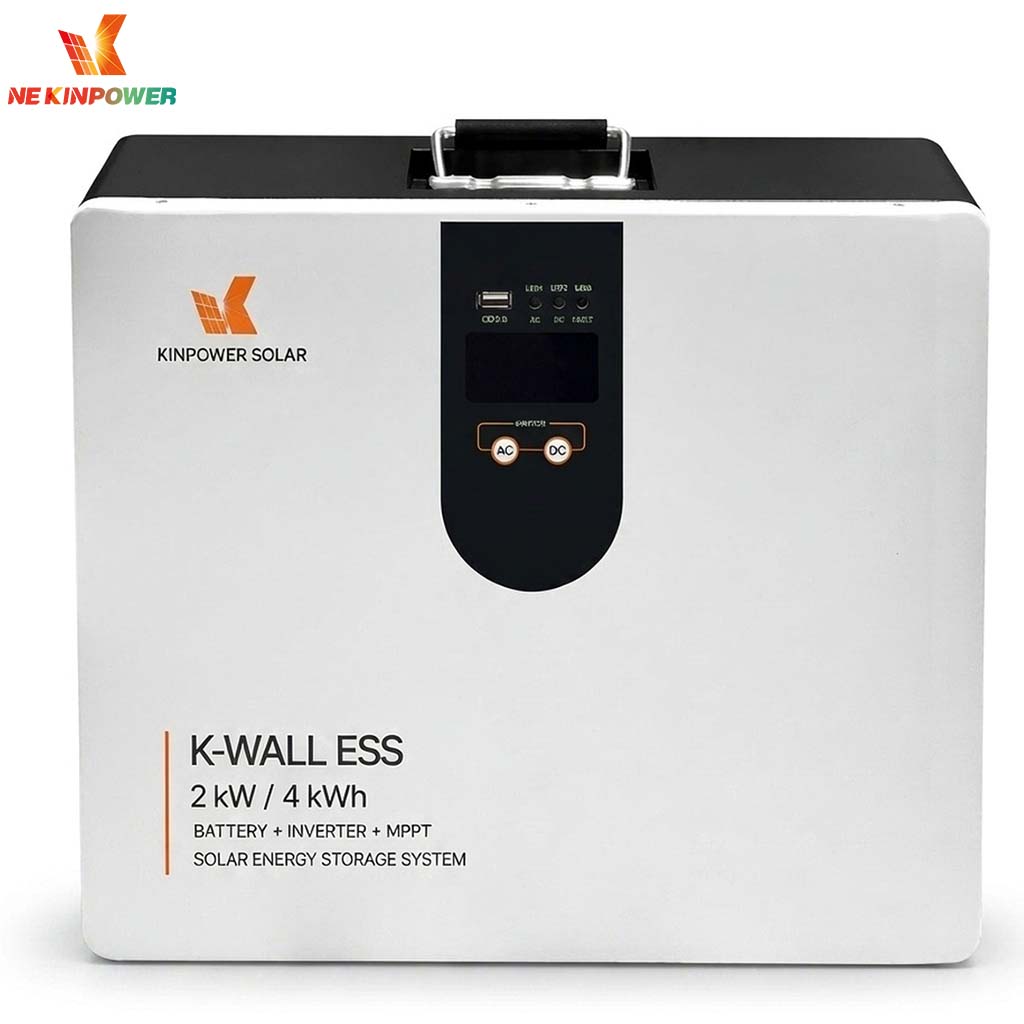
MICRO HOME STORAGE-Micro Wall-Mounted Energy Storage System | 2-4 kWh
Most home batteries are bolted down for life. This one isn't. Hang it on the garage wall for daily backup - then lift it off the bracket and carry it to the campsite, the RV, or the job site. Available in 2, 3 and 4 kWh.
- Overview
- Recommended Products
- Fix the bracket to a solid wall at 1.2 m using the supplied drill template. Masonry and concrete take the supplied anchors; drywall needs a stud or a backing plate.
- Hang the unit. It seats with an audible click and is locked by two M6 screws.
- Plug the AC cable into a wall socket, connect PV to the panels, scan the QR code and finish setup in the app in about four minutes.
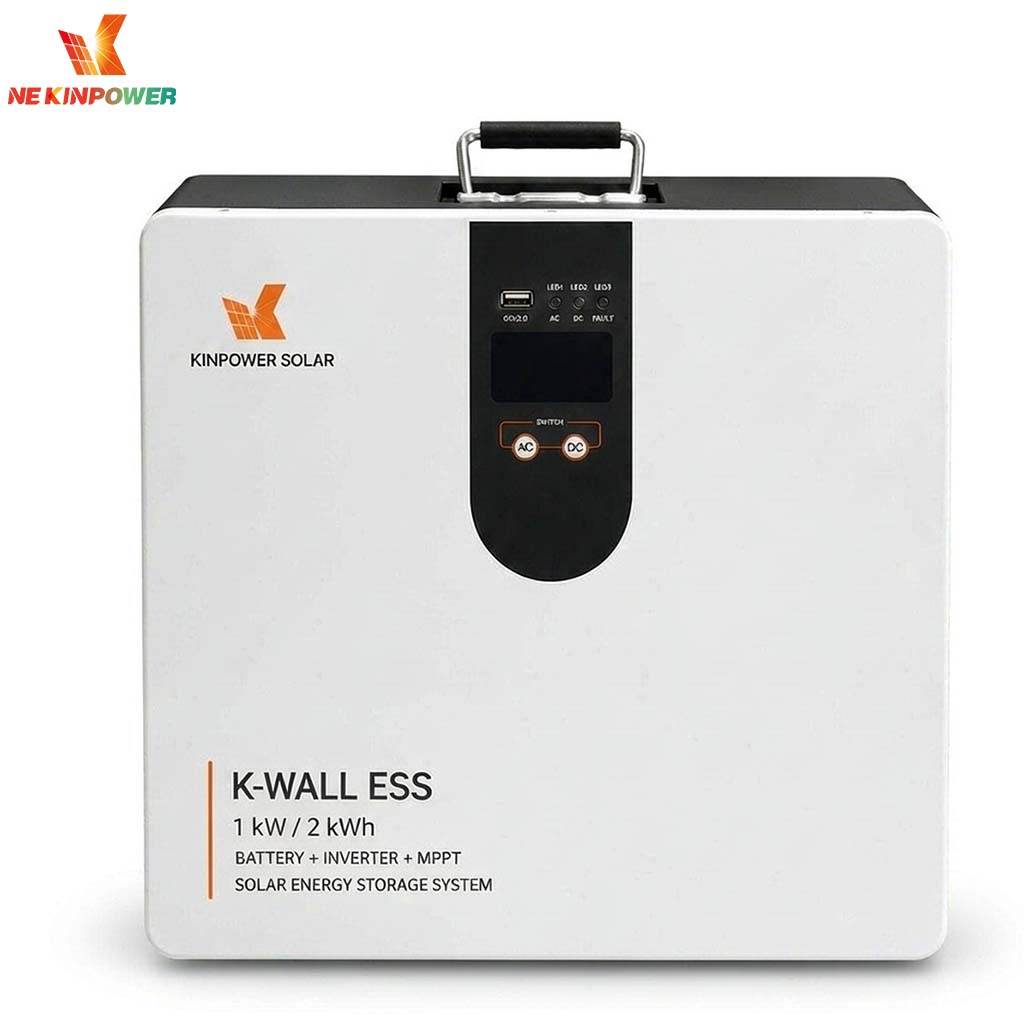
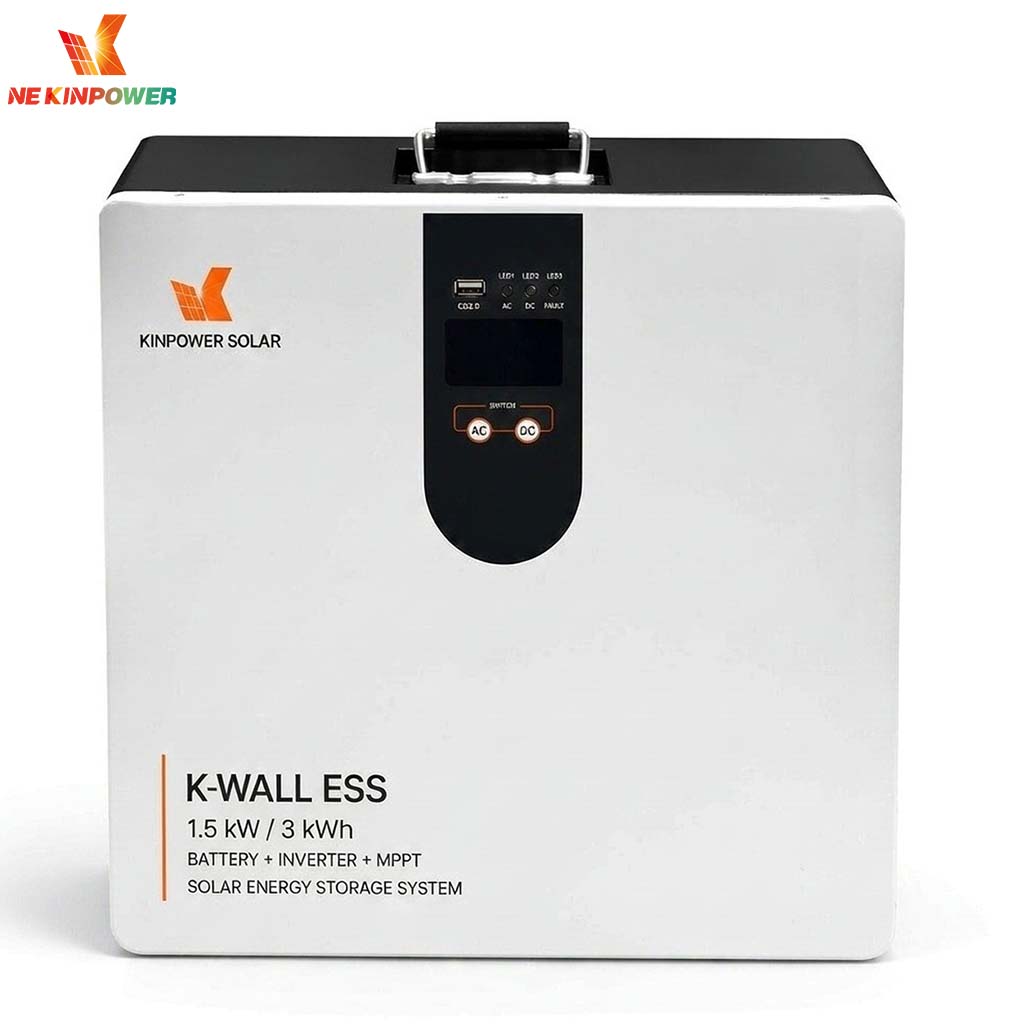
The KINPOWER MICRO HOME STORAGE is a micro wall-mounted energy storage system: a LiFePO4 battery with an integrated hybrid inverter that hangs on a wall bracket like a boiler, and detaches from that bracket in seconds when you need power somewhere else. It comes in three capacities — 2 kWh with a 1 kW inverter, 3 kWh with 1.5 kW, and 4 kWh with 2 kW — for apartments, balconies and small homes where a 10-20 kWh floor battery is too large, too heavy, or simply not permitted.
What is a micro wall-mounted energy storage system?
A micro wall-mounted energy storage system is a compact battery unit, typically 1 to 5 kWh, with a built-in inverter that mounts on a wall bracket instead of a floor stand. It is built for apartments, balconies, rental properties and small homes where a full-size battery would be oversized, too heavy to install, or blocked by landlord and building rules.
Unlike a traditional home battery, a micro ESS usually connects through a standard AC socket or a balcony solar microinverter, so it can be installed without a licensed electrician in most EU markets.
Which capacity do I need: 2, 3 or 4 kWh?
Choose by your peak load first, and by total capacity second. The 2 kWh model with a 1 kW inverter runs lighting, a router, a laptop, a TV and a fridge. Step up to 3 kWh and 1.5 kW if you also use a microwave or a coffee machine. Choose 4 kWh and 2 kW only if you need a kettle, an induction hob or power tools.
| If you need to run | Minimum model |
|---|---|
| Router, lights, laptop, phone charging | 2 kWh / 1 kW |
| TV, fridge-freezer, fans | 2 kWh / 1 kW |
| Microwave, coffee machine, hair dryer | 3 kWh / 1.5 kW |
| Kettle, induction hob, circular saw | 4 kWh / 2 kW |
| Oven, water heater, whole flat | Not this category |
One battery, two modes
The MICRO HOME STORAGE is the same device in both modes: no second product, no extra hardware, no reconfiguration. The bracket holds the unit at 1.2 m on a 6 mm steel plate rated for 150 kg, several times the unit's own weight, and the rear handle sits over the centre of gravity so the load stays balanced when you lift it off.
Mounted on the wall, the unit runs as a permanent home backup: it charges from PV during the day, discharges at night, and switches to battery within 20 ms when the grid drops, fast enough that a desktop PC and a router do not reboot.
Detached, it becomes a portable power source. It is not a device you carry on a hike — the three models weigh [14 KG / 19 KG / 23.5 KG] respectively. It is portable in the practical sense: one adult can lift it off the bracket, carry it 50-100 m with the balanced handle, and load it into a car boot. For longer distances the optional folding trolley converts it into a wheeled case in about 15 seconds.
How long will it run my appliances?
Usable energy is nominal capacity at 90% depth of discharge, minus roughly 8% conversion loss: about 1.66, 2.48 and 3.31 kWh. The table below shows expected runtime for common loads, and marks the cases where the smaller inverter cannot start the appliance at all.
| Load | Power draw | 2 kWh / 1 kW | 3 kWh / 1.5 kW | 4 kWh / 2 kW |
|---|---|---|---|---|
| Router + ONT | 12 W | ~138 h | ~207 h | ~276 h |
| LED lighting (6 bulbs) | 30 W | ~55 h | ~83 h | ~110 h |
| Laptop | 60 W | ~28 h | ~41 h | ~55 h |
| Fridge-freezer (A-class) | 90 W avg | ~18 h | ~28 h | ~37 h |
| TV + console | 150 W | ~11 h | ~17 h | ~22 h |
| Microwave | 900 W | ~1.8 h | ~2.8 h | ~3.7 h |
| Coffee machine | 1,200 W | Output limit | ~2.1 h | ~2.8 h |
| Kettle | 1,800 W | Output limit | Output limit | ~1.8 h |
| Induction hob (1 zone) | 2,000 W | Output limit | Output limit | ~1.7 h |
Specifications
All three models share the same housing family, BMS platform and wall bracket. They differ in cell count, inverter rating and weight.
| WALL MOUNTED FORMAT | |||||||
| Model | AC power | Energy | PV range | ||||
| K-WALL ESS 1000 | 1000 W | 2000 Wh | 11-55 V | ||||
| K-WALL ESS 1500 | 1500 W | 3000 Wh | 18-120 V | ||||
| K-WALL ESS 2000 | 2000 W | 4000 Wh | 18-120 V | ||||
Where it pays for itself
On a balcony solar system, an 800 W array produces most of its power between 11:00 and 15:00, when nobody is home. Storing that surplus and releasing it in the evening raises self-consumption from roughly 30% to 70-80%. At one cycle per day, a 3 kWh model shifts about 850-900 kWh a year, the single biggest lever on payback period.
In an apartment, the bracket mounts to a utility wall or balcony slab and the unit unplugs when you move out, with no drilling into structural walls and no electrician. In a campervan, a cabin or on a job site, the 2 kW model runs a circular saw or a small compressor, and two units can be paralleled for 8 kWh and 4 kW.
Installation in three steps
Safety and certification
The MICRO HOME STORAGE uses prismatic LFP cells with a cell-level BMS that monitors voltage, current and temperature per module, plus a physical thermal fuse and a pressure-relief vent. It carries CE, RoHS, UN38.3 for transport, IEC 62619 for stationary battery safety and IEC 62109 for inverter safety, with grid-code approvals to VDE-AR-N 4105 and EN 50549 for EU connection.
Frequently asked questions
Can a wall-mounted battery also be used as a portable power station?
Yes, if the unit has a detachable bracket and a balanced handle, as this series does. It works as a fixed home battery while mounted, then becomes a portable power source once lifted off. Units hard-wired into the consumer unit cannot be moved.
Can the 1 kW model run a kettle or a coffee machine?
No. A 1 kW inverter cannot start a 1,200 W coffee machine or an 1,800 W kettle, and the unit will shut down on overload. Step up to the 1.5 kW model for a coffee machine, and to the 2 kW model for a kettle or an induction hob.
How long will a 2 kWh battery run a fridge?
About 18 hours for a modern EU A-class fridge-freezer drawing 90 W on average, given 1.66 kWh of usable energy after inverter loss. The 3 kWh model runs roughly 28 hours and the 4 kWh model about 37 hours.
Does it work with my existing balcony solar panels?
Yes. The MPPT input accepts PV from 12 to 60 V and is sized for one or two standard 400-500 W balcony panels. The AC side is compatible with common microinverters, and no changes to your existing panel wiring are needed.
Can it be installed outdoors?
It is rated IP65, so it tolerates rain and dust on a balcony or under an eave, but it should not sit in direct driving rain or standing water. Charging is disabled below 0 °C to protect the cells, while discharge continues down to -20 °C.
Does it provide UPS backup during a power cut?
Yes. Switchover takes under 20 ms, which keeps routers, computers and lighting running without a reboot. It is not a whole-house generator: it powers whatever is plugged into its outlets, up to the model's rated output.
Can I expand the capacity later?
Yes. Units can be paralleled up to 8 kWh and 4 kW. Units added later must be the same model and within 200 cycles of the existing ones to keep the BMS balanced.
Which certifications does it hold for the EU and US?
For the EU: CE, RoHS, IEC 62619, IEC 62109, VDE-AR-N 4105 and EN 50549. For transport: UN38.3. US units ship with UL 9540A cell-level test reports and UL 1973 where applicable. Certificates are available on request for tenders.
Request a quote
Sample units, OEM/ODM and container pricing available for all three capacities. Tell us your target market and we will send the matching certification pack with the quotation.