 ×
×
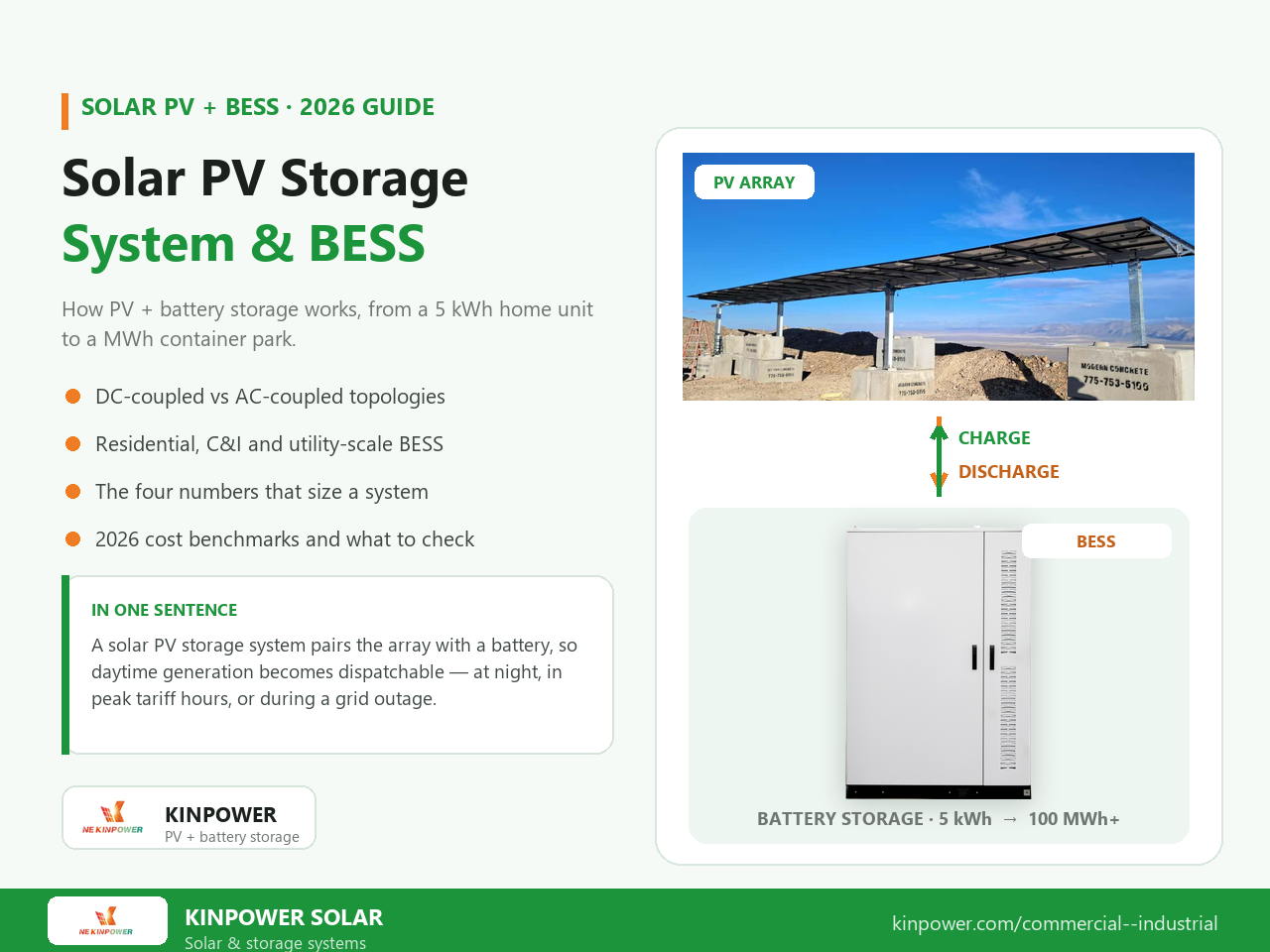
A solar pv storage system is a photovoltaic array combined with a battery so that electricity generated during the day can be stored and used later — at night, at peak tariff hours, or during a grid outage. In industry language the same hardware is described as a pv ess system (photovoltaic energy storage system), or more generally a solar energy storage system.
The concept matters because a plain grid-tied PV array delivers value only at the moment of generation. Add storage, and the electricity becomes dispatchable: you decide when to use it, sell it, or keep it in reserve. That single change is what turns PV from a bill-reduction tool into a power-reliability asset.
Every solar pv storage system is built from five functional blocks:
|
Block |
Role |
|
PV array |
Generates DC power; a larger solar array battery storage ratio improves self-consumption |
|
Inverter / PCS |
Converts DC to AC and manages grid interaction; in a hybrid system it also charges the battery |
|
Battery bank |
Stores energy; this is the pv storage battery, usually LiFePO4 today |
|
BMS |
Battery management system — cell balancing, protection, state-of-health reporting |
|
EMS |
Energy management system — decides when to charge, discharge, export or island |
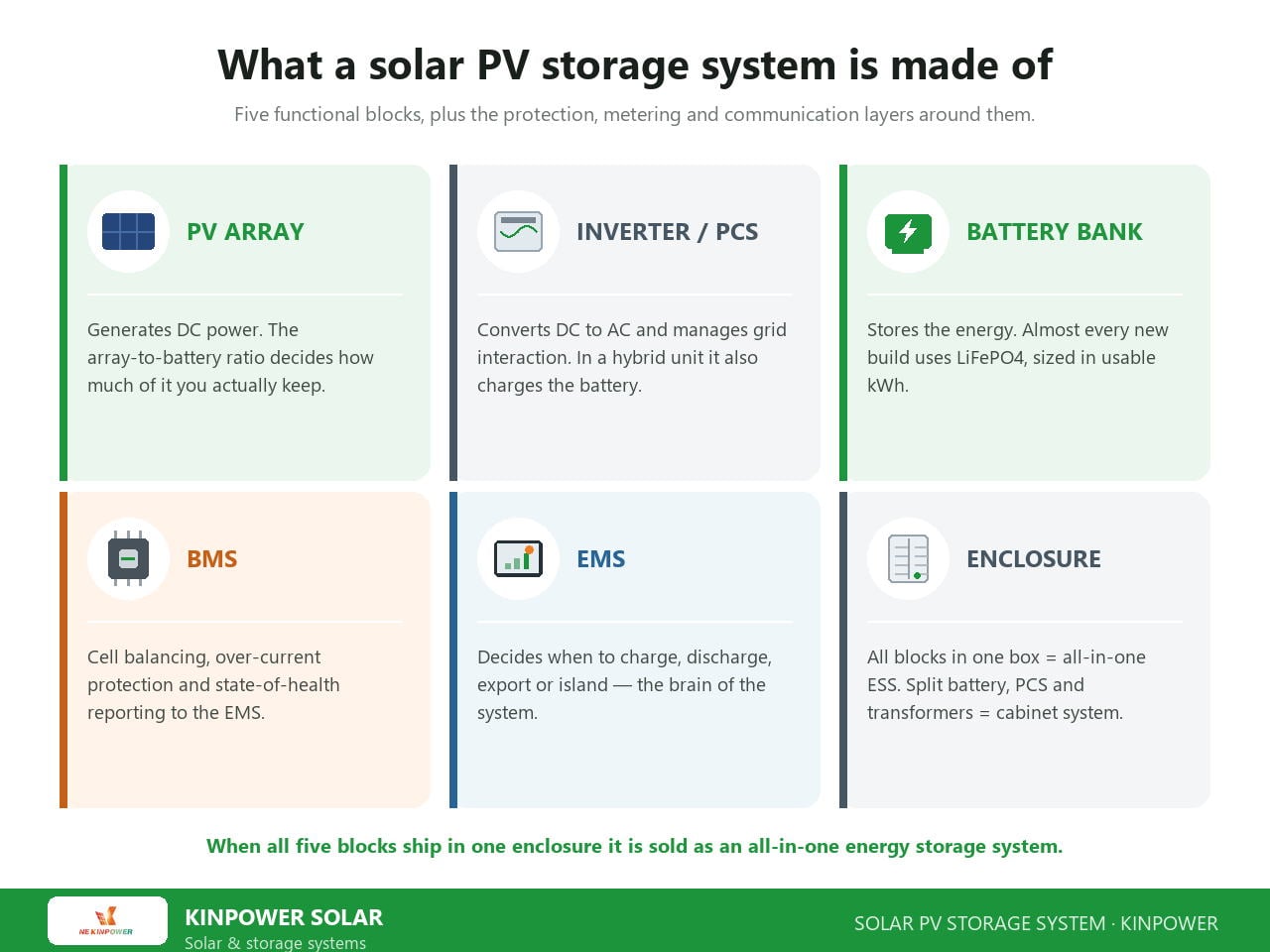
Around these blocks sit protection, metering and communication layers. When all of them ship in one enclosure it is marketed as an all in one energy storage system; when the battery, PCS and transformers are separate, it is a containerised or cabinet-based solution.
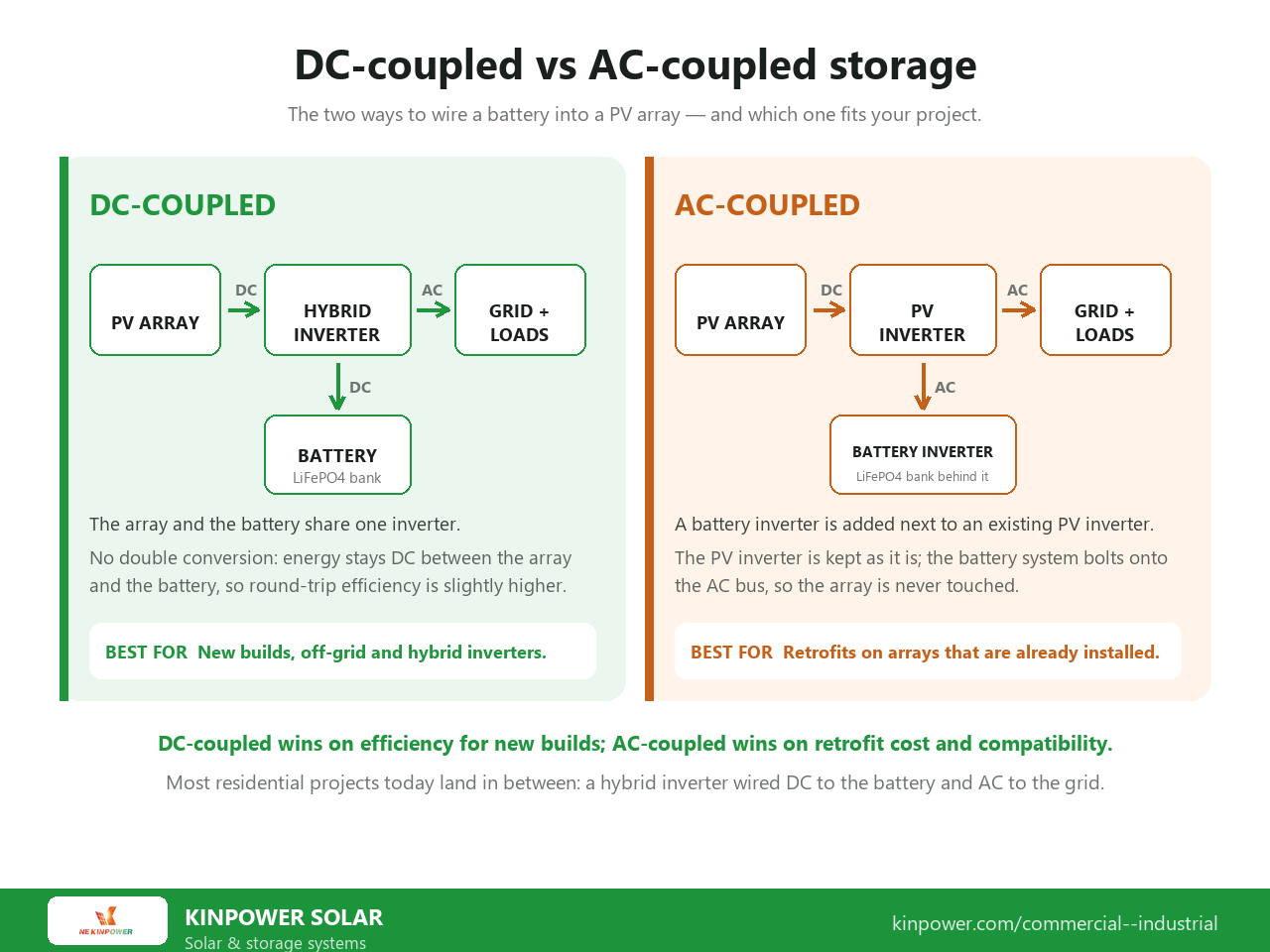
Most residential and small commercial projects today use a hybrid inverter, which behaves as a DC-coupled battery storage system for solar while remaining AC-connected to the grid.
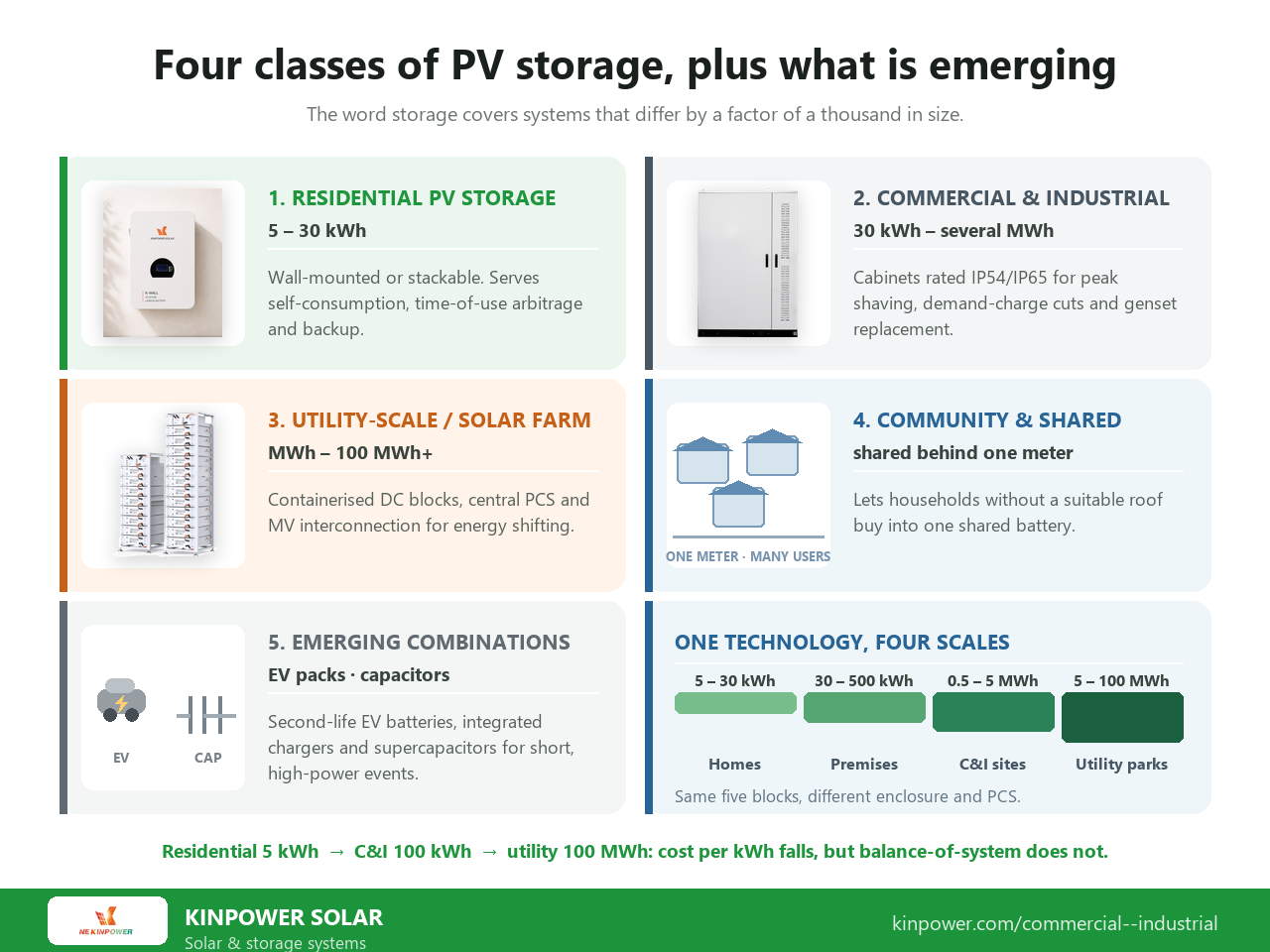
The word "storage" covers systems that differ by a factor of a thousand in size. The four categories below are what suppliers quote most often.
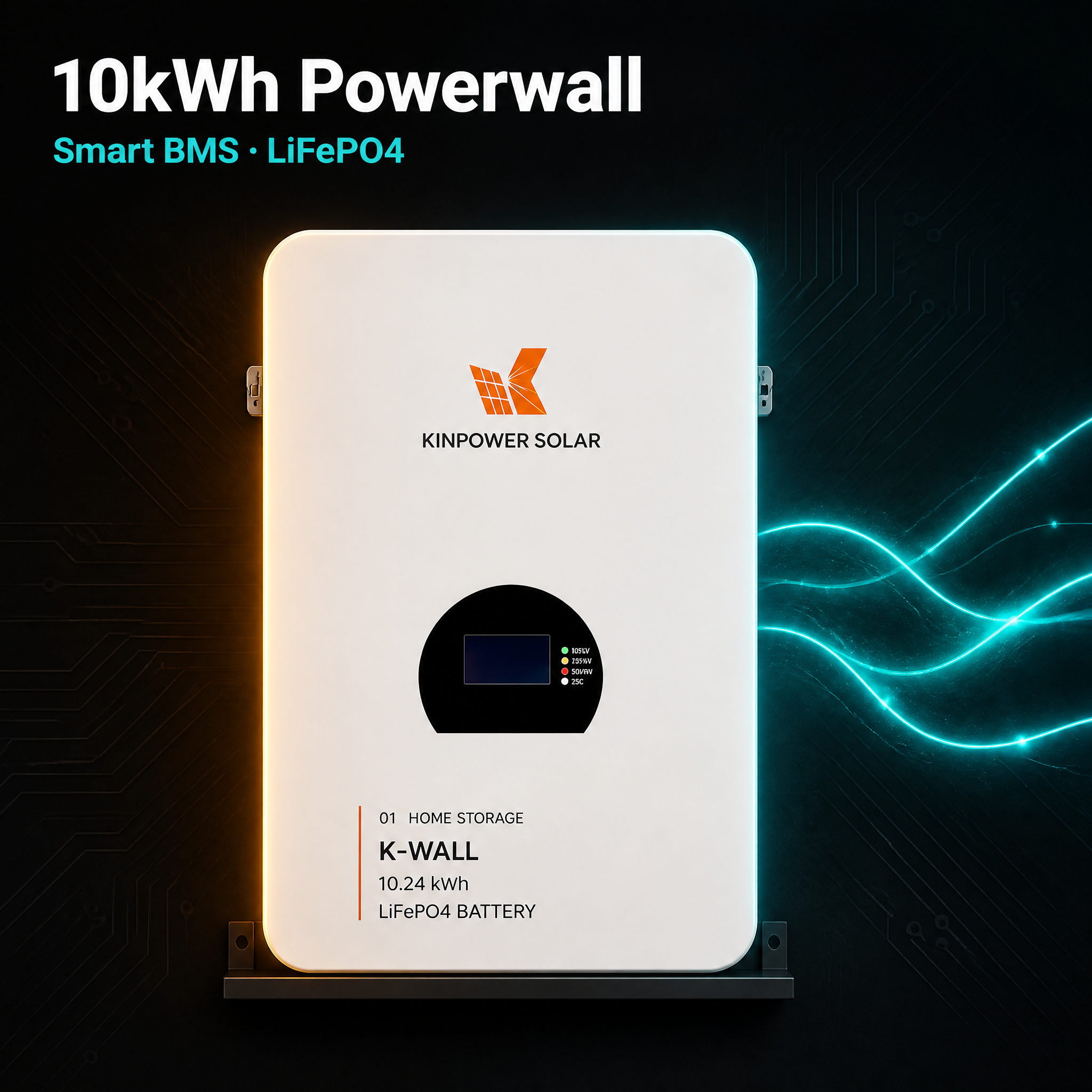
A home system of 5–30 kWh, usually wall-mounted or stackable. It serves self-consumption, time-of-use arbitrage and backup. Most buyers of a residential solar power storage system care about three numbers: usable kWh, continuous kW output, and cycle life.
From 30 kWh to several MWh, typically installed in cabinets or outdoor solar battery storage enclosures with IP54/IP65 ratings. Applications include peak shaving, demand-charge reduction, PV self-consumption, and diesel-generator replacement. C&I is where battery storage solutions solar become a financial instrument rather than a consumer product.
This is where solar farm battery storage and stationary energy storage systems live: containerised DC blocks, central PCS, and medium-voltage interconnection. Use cases include energy shifting, frequency response, curtailment avoidance, and co-location with a large PV plant.
Community solar battery storage is shared by multiple subscribers behind one meter, smoothing export spikes and letting households without a suitable roof participate. In several markets it is the fastest-growing segment of energy storage in pv systems.
Two adjacent technologies keep appearing in tenders: ev battery solar storage, which reuses second-life EV packs or integrates a charger with the ESS, and capacitor for solar storage (supercapacitor or hybrid capacitor banks), used for high-power, short-duration buffering rather than bulk energy. Most projects still rely on a lithium battery bank for solar storage as the energy layer, with capacitors handling transients.
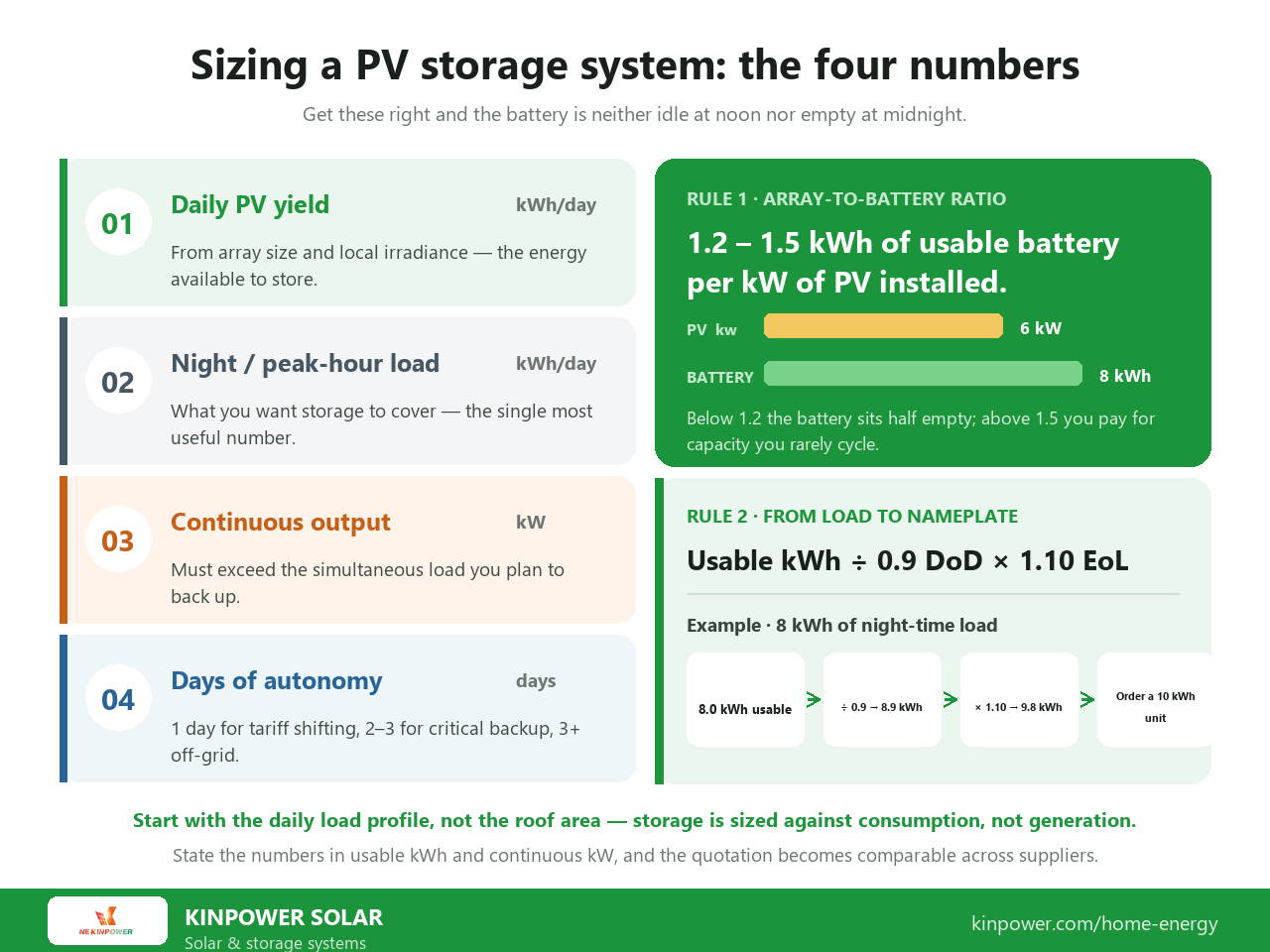
A quick rule: array-to-battery ratio of 1.2–1.5 kWh of usable battery per kW of PV gives good self-consumption without over-building. Storage capacity divided by 0.9 (usable depth of discharge) then plus 10% (end-of-life fade) gives the nameplate size to order.
|
Segment |
Hardware cost range |
Notes |
|
Residential (LiFePO4) |
$150 – $250 / kWh ex-factory; $400 – $700 / kWh installed |
Includes BMS and enclosure |
|
C&I cabinet systems |
$180 – $320 / kWh |
Add PCS, EMS and solar battery storage installation |
|
Containerised utility-scale |
$120 – $220 / kWh |
Excludes MV interconnection and civil works |
|
All-in-one hybrid unit (5 kW / 10 kWh) |
$1,800 – $3,500 per unit |
Single-box solar battery storage units |
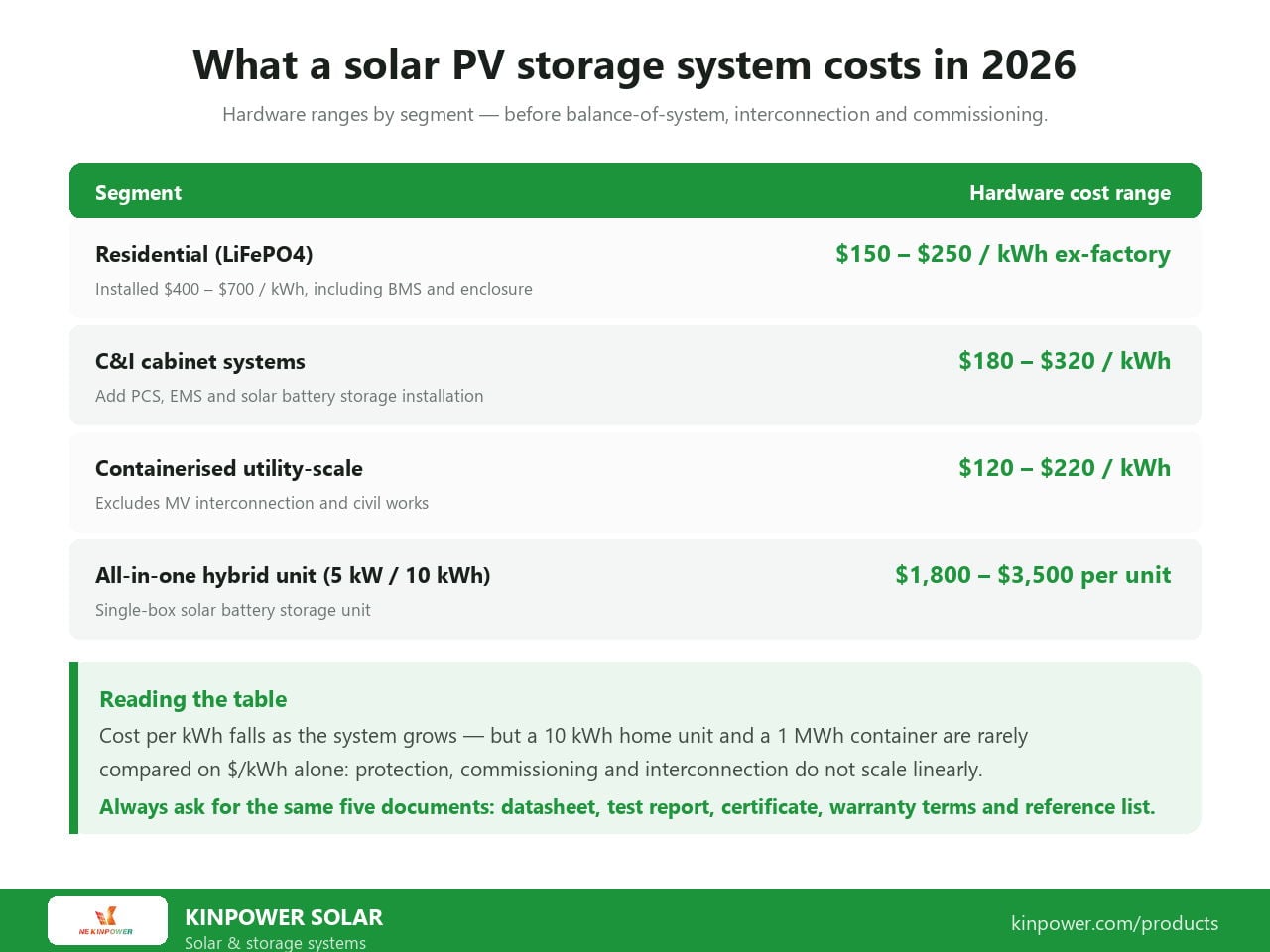
Cost per kWh falls as system size rises, but balance-of-system, protection and commissioning do not scale linearly — which is why a 10 kWh residential unit and a 1 MWh container are rarely compared on $/kWh alone.
If you plan to buy solar battery storage, the checklist below separates a durable asset from a spec sheet:
For buyers comparing a solar storage system across vendors, request the same five documents from every supplier: datasheet, test report, certificate, warranty terms and reference list. Differences in cycle life and usable DoD usually outweigh headline price.
Whether the project is a 10 kWh home unit or a 1 MWh cabinet, the same physical rules apply:
The same hardware is sold under a dozen names. Use this table to decode quotations:
|
Term you will see |
What it means |
|
Solar pv storage system / pv ess system |
PV array plus battery, described as one system |
|
Solar energy storage system / battery storage energy system |
Generic term covering any PV + battery combination |
|
Solar power storage systems / energy storage systems for solar power |
Plural / descriptive phrasing, common in tenders |
|
Solar panel storage system / solar panel storage systems |
Focuses on the panel side of the coupling |
|
PV storage battery / photovoltaic battery storage |
The battery element specifically |
|
Solar array battery storage |
Storage sized against the array output |
|
Solar battery energy storage system |
Full-stack name used in datasheets |
|
Battery storage solutions solar |
Vendor marketing phrasing; check it against the five documents |
|
Solar panels and energy storage |
Whole-system phrasing used by EPCs |
Q: Do I need a solar pv storage system, or is a plain PV array enough? It depends on your goal. If bill reduction via export credits is enough, PV alone works. If you want night-time self-consumption, peak-hour protection or outage backup, storage is the deciding component.
Q: Can I add storage to an existing PV system? Yes — an AC-coupled retrofit adds a battery inverter alongside the existing PV inverter. It costs slightly more per kWh than a DC-coupled new build but avoids replacing the array's inverter.
Q: How long does a PV storage battery last? A quality LiFePO4 bank lasts 10–15 years at one cycle per day. Plan for one replacement over a 25-year PV lifetime.
Q: Is a capacitor for solar storage a substitute for a battery? No. Capacitors handle high-power, short-duration events; batteries hold bulk energy. Most systems use both, with the battery bank doing the heavy lifting.
Q: What size system do I need for a small commercial site?
Start with the daily load profile, not the PV size. A site with a 200 kWh/day load and a 60 kW peak typically lands between 100 and 200 kWh of usable storage plus a 50–100 kW PCS.
Designing a PV storage project? Kinpower supplies residential wall-mounted and stackable LiFePO4 batteries, all-in-one hybrid ESS units and C&I cabinet solutions — factory-direct, IEC/UL certified, with a single monitoring platform across every product line. See commercial & industrial solutions or browse the full product range.
or a worked example on a single product, see our 5kWh battery price guide.
 Hot News
2026-10-12
2026-10-10
2026-10-08
2026-10-06
2026-09-30
2026-09-28
 EN
EN