 ×
×
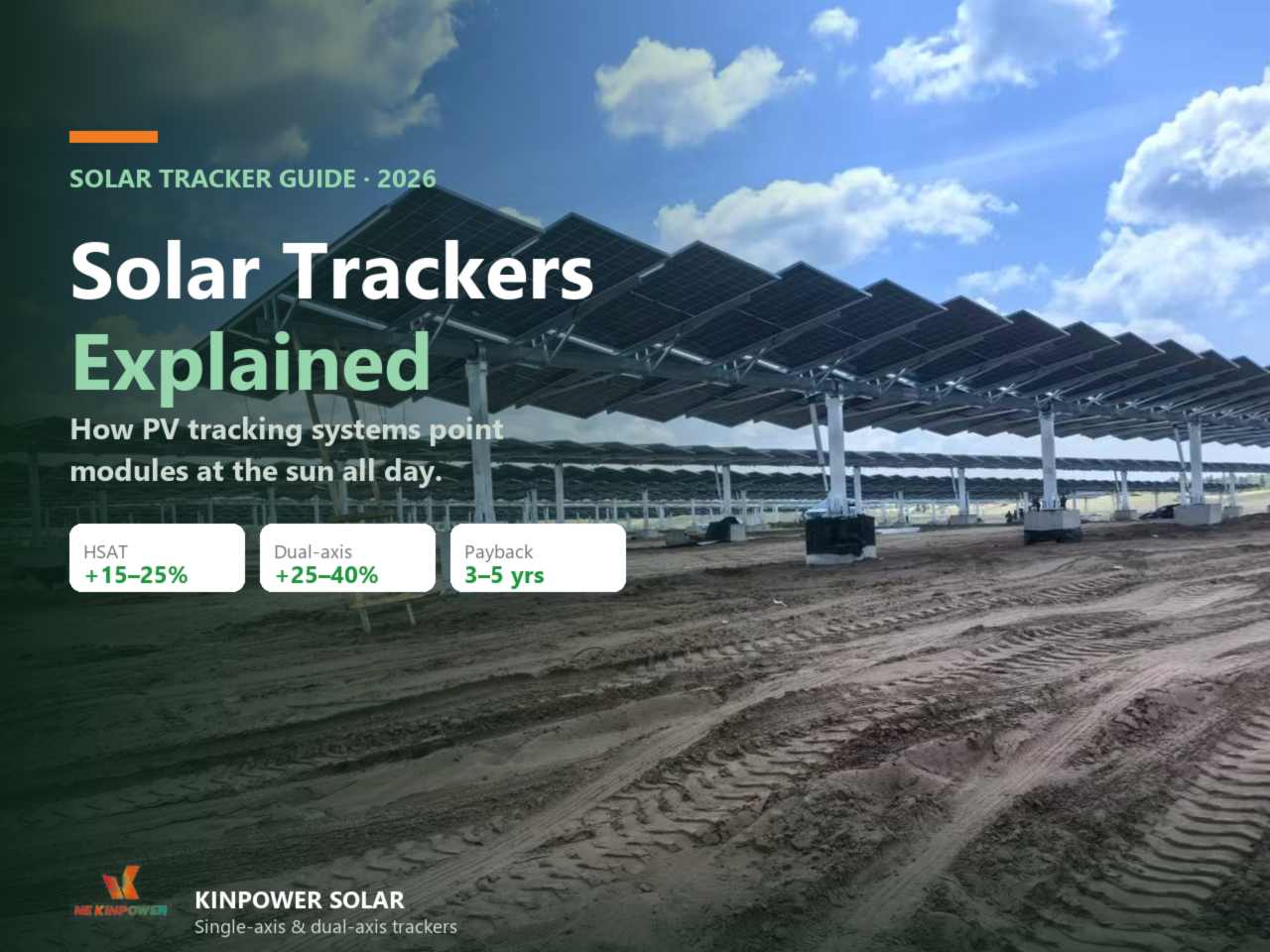
A solar tracker is a mounting system that continuously orients photovoltaic modules toward the sun instead of leaving them fixed at one tilt and azimuth. The PV tracking system follows the sun's path across the sky through the day, keeping the array closer to perpendicular incidence and therefore capturing more irradiance.
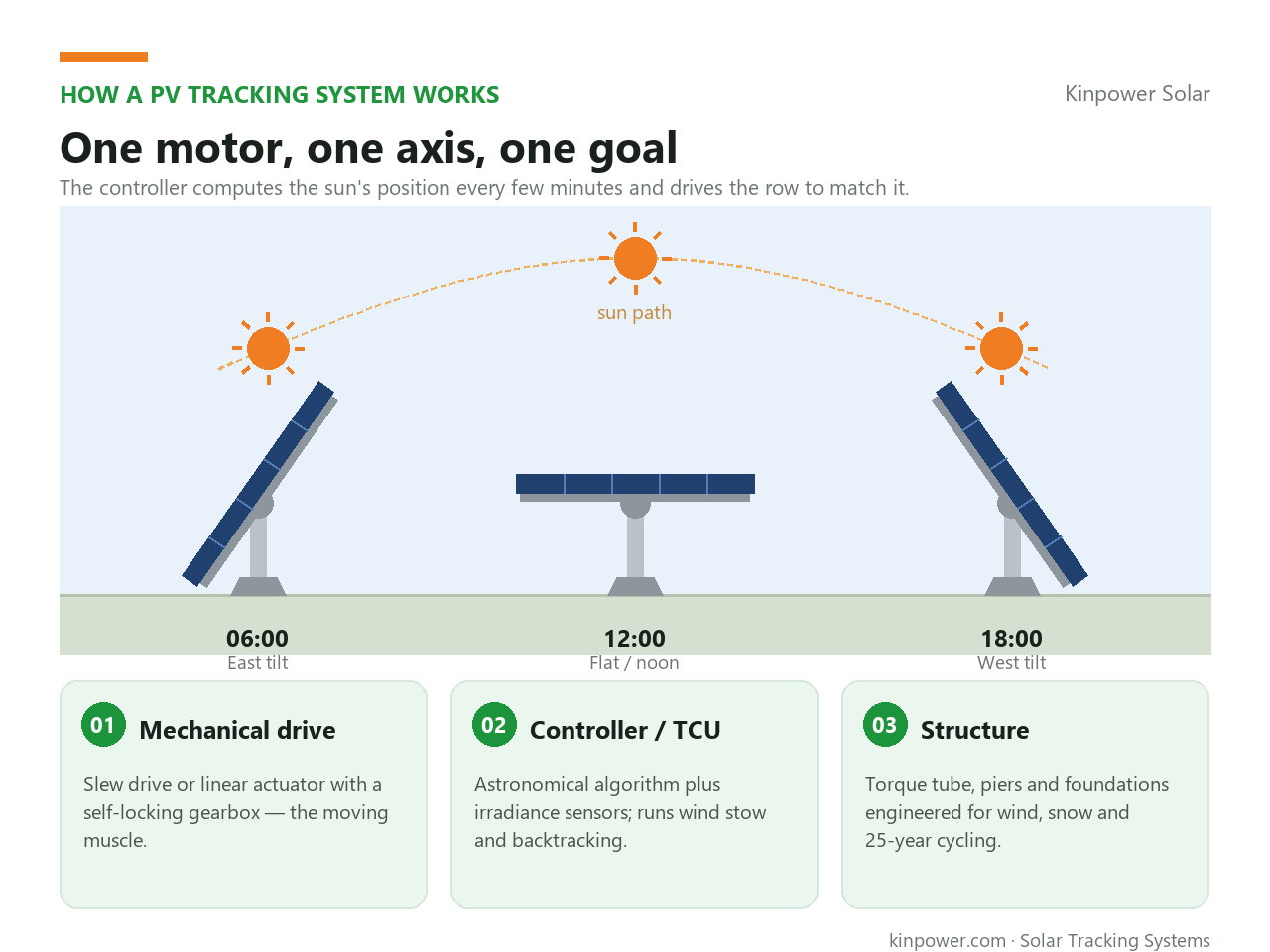
A solar tracking device typically combines three elements:
Installations using solar tracker for solar panels hardware produce measurably more energy per module — which is why trackers dominate utility-scale and increasingly appear in commercial portfolios.
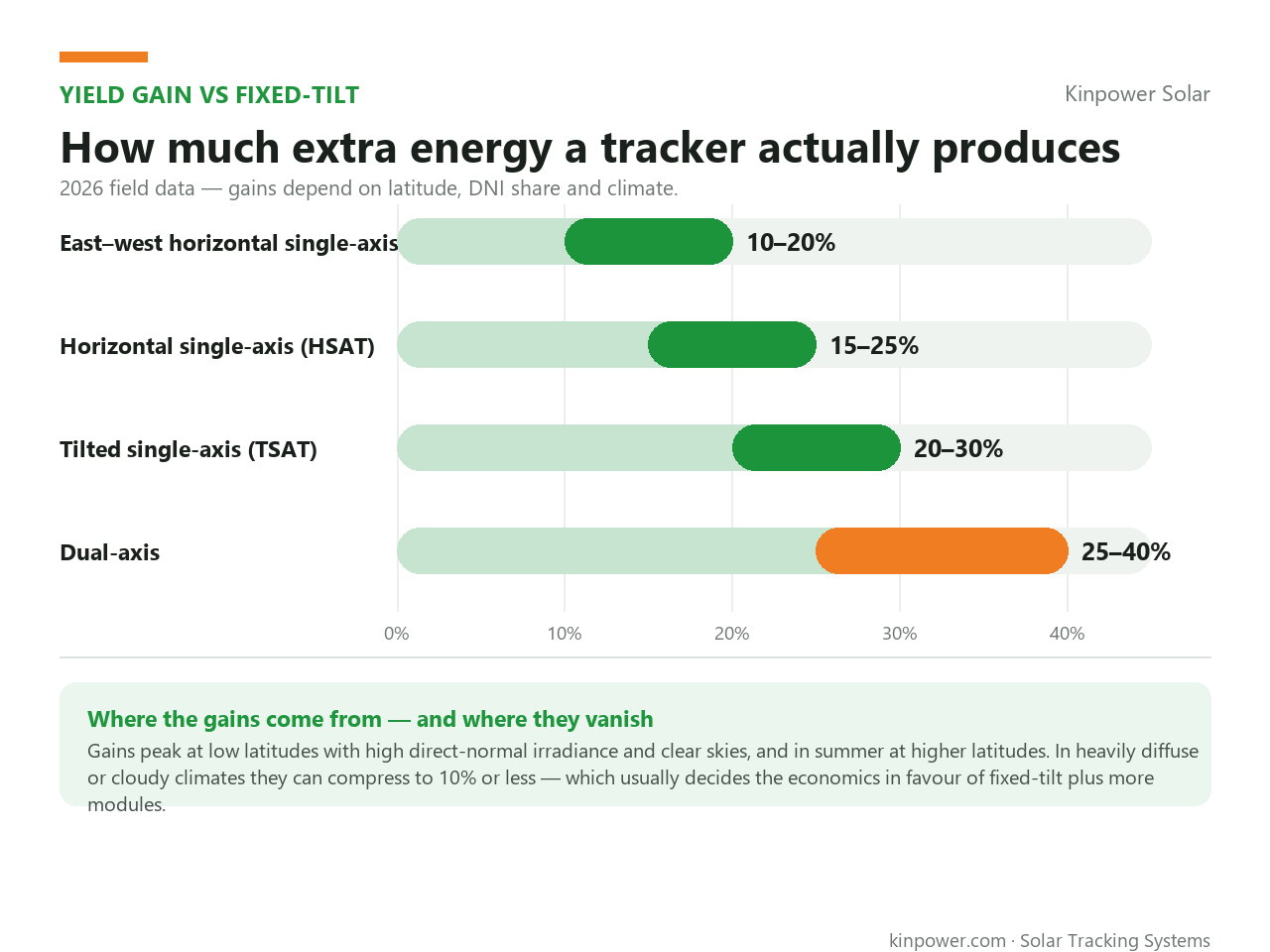
Tracking gains depend on latitude and climate, but 2026 field data supports these ranges:
|
System type |
Typical yield gain vs fixed-tilt |
|
Horizontal single-axis (HSAT) |
15–25% |
|
Tilted single-axis (TSAT) |
20–30% |
|
Dual-axis |
25–40% |
|
East-west horizontal single-axis |
10–20% |
Gains are highest in:
Gains compress in heavily diffuse or cloudy climates — sometimes to 10% or less, which changes the economics decisively.
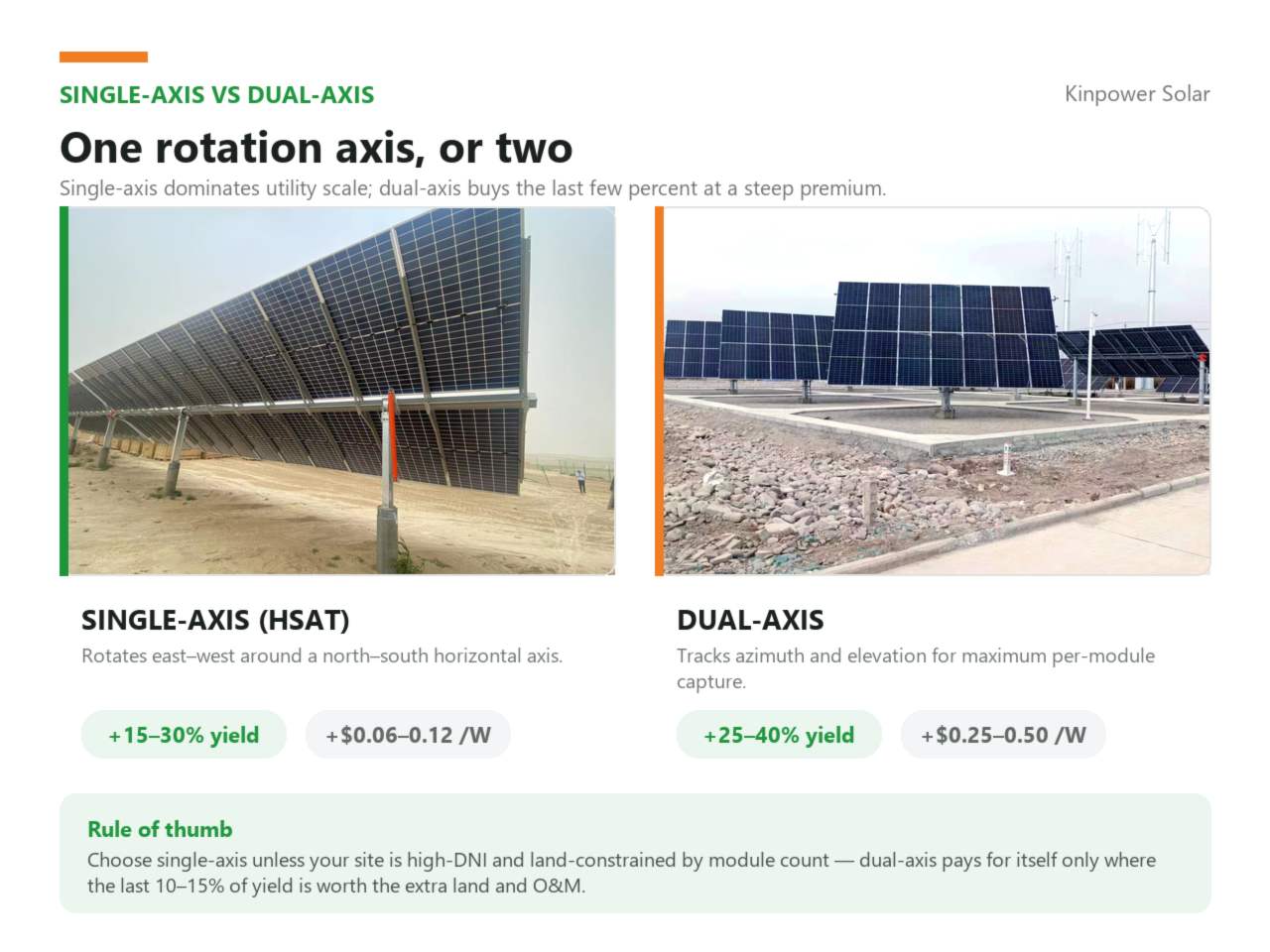
Single-axis trackers rotate around one axis:
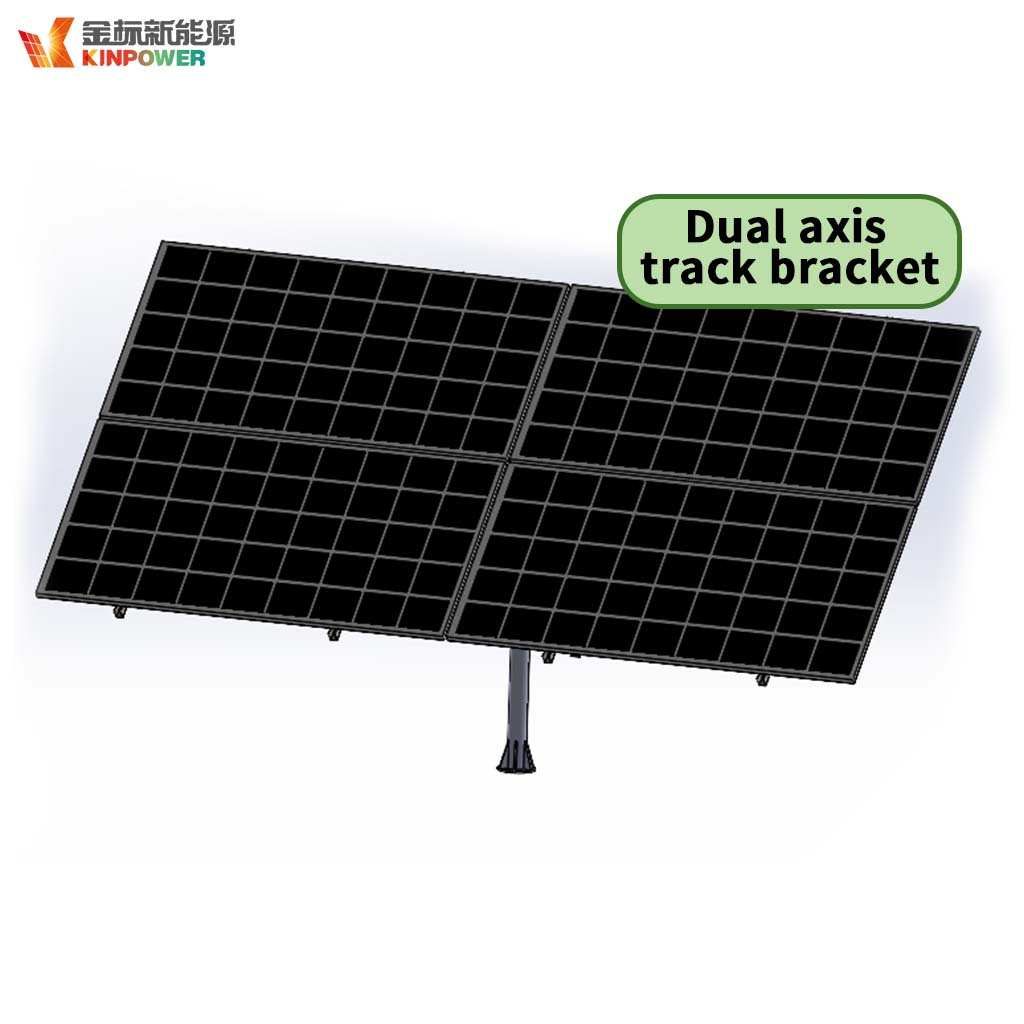
Dual-axis trackers rotate around two axes (azimuth and elevation), achieving the highest energy capture per module. They cost significantly more, use more land per kW, and need more maintenance — so they concentrate in high-DNI, high-value applications and concentrated solar projects.
See our detailed comparisons of single-axis systems and dual-axis and smart trackers.
Modern controllers work on a hybrid approach:
1. Astronomical algorithm The controller knows its GPS coordinates and the date/time, so it computes the sun's exact position every few minutes. This is the primary method — no moving parts, no blindness to clouds.
2. Irradiance sensors (supplementary) Pyranometers or irradiance sensors can trigger backup behaviour — for example, stowing during high winds or responding to unusually uneven irradiance across the array.
3. Wind stow and protection modes Above a configurable wind speed (commonly 15–25 m/s), the system drives to a flat stow position to protect the structure. Hail stow and snow-shed modes also exist on premium controllers.
4. Backtracking Neighbouring rows shadow each other when the sun is low. Backtracking algorithms rotate rows slightly away from ideal sun angle to eliminate inter-row shading losses — a standard feature that recovers several percentage points of yield.
5. Monitoring and reporting Trackers report position, motor current, wind speed and fault codes. This data is how you catch a stalled row before it costs you weeks of production.
|
Item |
Fixed-tilt |
Single-axis tracker |
Dual-axis |
|
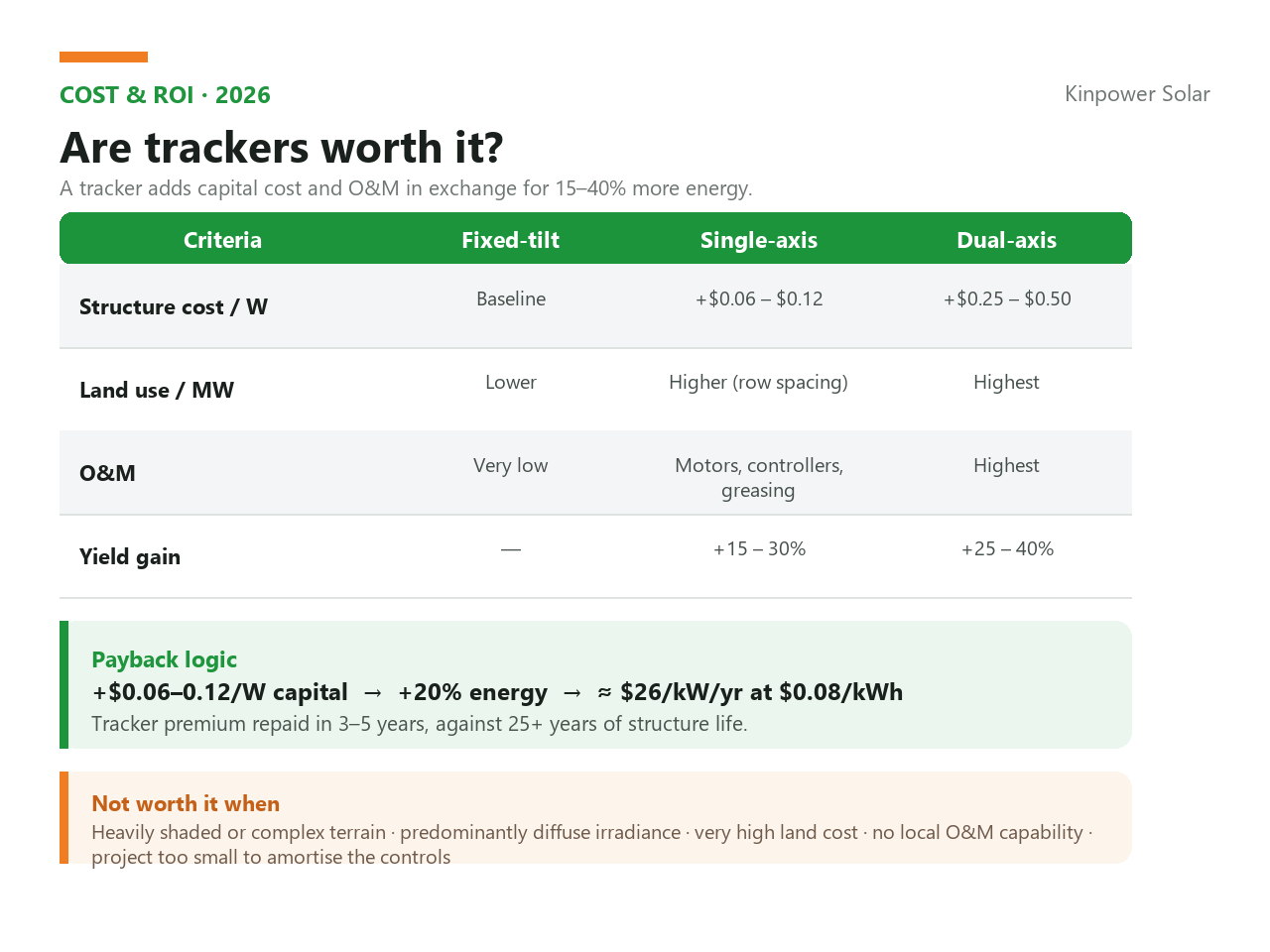
Structure cost per W |
Baseline |
+$0.06 – $0.12 |
+$0.25 – $0.50 |
|
Land use per MW |
Lower |
Higher (row spacing) |
Highest |
|
O&M |
Very low |
Motors, controllers, greasing |
Highest |
|
Yield gain |
— |
+15–30% |
+25–40% |
Rough ROI logic: a tracker adds roughly $0.06–0.12/W of capital cost for a 20% energy gain. In a market with $0.08/kWh PPA revenue and 1,600 kWh/kW/year production, that extra 20% equals about $26/kW/year — paying back the tracker premium in 3–5 years, with 25+ years of structure life.
Trackers are not worth it when:
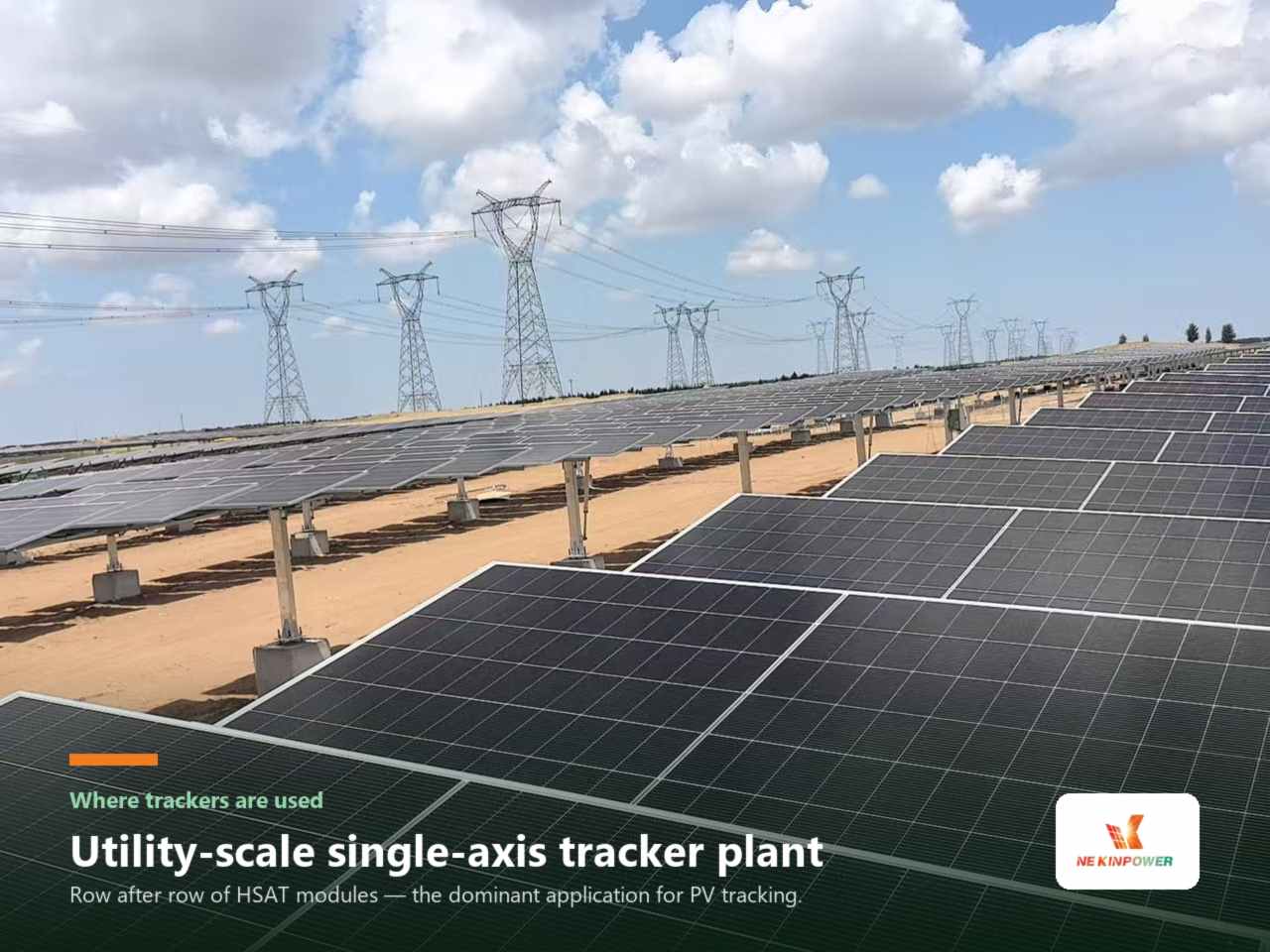
Utility-scale plants — the dominant application, for maximum kWh per module and per acre.
Commercial and industrial — large flat sites, logistics parks, and self-consumption projects where every extra kWh displaces a retail electricity price.
Agrivoltaics — tracking improves light distribution for crops and can reduce heat stress on plants.
Residential and small commercial — rarer, but single-axis residential trackers exist for driveway, ground-mount and carport applications where space is abundant and grid tariffs are high. See residential tracker options.
Specialty applications — solar-powered EV charging stations, remote telecom power, water pumping.
Tracking hardware and controls are sold under a wide range of names. Here is the working vocabulary:
|
Term |
What it covers |
|
Photovoltaic tracker / PV tracker |
The complete mechanical + control system that follows the sun |
|
PV trackers / pv trackers solar |
Plural — refers to a fleet of tracker rows or the product category as a whole |
|
PV solar tracker |
Variant phrasing common in product catalogues |
|
Solar panel sun tracking system / solar panel with sun tracking system |
Consumer-facing description of the same technology |
|
PV solar tracking system / pv sun tracking system |
Technical description of the control architecture |
|
Solar array tracking system |
Emphasises the array-level implementation rather than a single device |
|
Solar power tracking system / solar tracking energy system |
Often used in tender documents and energy-yield studies |
|
Sun tracking solar power system / sun tracker solar tracking system |
Marketing phrasing highlighting the sun-following behaviour |
|
Solar pv tracker systems |
Plural technical form, typically in procurement specifications |
|
PV tracker using solar |
Phrase describing trackers that are themselves powered by a small PV panel on the controller |
|
PV hardware tracker |
Emphasises the mechanical hardware (drive, torque tube, foundations) vs the software layer |
|
Horizontal single-axis tracker (HSAT) |
East–west rotation around a north–south axis — the utility-scale standard |
|
Tilted single-axis (TSAT) / vertical single-axis (VSAT) |
Variations tuned to latitude, terrain or land constraints |
|
Dual-axis tracker |
Azimuth + elevation rotation for maximum per-module yield |
|
Tracker controller / TCU |
The unit running the astronomical algorithm, stow logic and communication |
|
Backtracking |
Row rotation that eliminates inter-row shading when the sun is low |
Whatever the label, ask for three documents: the structural calculation report, the stow-logic specification, and a reference list of operating sites.
Tracker suppliers should provide structure calculation reports, installation training, and a documented commissioning procedure. Thermal and mechanical cycling will expose any shortcuts within the first two years.
Trackers are mechanical systems in an outdoor environment. Budget for:
A well-maintained tracker fleet achieves 99%+ availability. An unmaintained one silently loses percentage points of yield every month.
Q: How much more energy does a solar tracker produce? Typically 15–30% more than a fixed-tilt system at the same site, with dual-axis reaching 40% in high-DNI locations.
Q: Do trackers work on rooftops? Rarely — rooftop trackers add structural load and wind exposure with limited space benefit. They are used almost exclusively for ground-mount and carport applications.
Q: How long do solar trackers last?
25+ years for the structure, with motors and controllers typically serviced or replaced at 10–15 years.
Q: Are trackers worth it for a 100 kW commercial system? It depends on your tariff and irradiance. Where self-consumption displaces $0.20+/kWh retail power in a high-DNI region, yes — the maths often works. In diffuse climates, fixed-tilt with more modules is usually better value.
Q: What happens to trackers in a storm? Modern controllers automatically stow the array flat above the configured wind threshold, minimising structural load.
Evaluating tracking for your project? Kinpower designs and manufactures intelligent single-axis and dual-axis tracking systems with wind stow, backtracking and remote monitoring — engineered for utility-scale, commercial and specialty applications.
 Hot News
2026-10-08
2026-10-06
2026-09-30
2026-09-28
2026-09-23
2026-09-22
 EN
EN