 ×
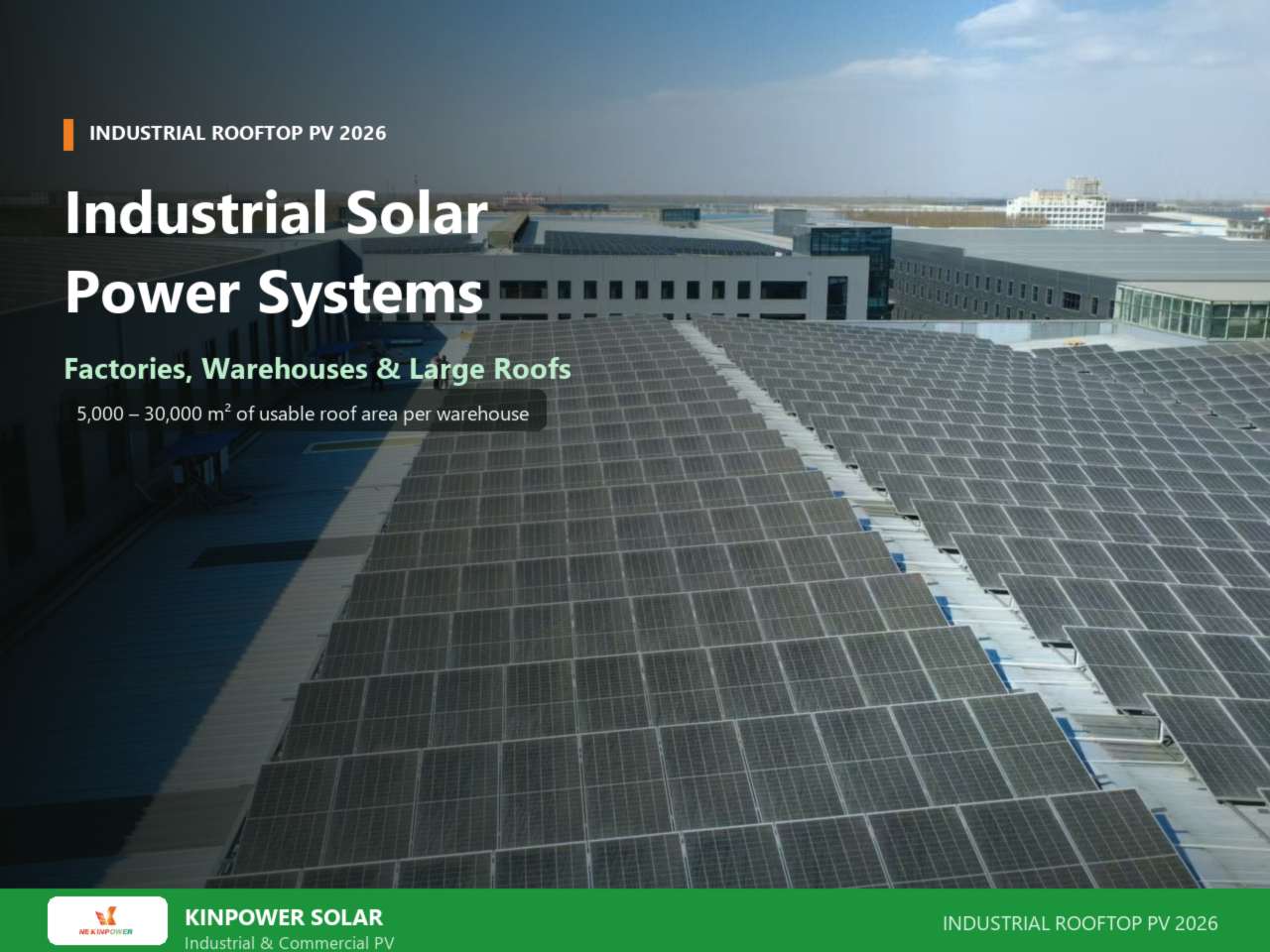
An industrial solar power system has an advantage no other segment enjoys: enormous, unencumbered, structurally strong roofs. A single warehouse can offer 5,000–30,000 m² of usable area with nothing on it — no chimneys, no dormers, no domestic plumbing vents.
That area translates directly into scale, and scale translates into cost per watt. This is why solar panels for industrial buildings deliver some of the lowest $/W figures in the entire PV market, and why industrial roofs are the first target for any serious commercial developer.
Industrial roofs are not all equal, and this is where projects fail.
|
Roof type |
Load capacity |
Suitability |
|
Standing seam metal (new) |
Good |
Excellent — non-penetrating clamps |
|
Corrugated metal, modern purlins |
Good |
Good — brackets into purlins |
|
Corrugated metal, light gauge or aged |
Limited |
Needs reinforcement or ballasted trays |
|
Asbestos-cement |
Very limited + hazardous |
Replacement usually required first |
|
Flat concrete / membrane |
Good |
Ballasted or anchored trays |
The load case that catches people out is not snow but wind uplift on a low-pitch roof. Uplift can exceed the array's weight, and ballast is often the answer — but ballast adds permanent load, which may push a marginal roof over its limit.
Also check the roof's remaining life. Interrupting an industrial roof to re-roof in five years destroys the project's economics, so an assessment of remaining service life is essential before design begins.
Industrial consumption has a distinctive shape, and it drives the design.
Sizing reference points for an industrial solar power system:
|
Roof area available |
Practical array |
Typical annual generation (1,300 kWh/kW) |
|
2,000 m² |
250 – 400 kW |
325 – 520 MWh |
|
5,000 m² |
600 – 1,000 kW |
780 MWh – 1.3 GWh |
|
10,000 m² |
1.2 – 2.0 MW |
1.6 – 2.6 GWh |
Industrial solar pv systems differ from residential in three technical respects:
Array architecture. Large roofs are divided into sub-arrays, each with its own string inverters, rather than one central plant. This limits the impact of a single failure and simplifies cable routing. Where multiple roof planes face different directions, sub-arrays also let each face operate at its own MPP.
Voltage drop and cable sizing. DC runs on an industrial roof can exceed 200 m. Cable sizing must be calculated on voltage drop, not just current-carrying capacity — otherwise the losses quietly erode the yield the model assumed.
Protection and isolation. Multiple inverters, DC isolators at roof level, and arc-fault detection are standard. Fire-service access requirements often dictate the layout more than energy optimisation does.
Monitoring. At industrial scale, per-sub-array monitoring is not optional — it is the only way to detect a degraded string among hundreds.
Storage plays three distinct roles on an industrial site, and they should be priced separately:
A 500 kWh cabinet-based BESS paired with a 500 kW roof array can transform a site's cost structure. But it should be assessed on its own numbers: if the demand charge is low and the tariff flat, storage adds cost without adding value.
Some industrial loads have no grid at all, or a grid too unreliable to trust:
In these cases the comparison is not against a tariff but against diesel: fuel cost per kWh plus delivery, storage, emissions and maintenance. Solar-storage usually wins comfortably.
|
System size |
Installed cost |
$/W |
|
100 kW roof |
$120,000 – $190,000 |
$1.20 – $1.90 |
|
500 kW roof |
$500,000 – $800,000 |
$1.00 – $1.60 |
|
1 MW roof |
$900,000 – $1,500,000 |
$0.90 – $1.50 |
|
2 MW roof |
$1.7M – $2.8M |
$0.85 – $1.40 |
|
Add-on BESS |
$180 – $320 / kWh |
— |
Roof replacement, structural reinforcement and any asbestos removal are excluded from these figures and can be substantial on older buildings.
Industrial projects differ from residential in how they are bought, and the procurement route determines both cost and risk.
Single EPC or split packages? A single engineering, procurement and construction contract gives one party responsibility for the outcome. Splitting design, hardware and installation can reduce cost by 5–12% but leaves you coordinating three parties and arbitrating between them when something underperforms. For a first industrial project, the single contract is usually worth the premium.
Hardware directly from the manufacturer. At industrial volumes, buying modules, inverters and storage direct is standard practice — it removes distributor margin and gives you direct access to test reports and warranty support. The requirement is that your EPC accepts owner-supplied equipment, which should be agreed contractually before award.
Delivery and logistics. A 1 MW roof installation arrives as 40–80 pallets of modules plus inverters, cabling and mounting. Plan crane access, laydown area and security. Roof loading during delivery is itself a structural consideration — concentrated pallet loads can exceed the finished array's distributed load.
Storage lead times. Battery cabinets and containers have longer lead times than modules. Ordering them late delays the whole project, even though they are often the last thing installed.
Spares. Hold at least 0.5% of module quantity plus a spare inverter on site. Waiting weeks for a replacement string inverter on a 1 MW plant costs more than the spare would have.
Q: How much roof area do I need per kW? Roughly 5–6 m² per kW for modern modules on a well-laid-out flat or low-pitch roof, allowing for walkways and setbacks.
Q: Will an industrial roof need reinforcing? Often not on a modern metal roof. Older, light-gauge or asbestos roofs frequently do, or require ballasted mounting instead of penetration.
Q: How long does an industrial installation take? A 500 kW roof installation typically takes six to twelve weeks on site, plus design, permitting and grid approval, bringing the total to four to eight months.
Q: Should I add storage? Only if you have a high demand charge, a wide time-of-use spread, or a resilience requirement. Price it separately and judge it on its own return.
Q: Can solar cover a 24-hour industrial load? Not economically without storage, and rarely even with it. Solar reduces daytime consumption and storage shifts some of it; the grid or a generator covers the remainder.
Planning an industrial installation? Kinpower supplies modules, string and central inverters, and LiFePO4 cabinet and containerised storage for industrial sites — engineered documentation, certified components and factory-direct pricing for developers, EPCs and facility owners. See commercial & industrial solutions or browse the product range.
 Hot News
2026-11-20
2026-11-17
2026-11-12
2026-11-10
2026-11-04
2026-11-02
 EN