 ×
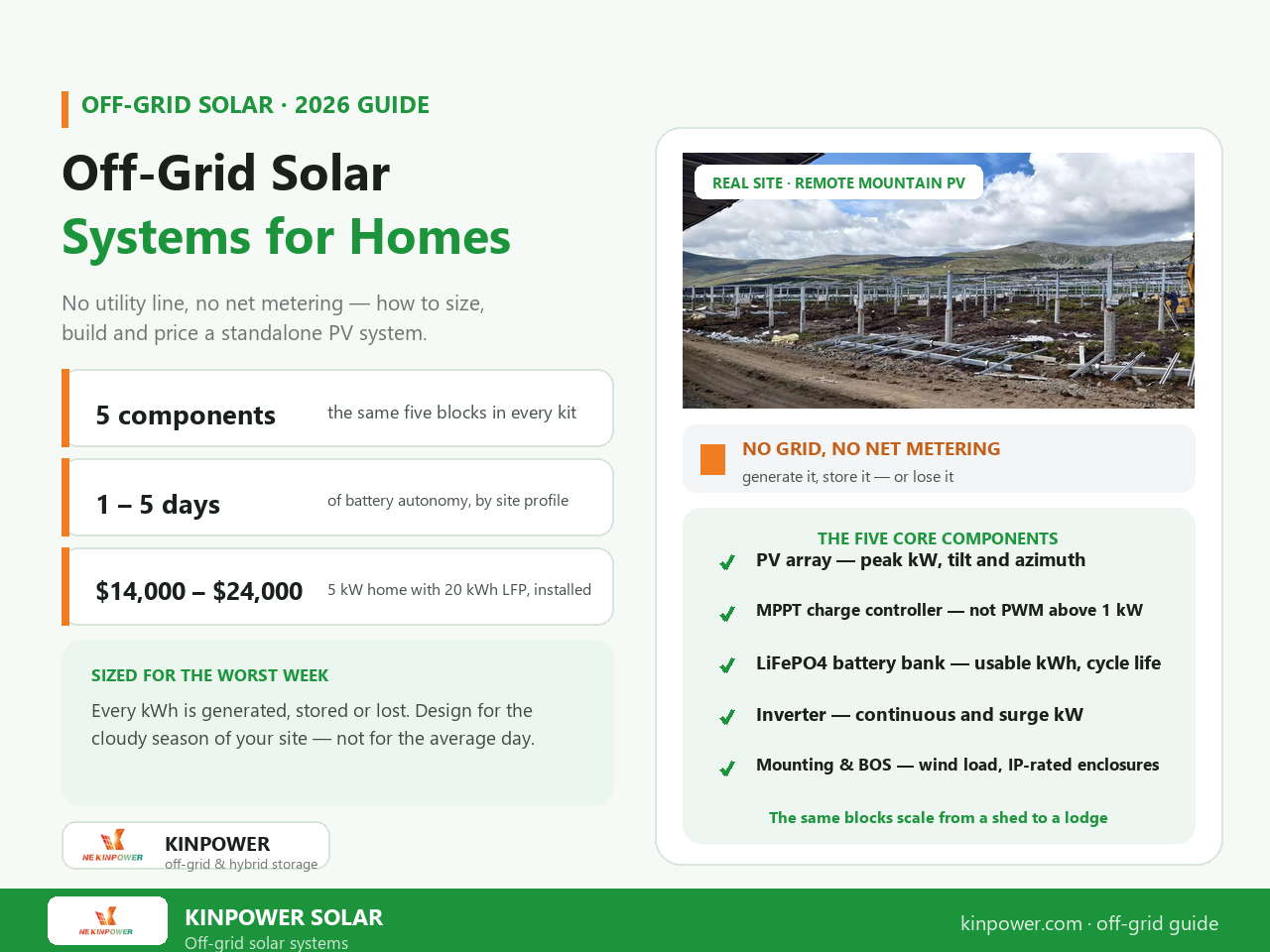
An off grid solar system is a photovoltaic installation that has no connection to the utility grid at all. Every kilowatt-hour you consume is either generated on site and used immediately, stored in a battery, or lost. There is no fallback meter, no net metering, and no grid to lean on during a cloudy week.
It is also called a standalone pv system — the term used in technical standards — or, in casual spelling, offgrid solar. Whatever the label, the engineering implication is the same: the system must be sized for the worst week of the year, not the average day.
This guide covers the five components, a repeatable sizing method, real kit configurations, and what a full off grid solar system costs in 2026.
Every off grid solar system — from a 1 kW shed setup to a 100 kW commercial installation — contains the same five blocks.
|
Component |
Function |
What to specify |
|
PV array |
Generates DC power during daylight |
Peak kW, module efficiency, tilt and azimuth |
|
Charge controller / MPPT |
Regulates array output into the battery |
MPPT (not PWM) for anything above 1 kW |
|
Battery bank |
Stores energy for night and cloudy days |
Usable kWh, chemistry, cycle life |
|
Inverter |
Converts DC to AC for household loads |
Continuous and surge kW, output waveform |
|
Mounting & BOS |
Structure, cabling, protection, monitoring |
Wind/snow load rating, IP-rated enclosures |
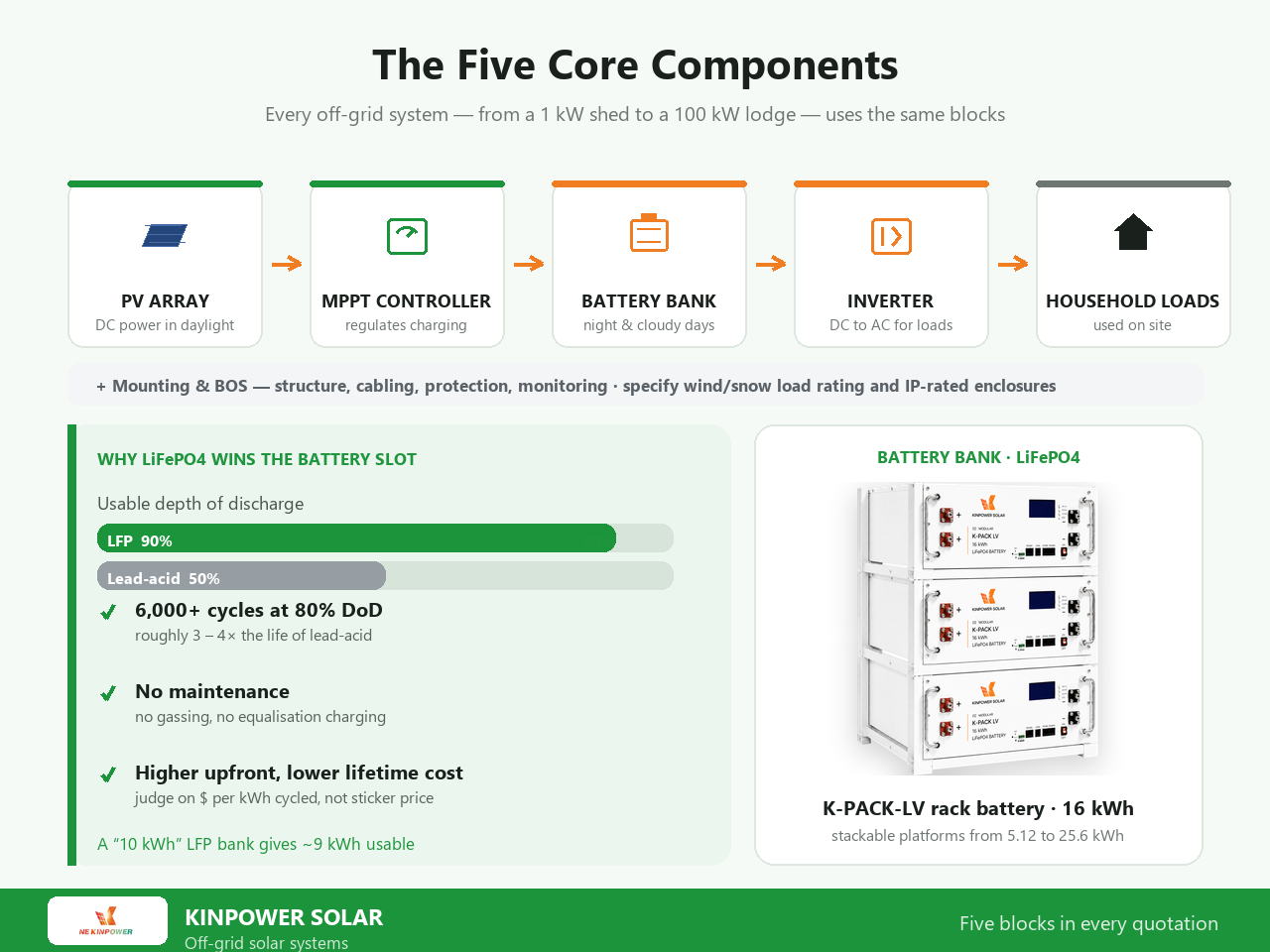
These are the off grid solar system components that appear in every quotation. If a vendor omits the charge controller or the surge rating, the quote is incomplete.
The off grid solar battery is the single most expensive and most consequential part of the system. Today the default choice is LiFePO4 (LFP):
For a solar system for off grid living, LFP is now the rational default unless the budget is extremely tight and the site is temperate.
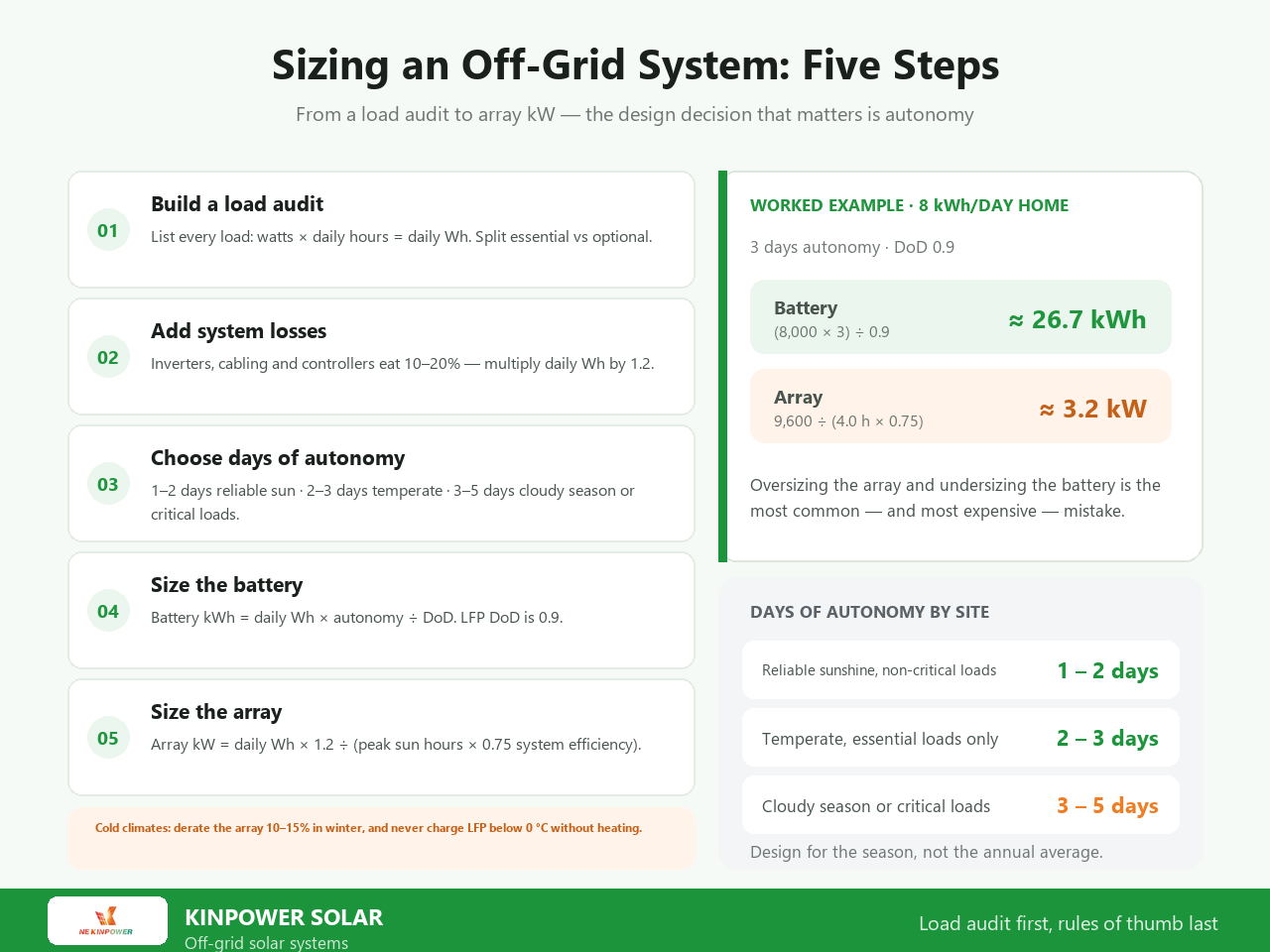
Step 1 — Build a load audit. List every load, its power (W) and its daily runtime (h). Multiply and sum to get daily Wh. Then split into "essential" and "optional".
Step 2 — Add system losses. Inverters, cabling and controllers consume 10–20%. Multiply daily Wh by 1.2.
Step 3 — Choose days of autonomy. This is the design decision that matters most:
|
Site profile |
Days of autonomy |
|
Reliable sunshine, non-critical loads |
1 – 2 days |
|
Temperate, essential loads only |
2 – 3 days |
|
Cloudy season or critical loads |
3 – 5 days |
Step 4 — Size the battery. Battery kWh = (daily Wh × autonomy) ÷ DoD. For 8 kWh/day, 3 days autonomy and 0.9 DoD: (8,000 × 3) ÷ 0.9 ≈ 26.7 kWh.
Step 5 — Size the array. Array kW = (daily Wh × 1.2) ÷ (peak sun hours × system efficiency). For 8 kWh/day at 4 peak sun hours and 0.75 overall efficiency: 9,600 ÷ (4,000 × 0.75) ≈ 3.2 kW.
Designing an off grid solar system in cold climates needs two corrections: derate array output by 10–15% for winter losses, and confirm the battery's low-temperature charge cut-off, because LFP must not be charged below 0 °C without heating.
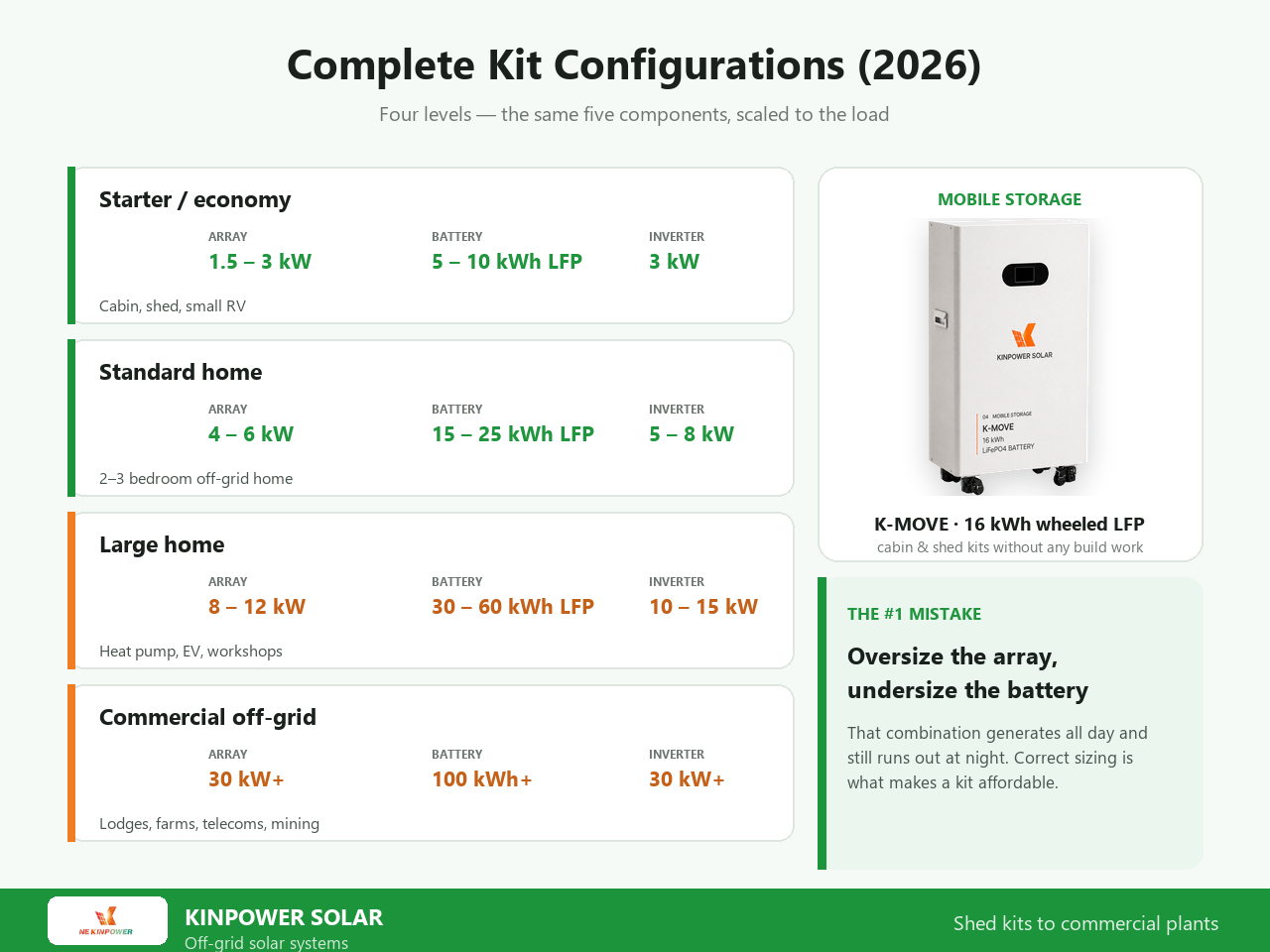
|
Kit level |
Array |
Battery |
Inverter |
Typical use |
|
Starter / economy |
1.5 – 3 kW |
5 – 10 kWh LFP |
3 kW |
Cabin, shed, small RV |
|
Standard home |
4 – 6 kW |
15 – 25 kWh LFP |
5 – 8 kW |
2–3 bedroom off-grid home |
|
Large home |
8 – 12 kW |
30 – 60 kWh LFP |
10 – 15 kW |
Heat pump, EV, workshops |
|
Commercial off-grid |
30 kW+ |
100 kWh+ |
30 kW+ |
Lodges, farms, telecoms, mining |
An affordable off grid solar system does not mean a small one — it means one sized correctly. Oversizing the array and undersizing the battery is the most common and most expensive mistake: you generate during the day and still run out at night.
A shed off grid solar system — also searched as an off grid solar system for shed — is the cheapest entry point, typically 400 W to 2 kW with a 2–5 kWh battery running lighting, a freezer, tools and a charger. Because loads are small and intermittent, a modest LFP bank plus a 1–2 kW inverter is usually sufficient.
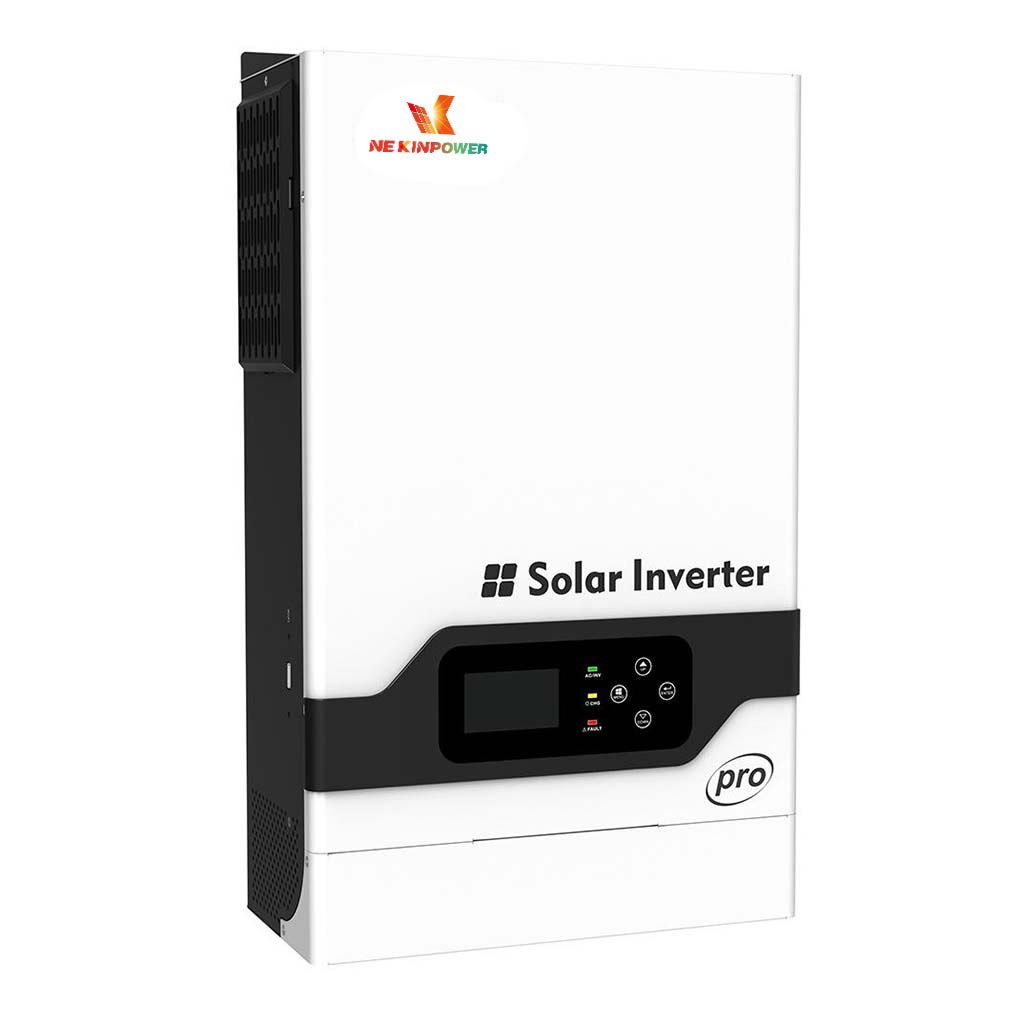
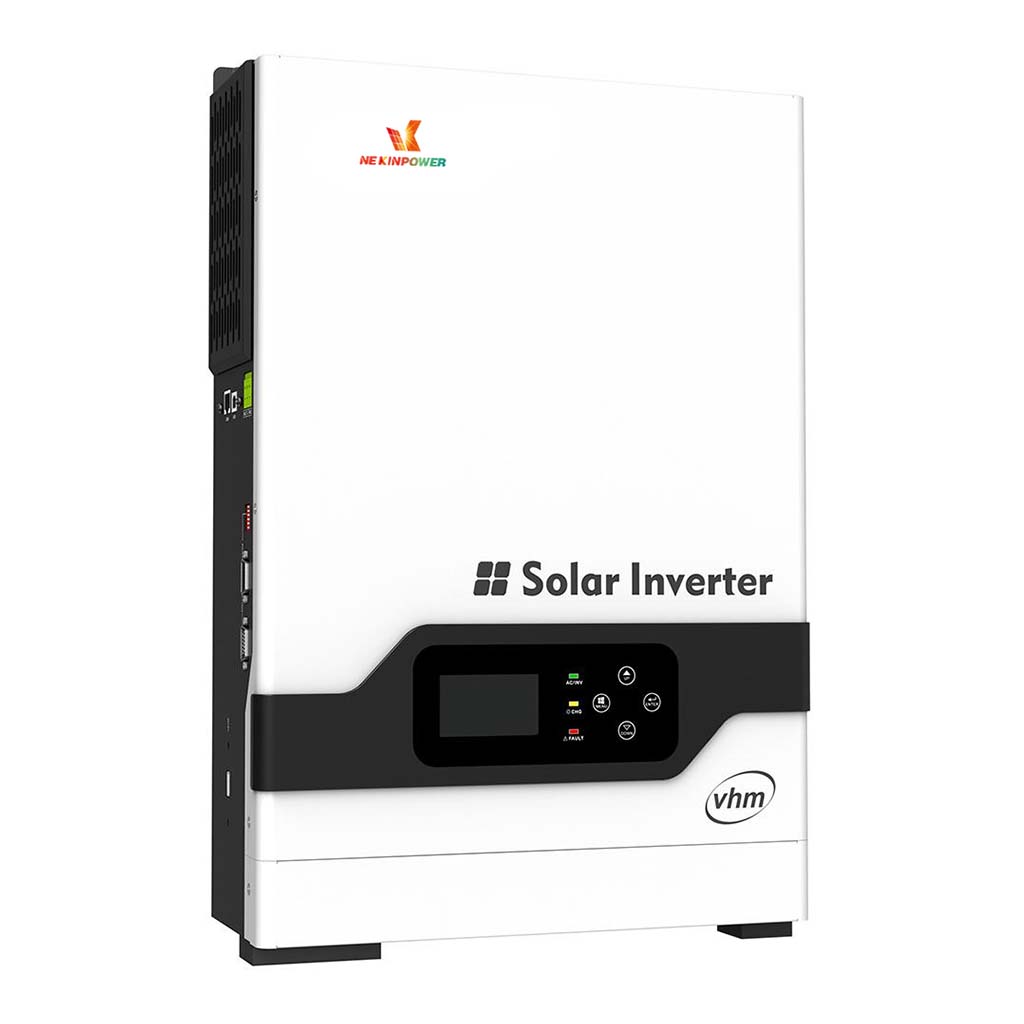
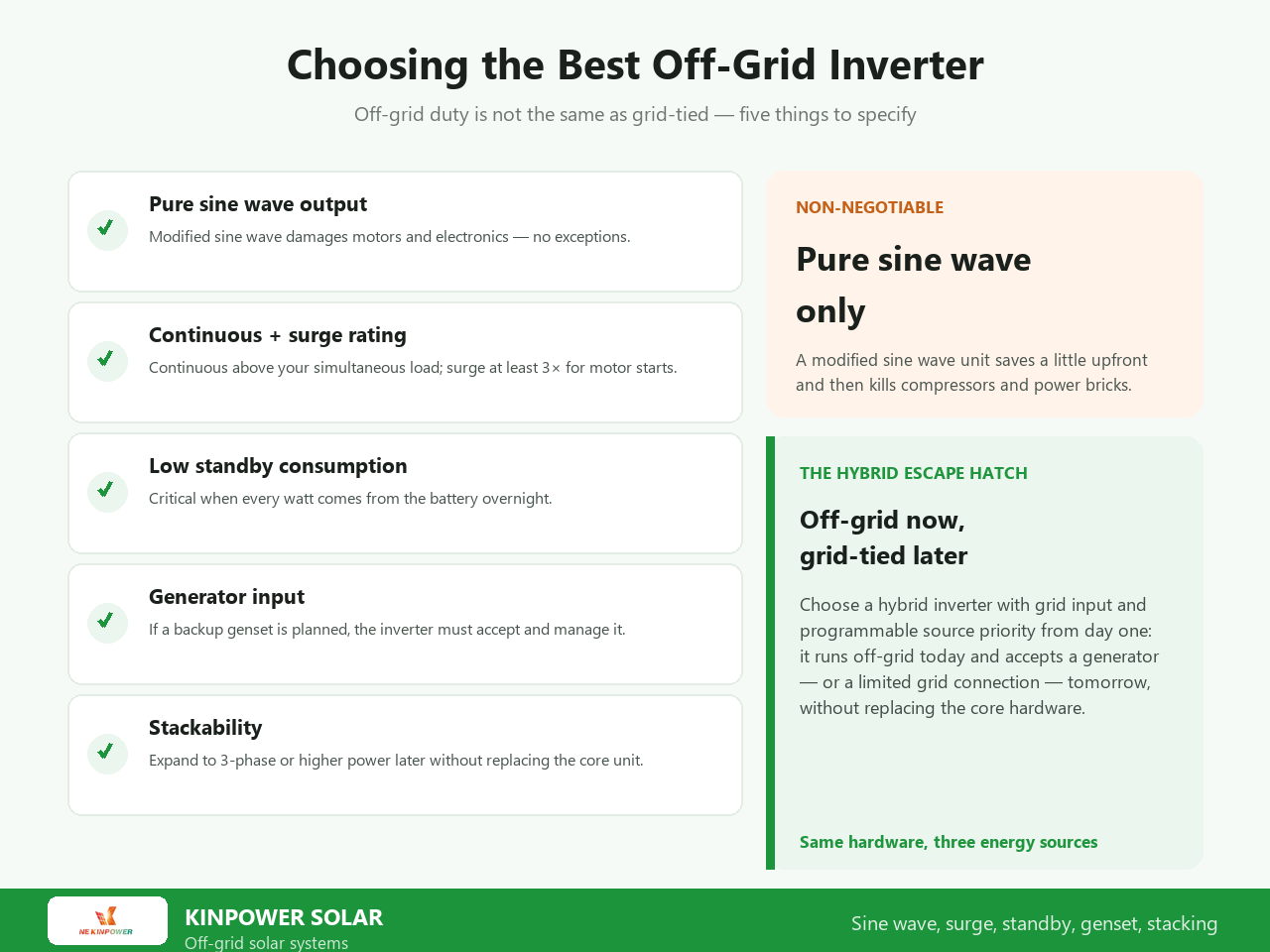
The best inverter for off grid solar system duty is not the same as a grid-tied hybrid inverter. Specify:
For an off grid hybrid solar system — one that can also accept a generator or a limited grid connection — choose a hybrid inverter with programmable source priority.
Off-grid architecture scales in both directions:
Sizing theory is easier to trust with numbers attached. Both examples below assume 4.2 peak sun hours and 0.75 system efficiency.
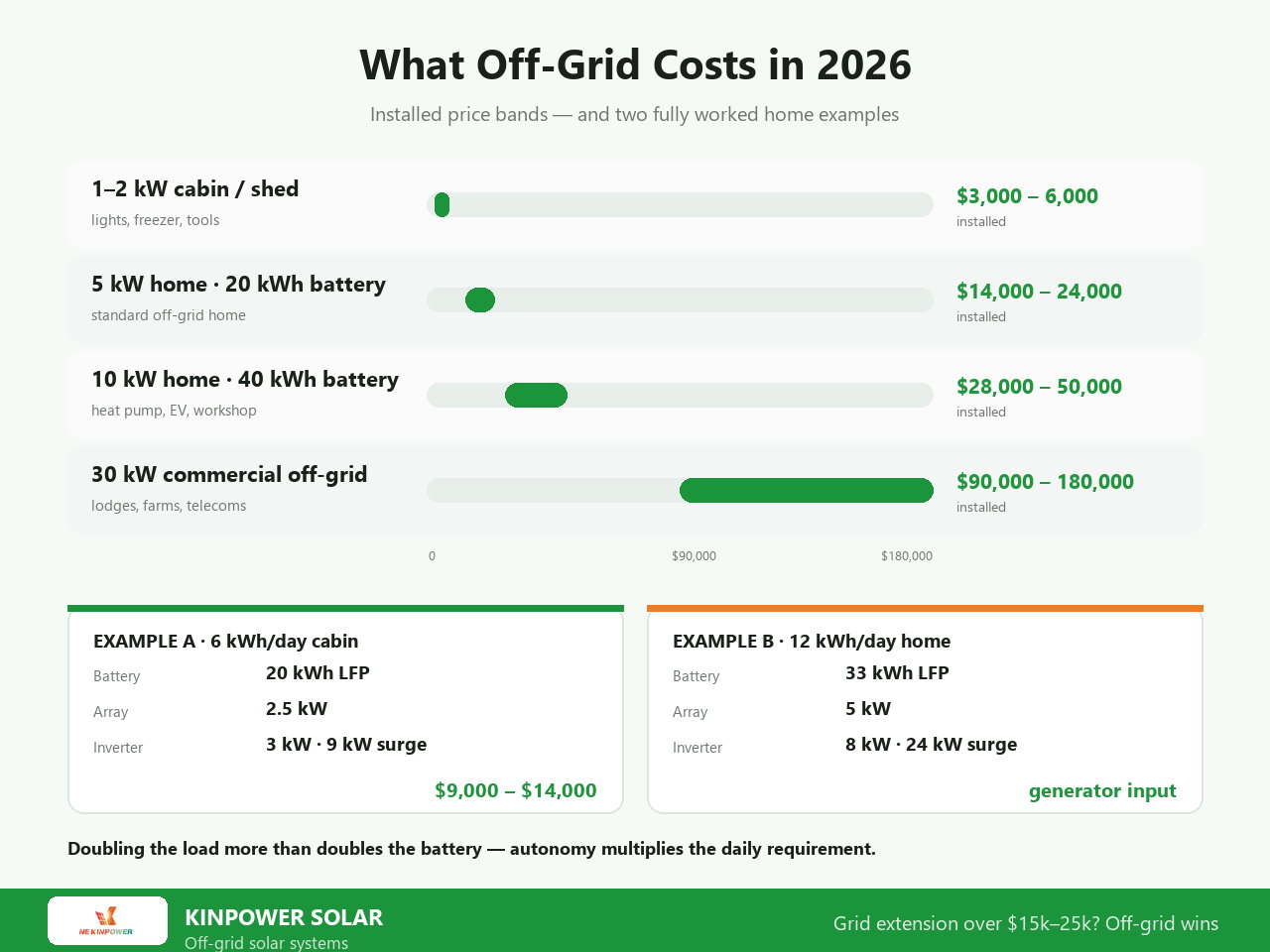
Example A — a 6 kWh/day cabin. Daily load 6,000 Wh, three days of autonomy, 0.9 depth of discharge:
A stand alone off grid solar system of this size costs roughly 9,000–14,000 installed and covers a cabin's fridge, pumps, lighting and electronics year-round in a temperate climate. It is the configuration most owners describe as the best off grid solar system for home use when mains power is genuinely unavailable, because it balances autonomy against cost without over-building.
Example B — a 12 kWh/day family home. Daily load 12,000 Wh, 2.5 days of autonomy:
The jump from Example A to B is not proportional — doubling the load more than doubles the battery, because autonomy days multiply the daily requirement. This non-linearity is why a load audit, not a rule of thumb, must drive the design.
A note on winter. Both examples should be re-run with winter sun hours (often 2–3 instead of 4.2). Designing on annual averages is the single most common cause of under-performing off-grid systems.
The same system appears under many names. Use this decoder when comparing quotes:
|
Term you will see |
What it means |
|
Offgrid solar |
Casual spelling of off grid solar |
|
Off grid solar pv system / off grid pv system |
Technical phrasing for a battery-based PV system with no grid tie |
|
Solar energy off grid system |
Public-facing phrasing, common in tender documents |
|
Solar cell off grid |
Refers to the generation side; usually shorthand for the whole system |
|
Stand alone solar panels / standalone pv system |
Emphasis on independence from the grid |
|
Off grid solar panel system for home |
Residential configuration |
|
Off grid solar kits for homestead |
Pre-bundled kit with matched components |
|
Solar panels for off grid house |
Generation-side shorthand |
|
Buy off grid solar system |
Purchase intent — always request a load-audit-based design, not an off-the-shelf box |
|
System |
Installed cost range |
|
1–2 kW cabin / shed |
$3,000 – $6,000 |
|
5 kW home, 20 kWh battery |
$14,000 – $24,000 |
|
10 kW home, 40 kWh battery |
$28,000 – $50,000 |
|
30 kW commercial off-grid |
$90,000 – $180,000 |
Off-grid costs more per watt than grid-tied because of the battery and the oversized array. Where a grid connection would cost more than 15,000–25,000 to extend, off-grid usually wins on total cost of ownership.
Q: Can I start off-grid and add a grid connection later? Yes, and it is a sensible strategy. Choose a hybrid inverter with grid input from the start; it can run off-grid now and grid-tied later without replacing the core hardware.
Q: How many days of autonomy should I design for? Two to three days covers most temperate homes. If your site has a pronounced cloudy season, design for the season, not the annual average.
Q: Is off-grid cheaper than grid-tied? Only where the grid connection itself is expensive. Per watt, off-grid hardware costs more; per site, it can still be the cheapest option.
Q: Do I need a generator?
Not necessarily, but many owners keep a small genset for extended cloudy periods. A well-designed system with three days of autonomy rarely needs one.
Q: Can I use lead-acid instead of LFP? You can, but check lifetime $/kWh cycled rather than purchase price. LFP usually wins within five years.
Planning an off-grid build? Kinpower supplies stackable LiFePO4 battery banks from 5.12 to 25.6 kWh and mobile storage from 15 to 32 kWh, matched with hybrid and off-grid inverters, plus complete kit design support. See home energy solutions or browse the full product range.
 Hot News
2026-10-21
2026-10-19
2026-10-16
2026-10-14
2026-10-12
2026-10-10
 EN