Get a Free Quote

Our representative will contact you soon.
Email
Mobile/WhatsApp
Name
Company Name
Message
0/1000
grid connected pv system guide-0

News

Home >  News

Grid-Connected Solar: How On-Grid PV Systems Work, Cost & Setup (2026 Guide)

Oct 19, 2026

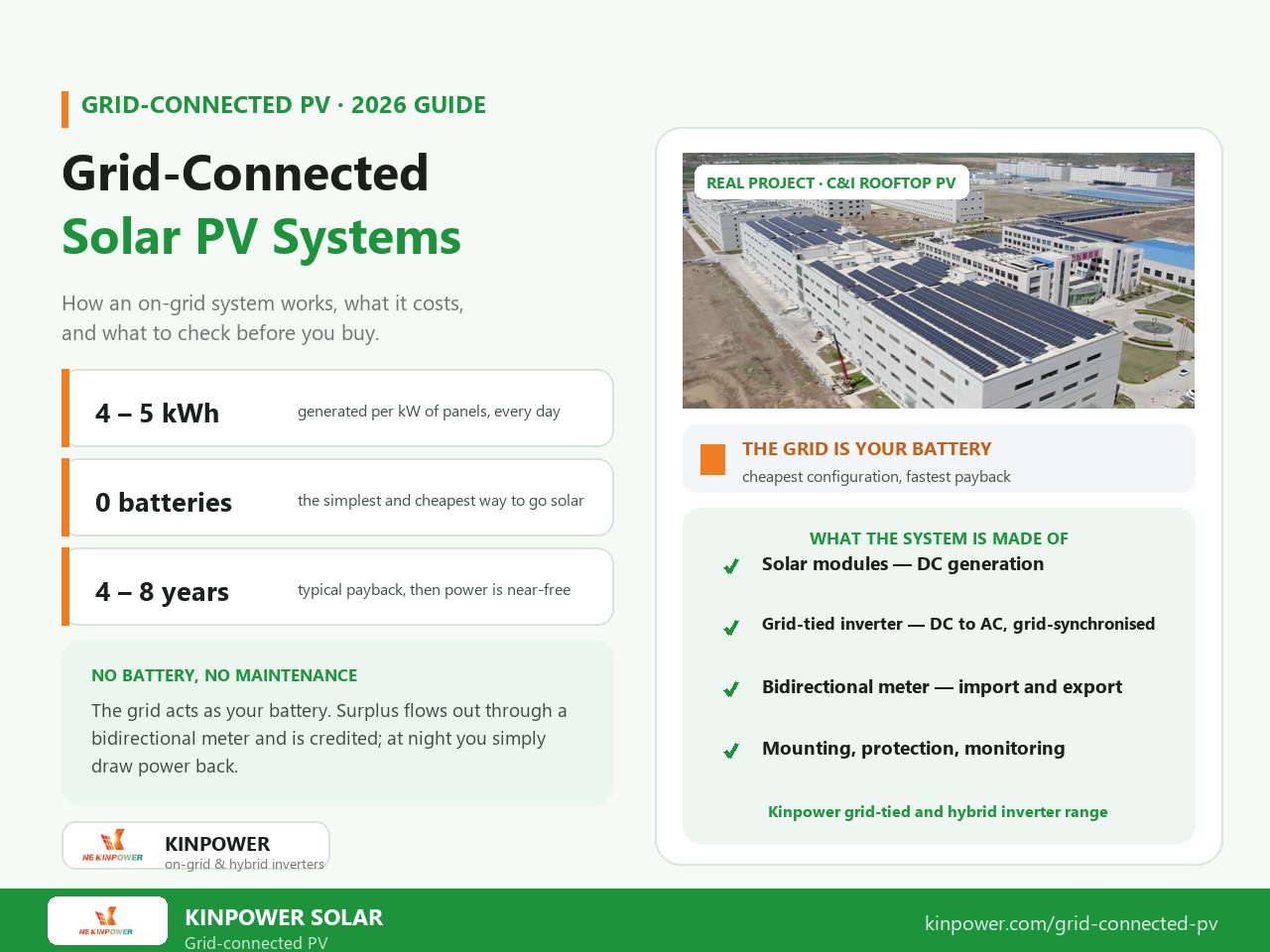
Grid-connected photovoltaic power system installed on a commercial rooftop — on-grid PV system guide for 2026

What Is a Grid-Connected Photovoltaic Power System?

A grid-connected photovoltaic power system — often called an on-grid or grid-tied solar system — generates electricity from solar panels and works together with the utility grid instead of storing all of its energy in batteries.

During the day, your on grid PV system powers your home or business directly from sunlight. Any surplus electricity flows back to the grid, and when your panels aren't producing (nighttime, cloudy days), you simply draw power from the grid as usual.

This is the most popular solar system for home on grid configuration worldwide because it is the simplest and cheapest way to go solar: no batteries, fewer components, and fast payback through bill savings or net metering credits. Because there is no battery to maintain or replace, a solar energy on grid system also carries the lowest lifetime service cost of any solar configuration.
How a Grid PV System Works — Step by Step

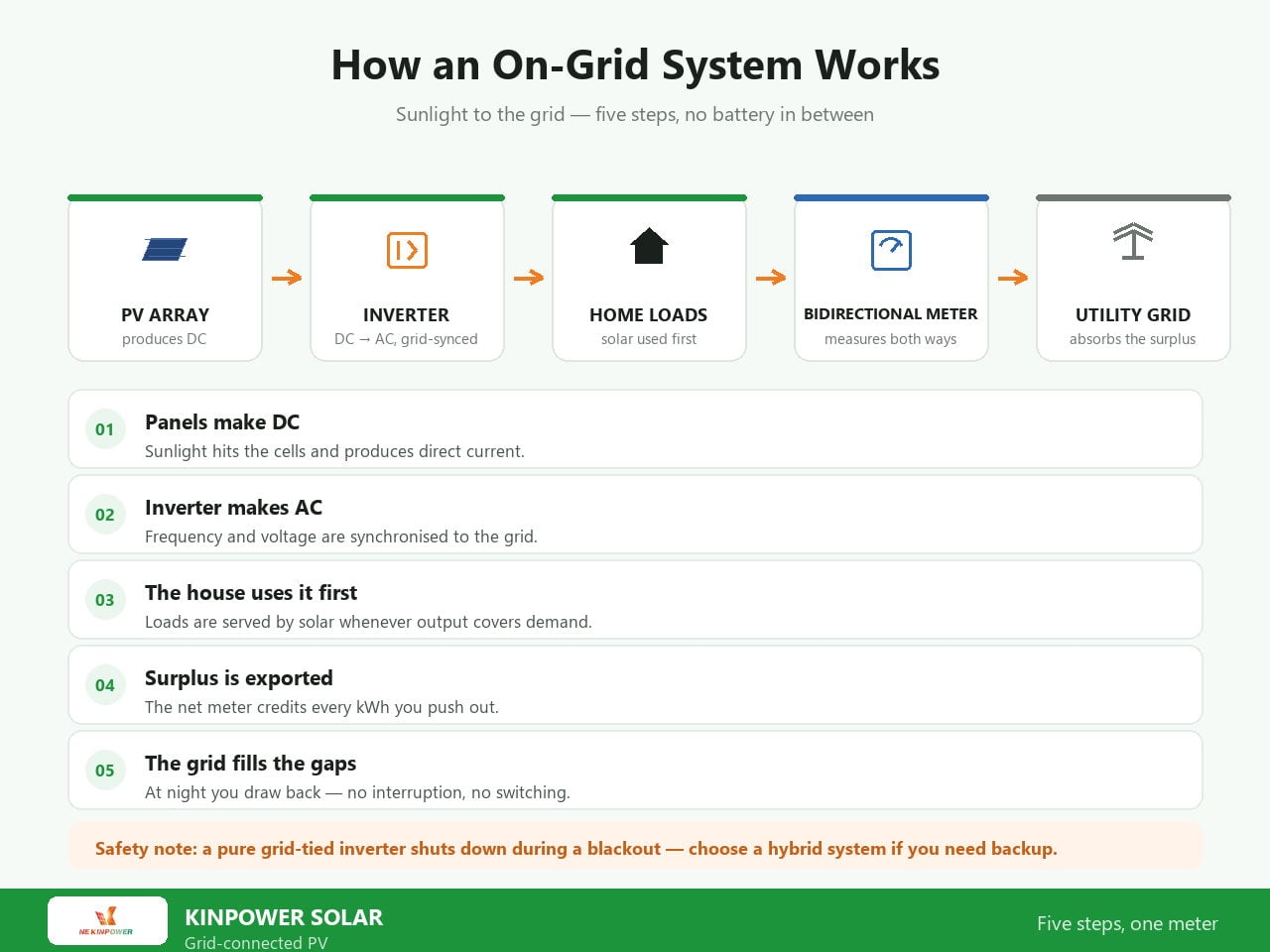
  1. Solar panels generate DC power. Sunlight hits the photovoltaic cells and produces direct current electricity.
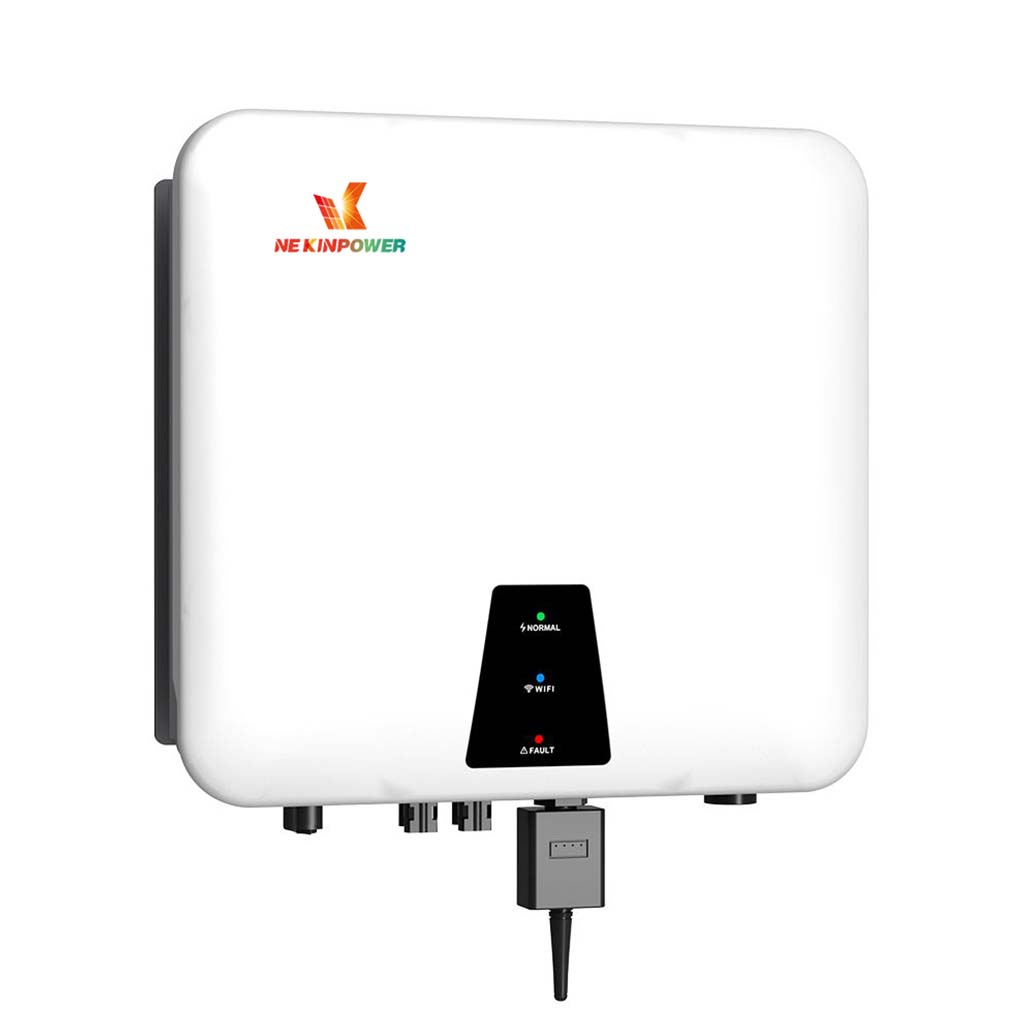
  2. The on-grid solar system inverter converts DC to AC. A grid-tied inverter transforms the DC power into the alternating current your appliances use, and synchronizes its frequency and voltage precisely with the grid.
  3. Your home consumes solar power first. Loads are served by solar energy whenever production covers demand.
  4. Surplus is exported or credited. Excess energy flows through a bidirectional (net) meter to the grid. Under net metering or feed-in tariff schemes, you receive credits or payment for exported kWh.
  5. The grid covers the gaps. When demand exceeds solar output, the grid supplies the difference automatically — you won't notice any interruption.

How an on grid PV system works: PV array produces DC, the inverter converts it to grid-synchronised AC, the house consumes solar first, surplus is exported through a bidirectional meter to the utility grid

One important limitation: a pure grid PV system shuts down during a blackout for safety (so line workers aren't injured by your export). If backup power matters to you, consider a hybrid system with battery storage — see our hybrid solar systems guide.

Main Components of an On-Grid Solar System

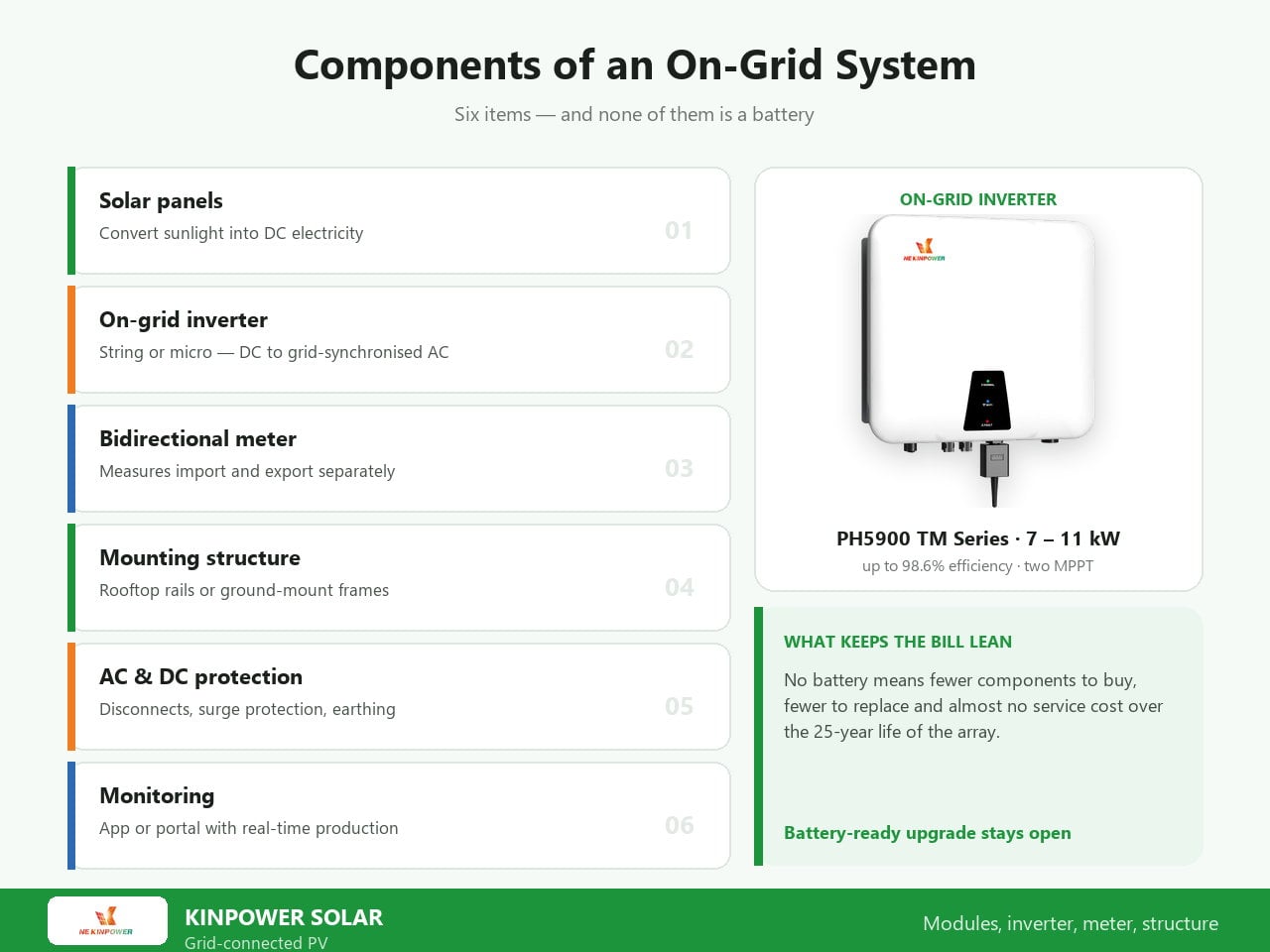
A typical on grid home solar system consists of:

Component

Function

Solar panels

Convert sunlight into DC electricity

On-grid inverter (string or micro)

Convert DC to grid-synchronized AC

Bidirectional / net meter

Measures import and export separately

Mounting structure

Rooftop rails or ground-mount frames

AC & DC protection

Disconnects, surge protection, earthing

Monitoring

App or portal showing real-time production

Components of an on grid solar system: solar panels, grid-tied inverter, bidirectional net meter, mounting structure, AC and DC protection and monitoring

There is no battery in a standard solar panels on grid system, which keeps the bill of materials lean and the payback short.
Popular Configurations

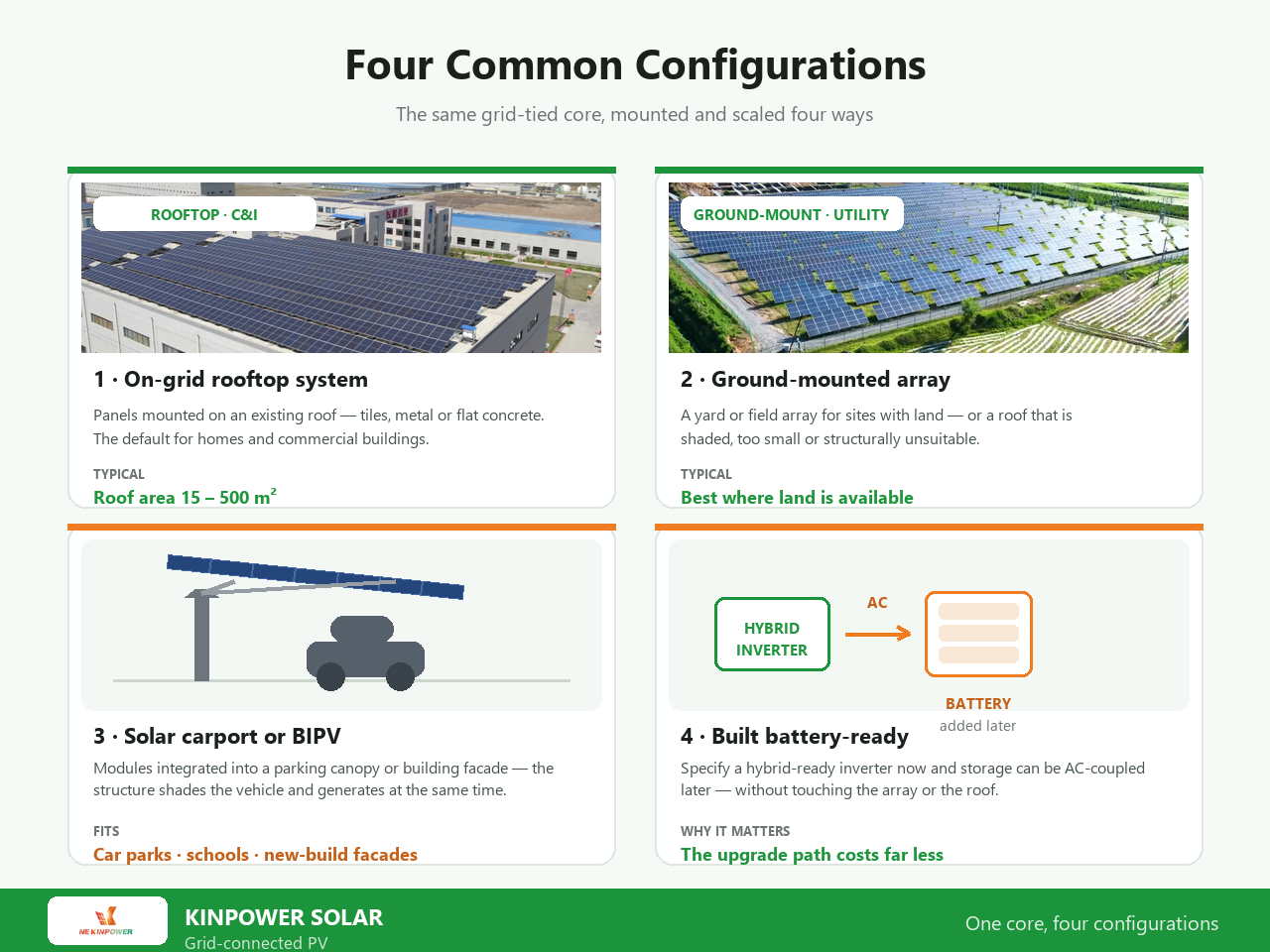
  • On grid solar rooftop system / solar on grid rooftop system — panels mounted on an existing roof (tiles, metal, flat concrete). The most common choice for homes and commercial buildings.
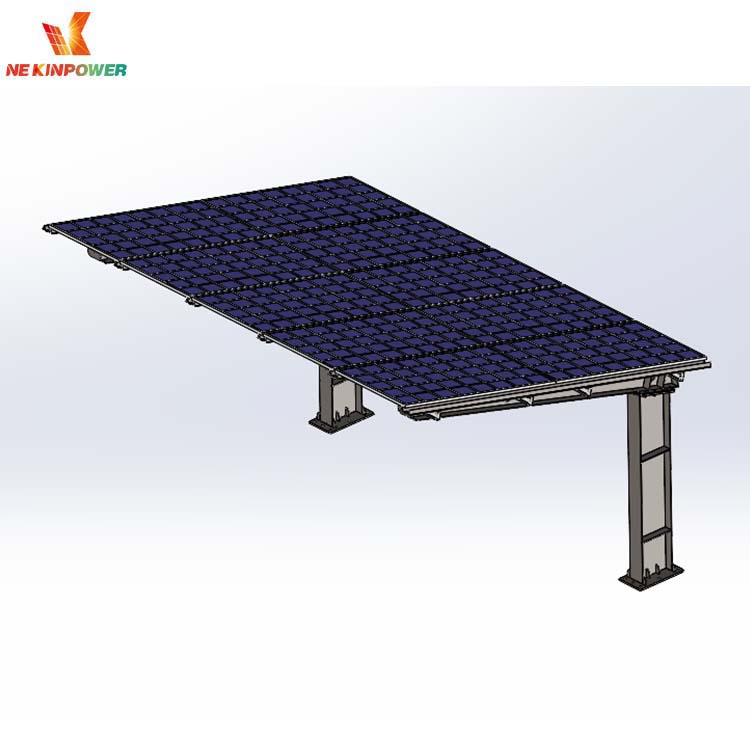
  • PV system on grid, ground-mounted — a yard-mounted array for properties with land and shading issues on the roof.
  • On grid solar plant for home — a ground-mounted array in the yard for properties with land and shading issues on the roof.
  • Solar cell on grid system (building-integrated) — modules integrated into facades or canopies; increasingly popular in new construction.
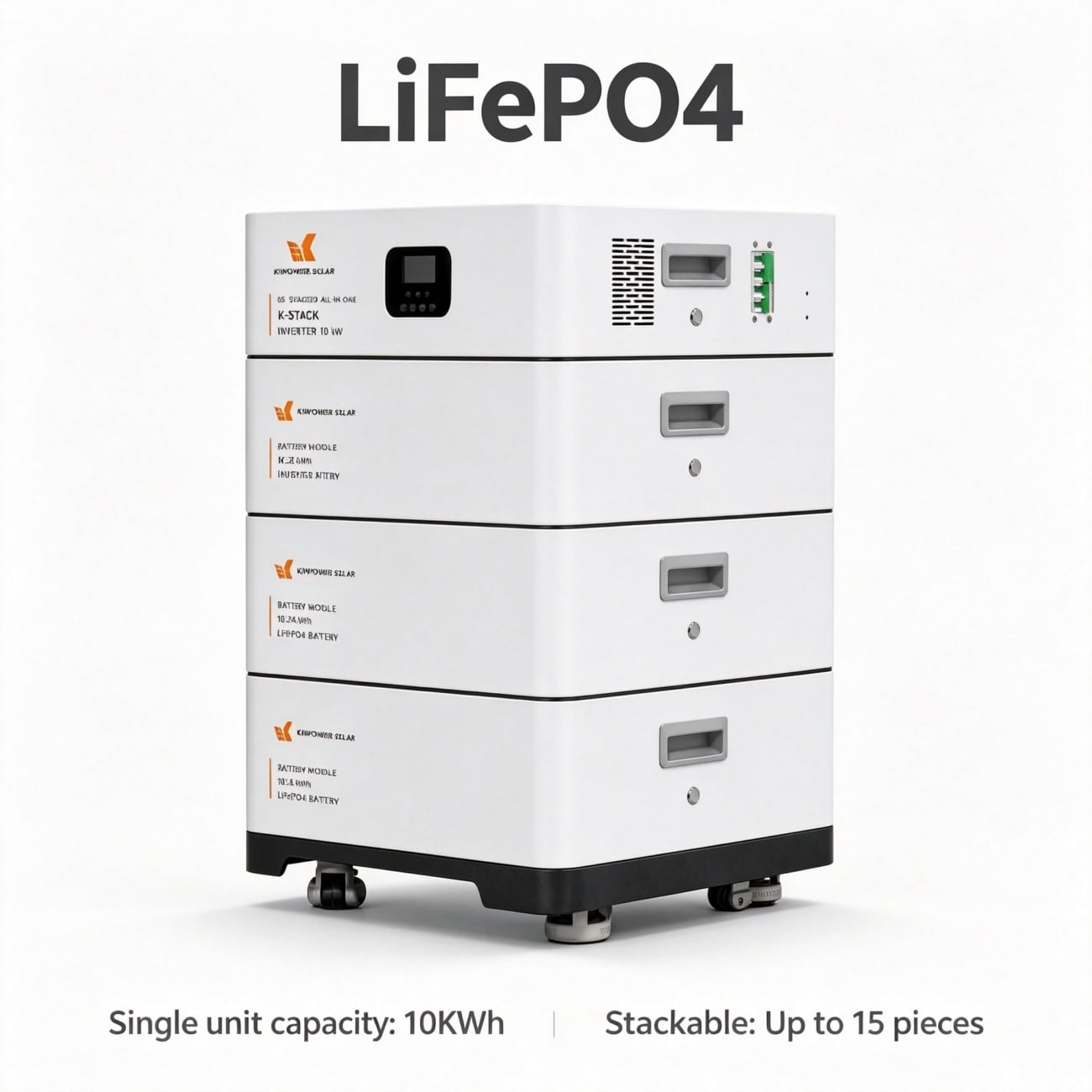
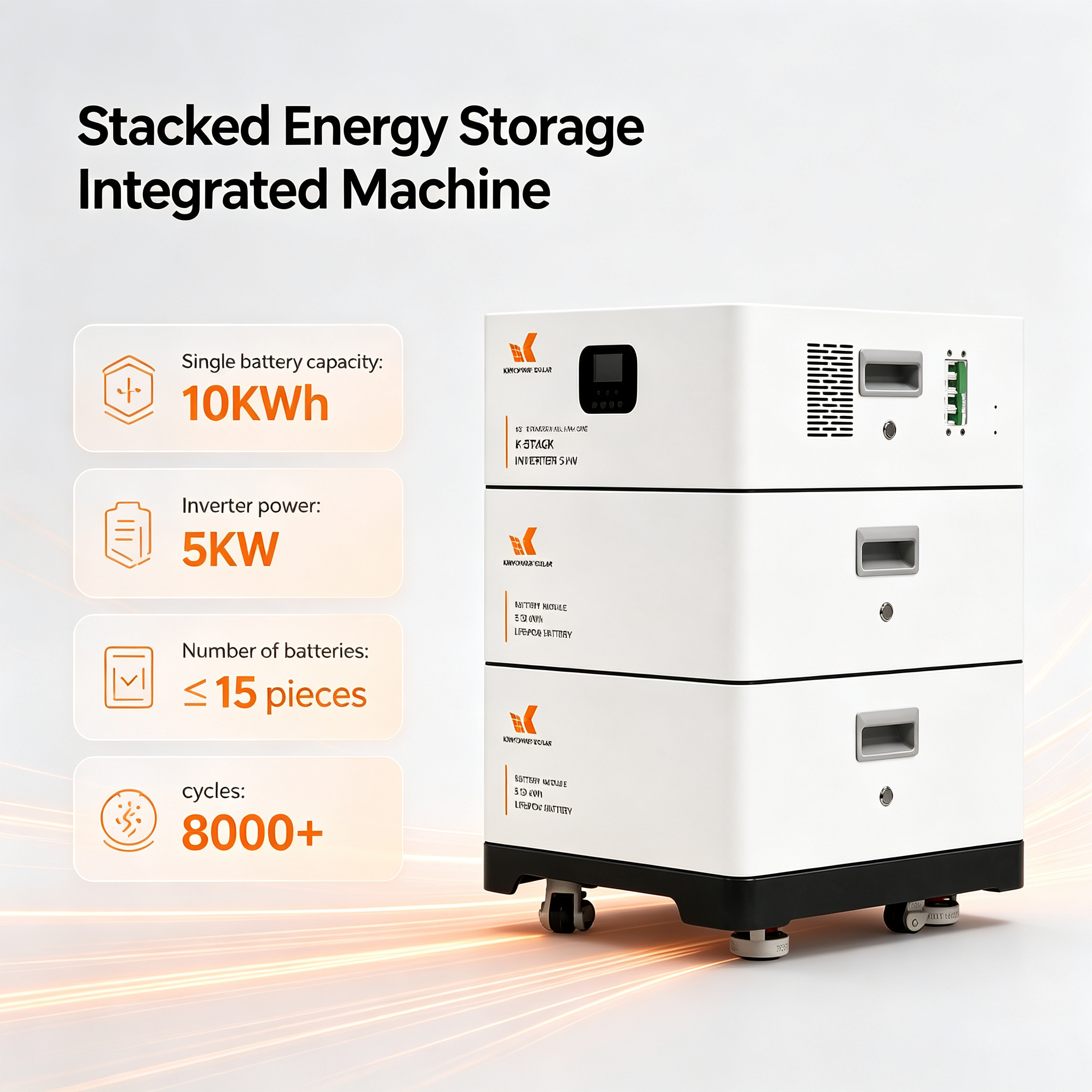
  • On grid solar power system for home with future storage — an AC-coupled design that installs battery-ready inverters so a hybrid upgrade can be added later.

On grid solar system configurations: rooftop array, ground-mounted array, solar carport or BIPV, and a battery-ready design with a hybrid inverter

How to Size an On-Grid PV System

A practical rule of thumb: 1 kW of panels generates roughly 4–5 kWh per day in moderate climates and 5–6 kWh in high-irradiance regions.

Household profile

Typical system size

Approx. roof area

Apartment / small home

3 kW

15–20 m²

Medium home, 400–600 kWh/month

5 kW

25–35 m²

Large home with EV + pool

8–10 kW

40–70 m²

Small commercial rooftop

20–100 kW

100–500 m²

Check your last 12 monthly bills for average daily kWh, then divide by your region's daily yield per kW. Oversizing 10–20% above your daytime consumption is usually cost-effective where export is credited.
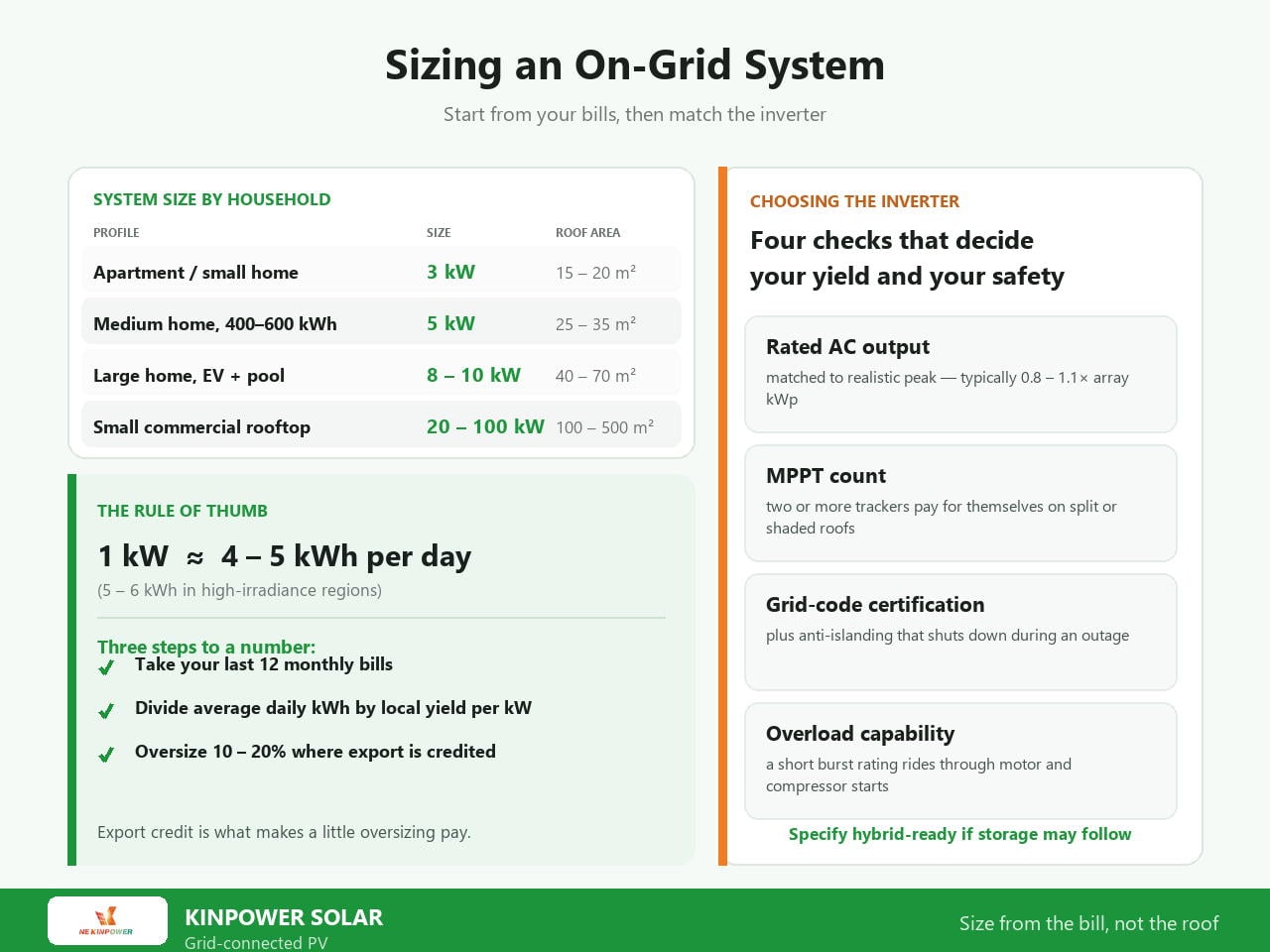
How to size an on grid PV system: 1 kW generates about 4 to 5 kWh per day, system size by household profile from 3 kW to 100 kW, and four inverter selection checks

Installation of On Grid Solar System: 6 Steps

  1. Site assessment — roof orientation, tilt, shading analysis, structural check.
  1. System design — panel layout, string sizing, inverter matching.
  1. Permits & utility approval — interconnection application and net-metering agreement.
  1. Mounting & panel installation — rails, flashing, module fixing (1–2 days for a home).
  1. Electrical work — inverter, protection devices, earthing, meter exchange.
  1. Commissioning & monitoring — grid synchronisation test, app setup, handover.

A professional on grid solar setup for a typical house takes 1–3 working days on site, with approval times varying from days to weeks depending on your utility.

On Grid Solar System Inverter: What to Choose

The on grid solar system inverter is the component that determines both your safety compliance and your yield. Three checks matter most:

  • Rated AC output matched to your array's realistic peak (typically 0.8–1.1× array kWp for residential).
  • MPPT count — two or more trackers pay for themselves on split or partially shaded roofs.
  • Grid-code certification for your country, plus an anti-islanding function that shuts the inverter down during outages.
  • Overload capability — a short burst rating above nominal lets the inverter ride through compressor and motor starts.

For projects that may add storage later, specify a hybrid-ready inverter now: it costs marginally more than a pure grid-tied unit and saves replacing hardware in two years.

Solar System On Grid Price (2026)

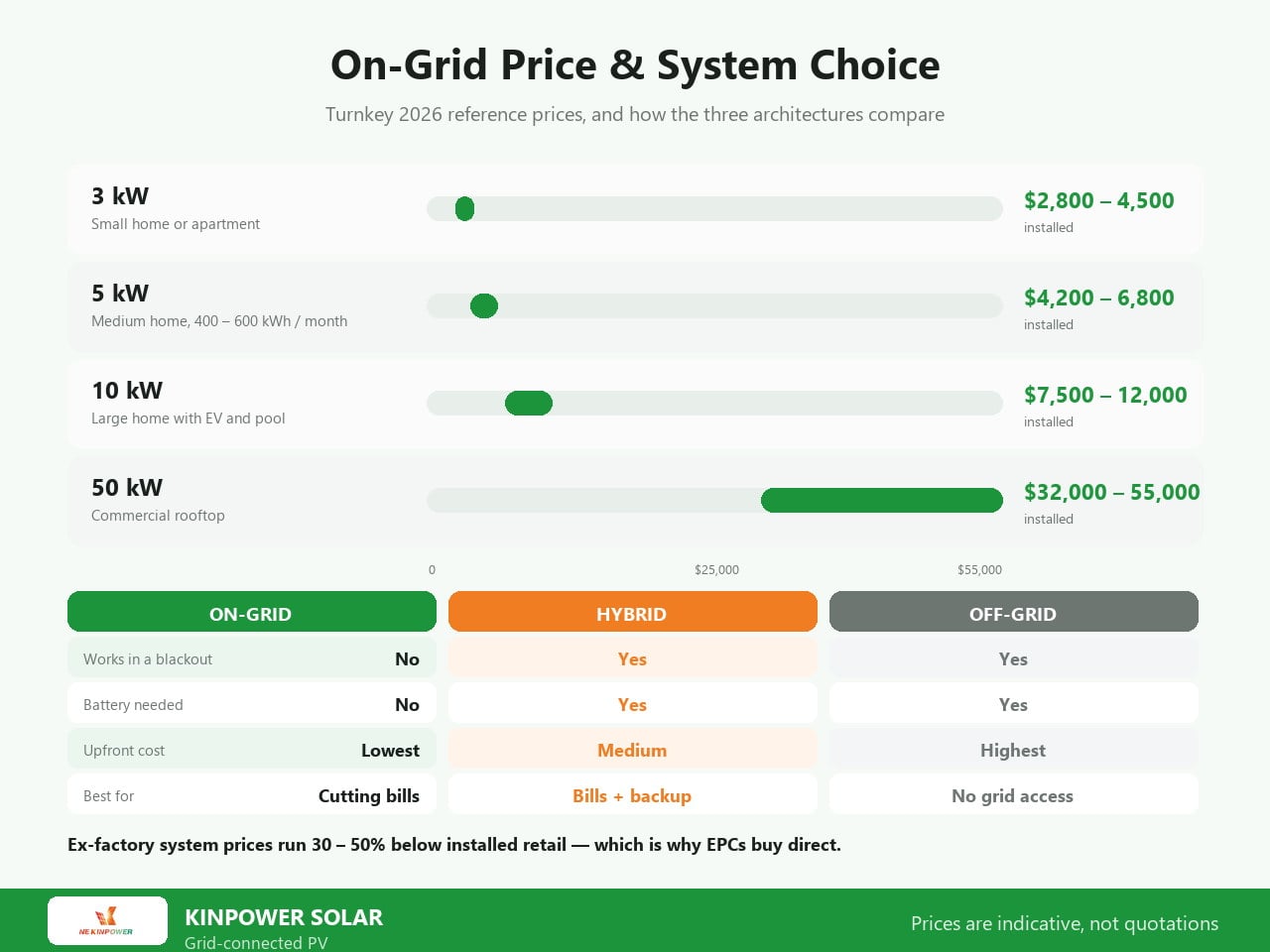
Prices vary by market, but these 2026 reference ranges for a turnkey on grid solar system for home (panels + inverter + mounting + installation) give you a planning baseline:

System size

Typical price range (installed)

3 kW

$2,800 – $4,500

5 kW

$4,200 – $6,800

10 kW

$7,500 – $12,000

50 kW commercial rooftop

$32,000 – $55,000

Solar system on grid price 2026: 3 kW at $2,800-4,500, 5 kW at $4,200-6,800, 10 kW at $7,500-12,000 and 50 kW commercial rooftop at $32,000-55,000 installed

Key price drivers:

  • Module efficiency and tier — premium N-type modules cost 10–20% more but yield more per m².
  • Inverter brand and warranty — 5 vs 10-year warranty difference is worth it.
  • Roof complexity — tile roofs and multi-plane roofs add labour.
  • Local labour and permitting costs.

For buyers sourcing equipment directly from manufacturers, ex-factory system prices are typically 30–50% lower than installed retail prices — this is why many EPCs and distributors buy on grid solar system packages direct from the factory.

Government Support: Subsidies and Net Metering

Most markets still support grid-tied solar in 2026 through net metering, feed-in tariffs, tax credits, or capital subsidies. Programs differ widely:

  • India: state agencies such as ANERT (Kerala) run residential ANERT on grid solar system subsidy programmes — an "up on grid solar system" registered through the national portal can receive a per-kW central subsidy, subject to empanelled vendors.
  • United States: the federal residential clean energy credit, plus state-level incentives.
  • Australia & Europe: feed-in tariffs or export limits set by the local network operator.

Always verify current rules with your installer or utility before purchase — schemes and rates change frequently.

Should You Choose On-Grid, Off-Grid, or Hybrid?

On-grid

Hybrid

Off-grid

Works during blackout

✗

✓

✓

Battery required

✗

✓

✓

Upfront cost

Lowest

Medium

Highest

Best for

Cutting bills

Bill savings + backup

No grid access

  • Choose on-grid if your grid is reliable and your goal is maximum savings per dollar.
  • Choose hybrid if outages are common or you want energy independence — see our hybrid solar system guide.

Buying Checklist: What to Verify Before You Buy

  • ✅ Module warranty (25–30 yr performance) and inverter warranty (≥10 yr preferred)
  • ✅ Inverter efficiency rating (≥97% peak)
  • ✅ Certifications: IEC 61215 / 61730 for modules, grid-code compliance for the inverter
  • ✅ Structural warranty on mounting (≥10 yr, corrosion-rated for coastal sites)
  • ✅ Monitoring access and remote diagnostics
  • ✅ Installer track record and after-sales response time

FAQ

Q: Can I add batteries to my on-grid system later? Yes. Two paths exist: replace the inverter with a hybrid inverter, or add an AC-coupled battery next to your existing inverter. Design your first installation with this in mind.

Q: What happens to my solar power during a blackout? A standard grid PV system stops exporting for safety. With a hybrid inverter and battery, an emergency backup circuit keeps essential loads running.

Q: How long until the system pays for itself? Typically 4–8 years depending on local electricity prices, irradiation and subsidy — after that, the electricity is effectively free for the system's remaining 15+ year life.

Q: Does an on-grid system need maintenance? Minimal: periodic panel cleaning, an annual visual inspection, and firmware/monitoring checks.


Planning a grid-connected project? Kinpower manufactures high-efficiency solar modules, grid-tied and hybrid inverters, and complete on-grid system kits for residential and commercial rooftops. Contact us for factory-direct pricing.

Email Email Tel Tel WhatsApp WhatsApp TopTop