 ×
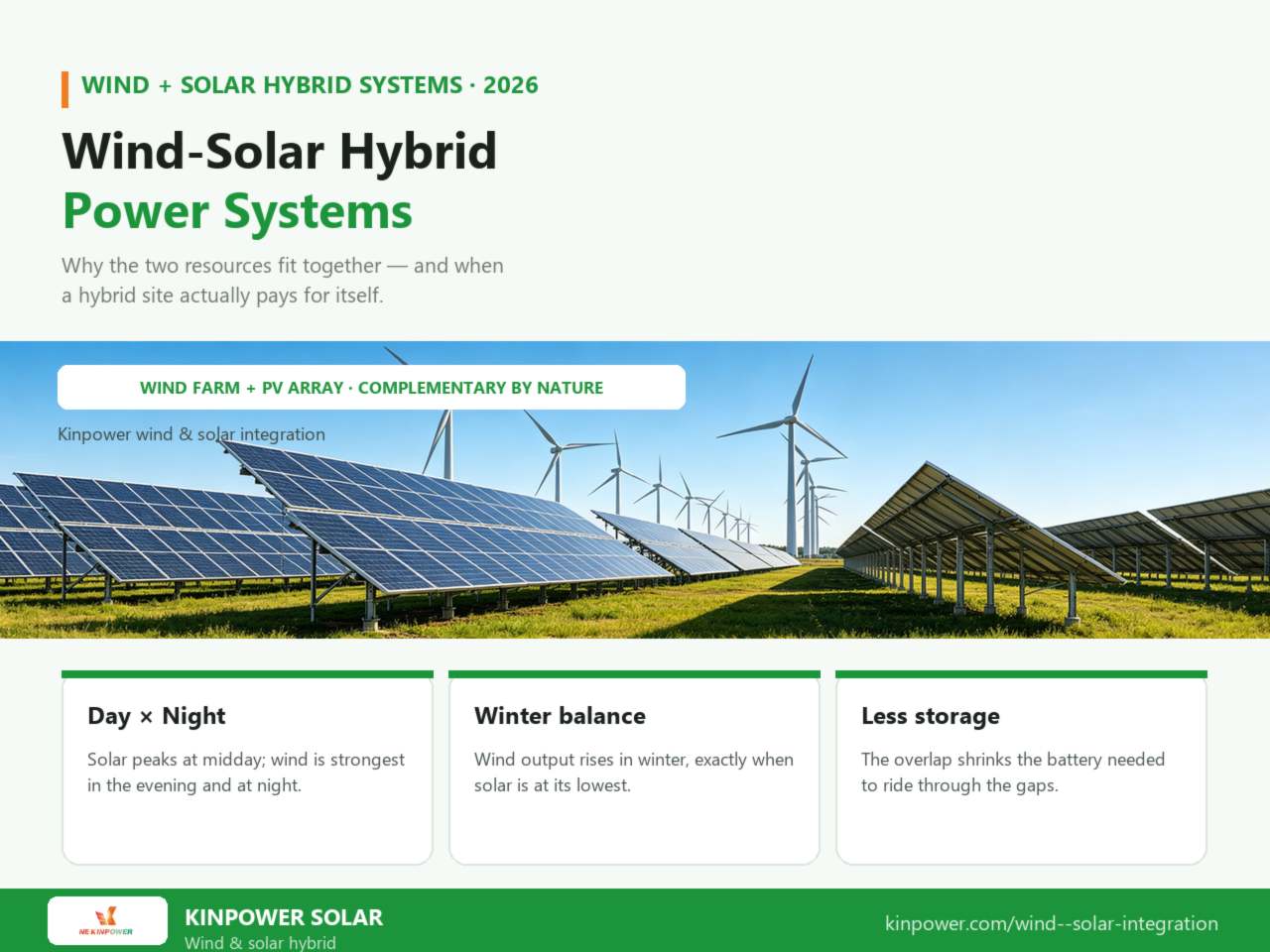
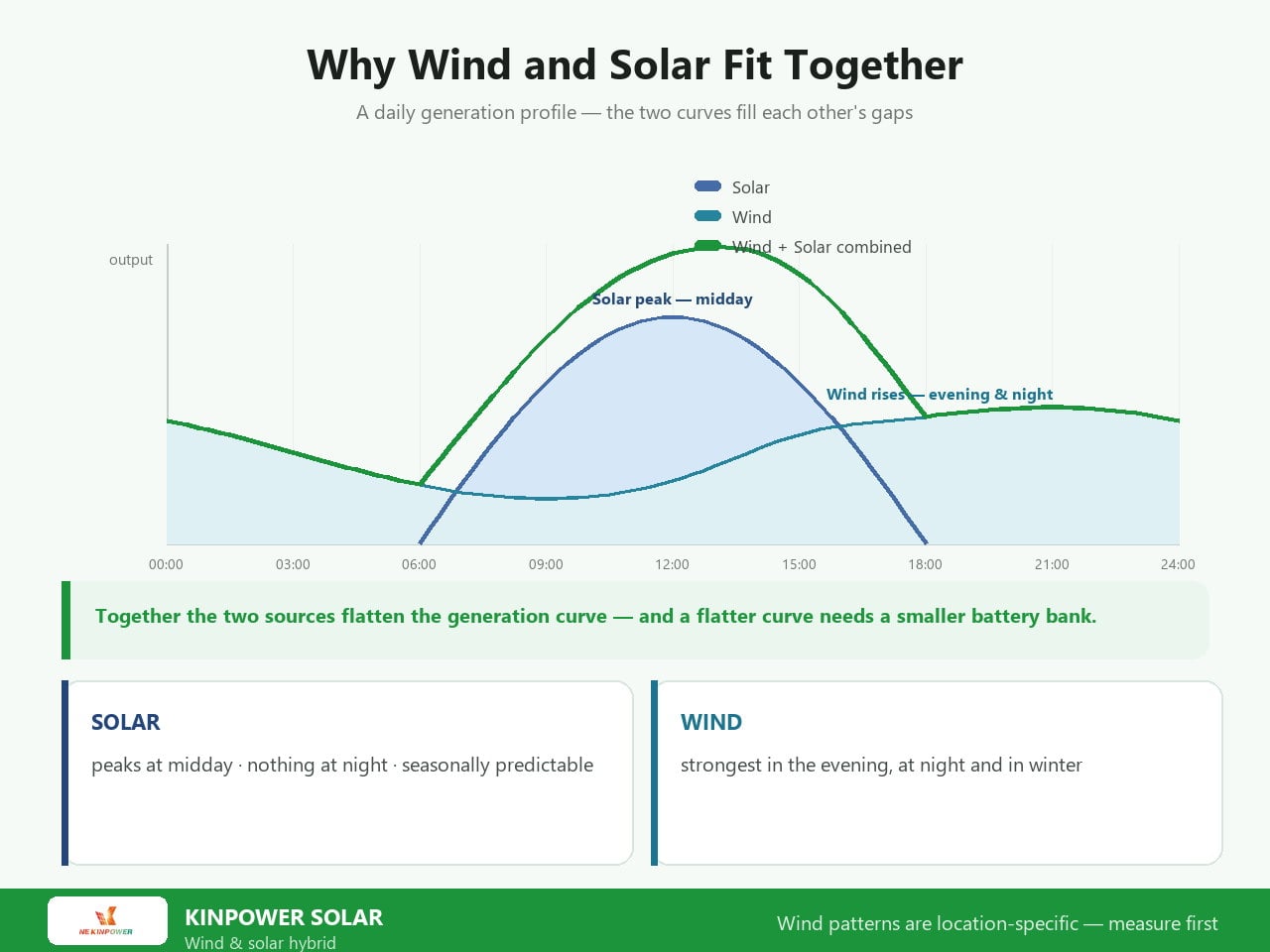
A hybrid wind solar energy system works because the two resources are complementary, not competitive.
In the right location, the two overlap enough to smooth the daily and seasonal generation curve, which shrinks the battery required to ride through the gaps. That reduction in storage is where most of the economic case lives.
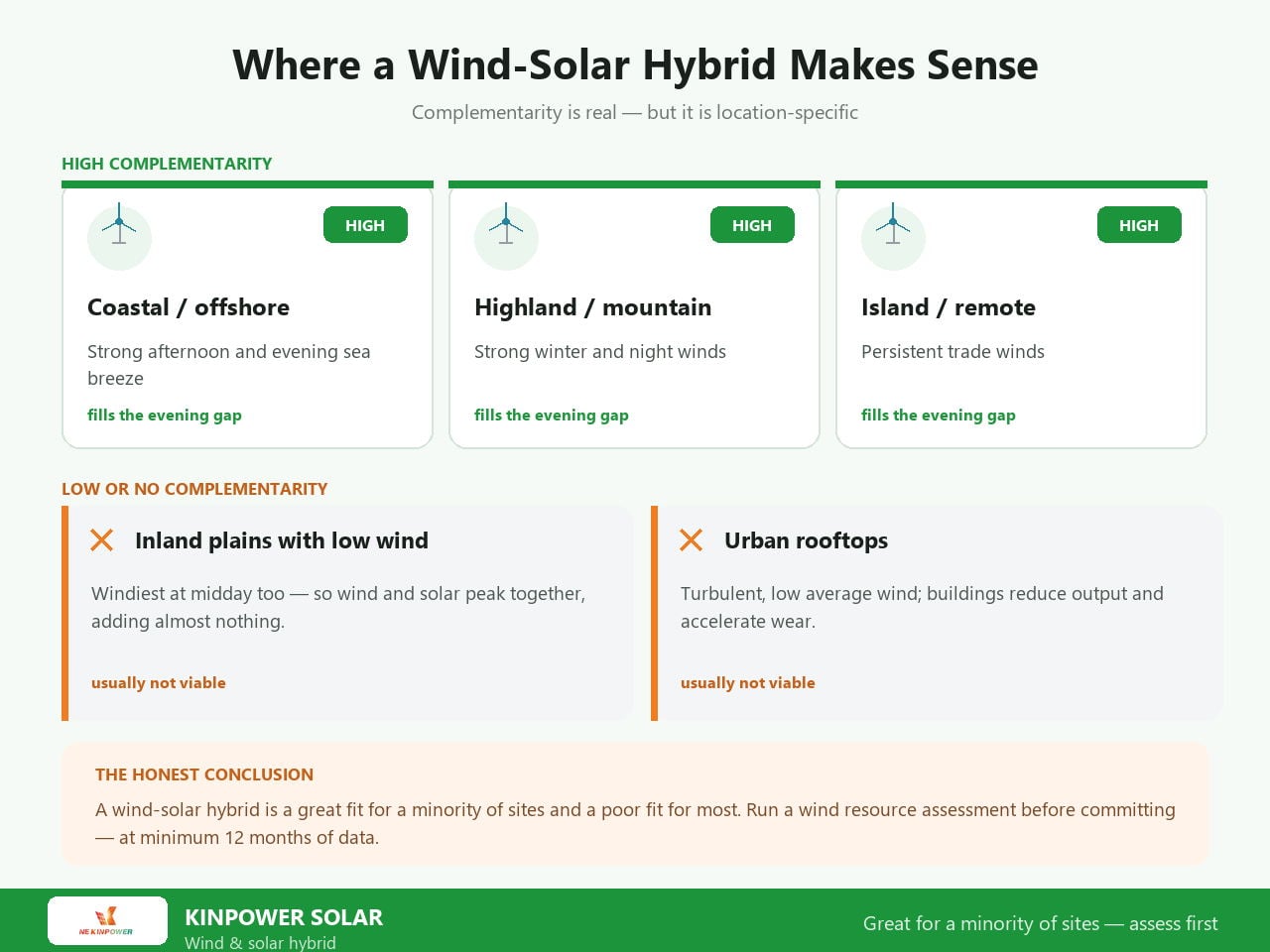
The complementarity effect is not uniform. It depends on local wind patterns:
|
Site type |
Wind behaviour |
Complementarity |
|
Coastal / offshore-influenced |
Strong afternoon and evening sea breeze |
High — fills the evening gap |
|
Highland / mountainous |
Strong winter and night winds |
High — seasonal counterbalance |
|
Island / remote |
Persistent trade winds |
High |
|
Inland plains with low wind |
Windiest at midday too |
Low — little benefit |
|
Urban rooftops |
Turbulent, low average |
Very low — usually not viable |
The honest conclusion: a wind-solar hybrid is a great fit for a minority of sites and a poor fit for most. Run a wind resource assessment before committing — at minimum twelve months of data, and ideally a modelled long-term record. A common failure mode is buying a turbine on the basis of an unusually windy month.
A hybrid solar wind power generation system for sale typically contains:
|
Block |
Function |
|
PV array |
Daytime generation |
|
Wind turbine(s) |
Night and winter generation |
|
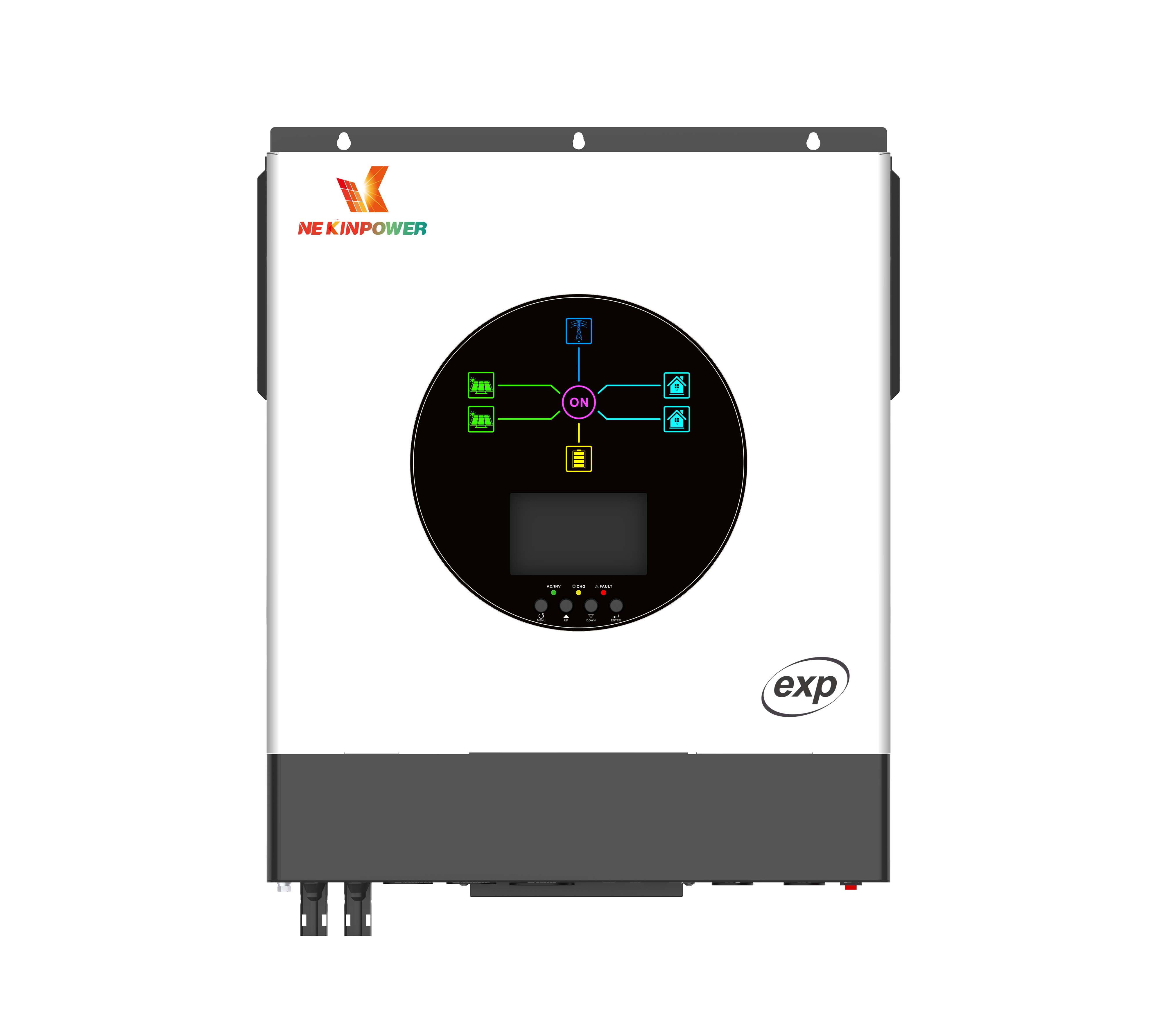
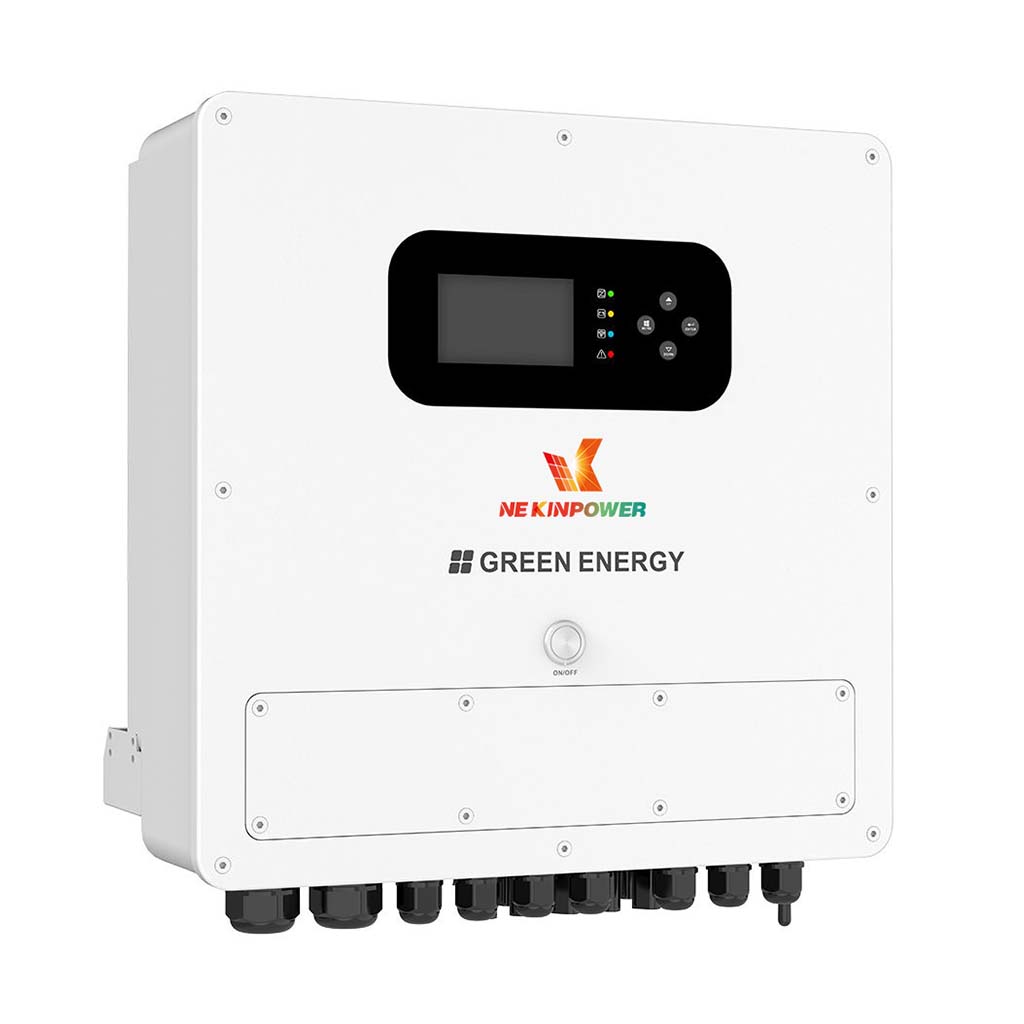
Hybrid charge controller / inverter |
Accepts both DC sources (or rectified turbine AC) and manages the battery |
|
Battery bank |
Buffers both sources; LiFePO4 for cycle life |
|
Dump load or curtailment |
Prevents overcharging when both sources are strong |
|
Monitoring |
Tracks yield per source, essential for diagnosing underperformance |
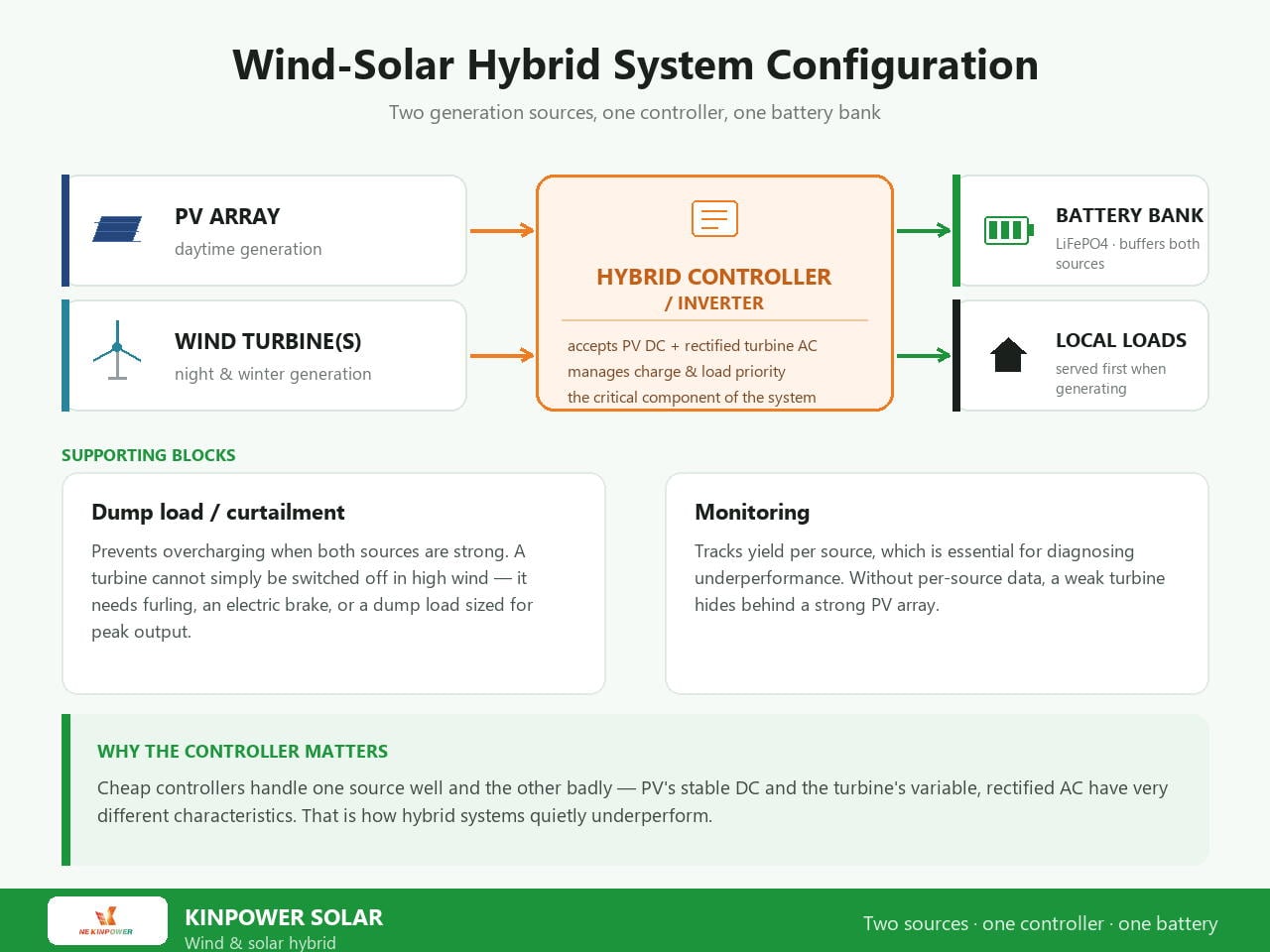
The critical component is the hybrid controller. It must handle two sources with very different output characteristics — PV's relatively stable DC, and the turbine's variable, rectified AC. Cheap controllers handle one well and the other badly, which is how hybrid systems end up underperforming without anyone noticing.
A well-designed system prioritises in this order:
The turbine adds a wrinkle: it cannot simply be switched off in high wind without mechanical protection. Turbines therefore need either a furling mechanism, an electric brake, or a dump load sized for their peak output. This is an engineering necessity, not a nicety — omitting it is the most common cause of turbine failure.
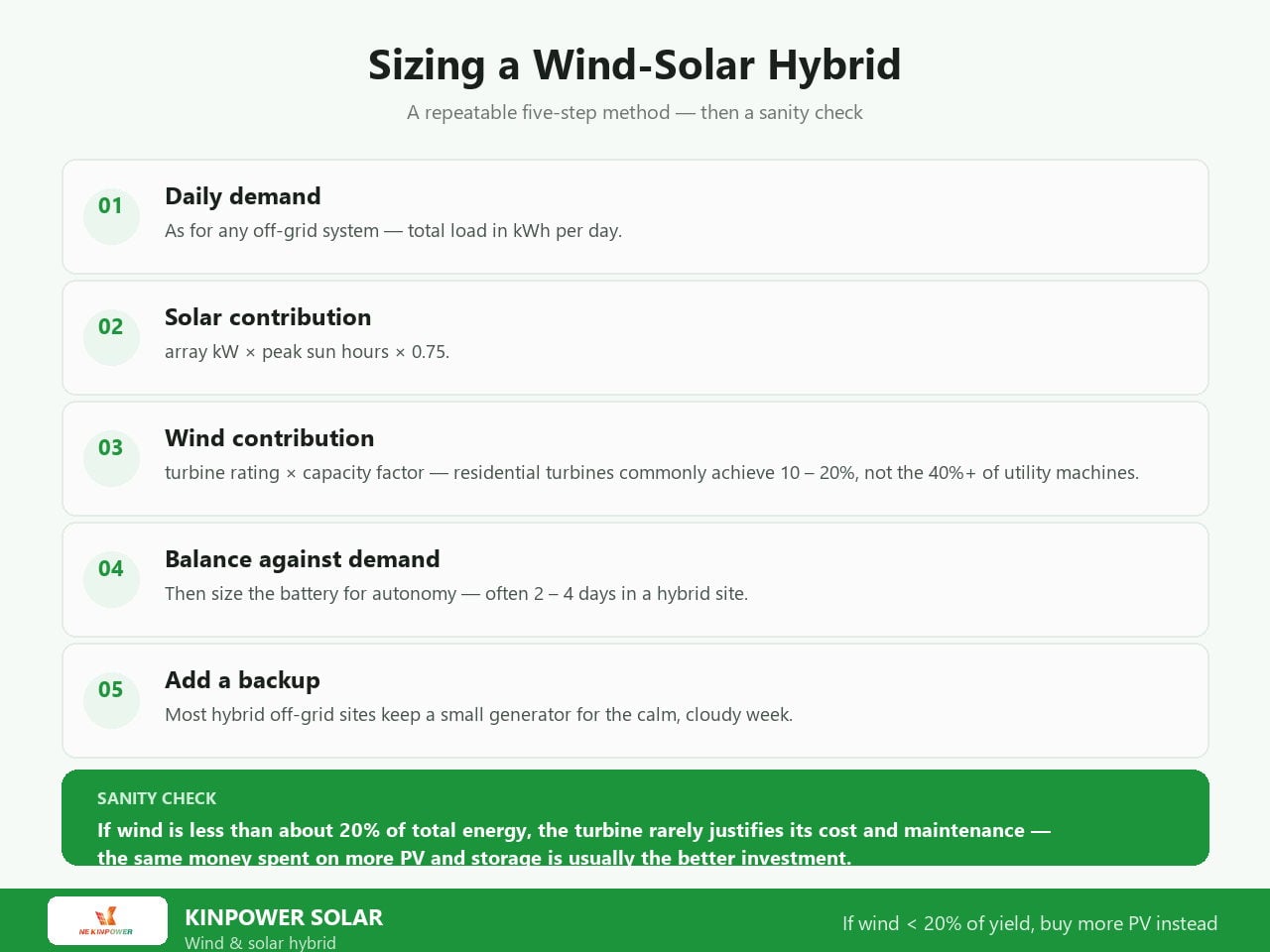
A repeatable method:
A useful sanity check: if the wind contribution is less than about 20% of the total energy, the turbine's cost and maintenance rarely justify inclusion. The same money spent on more PV and storage is usually a better investment.
Where it rarely makes sense: suburban rooftops, sites with a reliable grid connection, and locations without a measured wind resource.
|
Component |
Indicative cost |
|
PV array + mounting |
$800 – $1,300 / kW |
|
Small wind turbine (3 – 10 kW) + tower |
$12,000 – $35,000 |
|
Hybrid controller / inverter |
$2,500 – $8,000 |
|
LiFePO4 battery bank |
$250 – $450 / kWh installed |
|
Installation, foundations, wiring |
20 – 35% of hardware |
|
Annual maintenance |
2 – 4% of hardware (turbines dominate) |
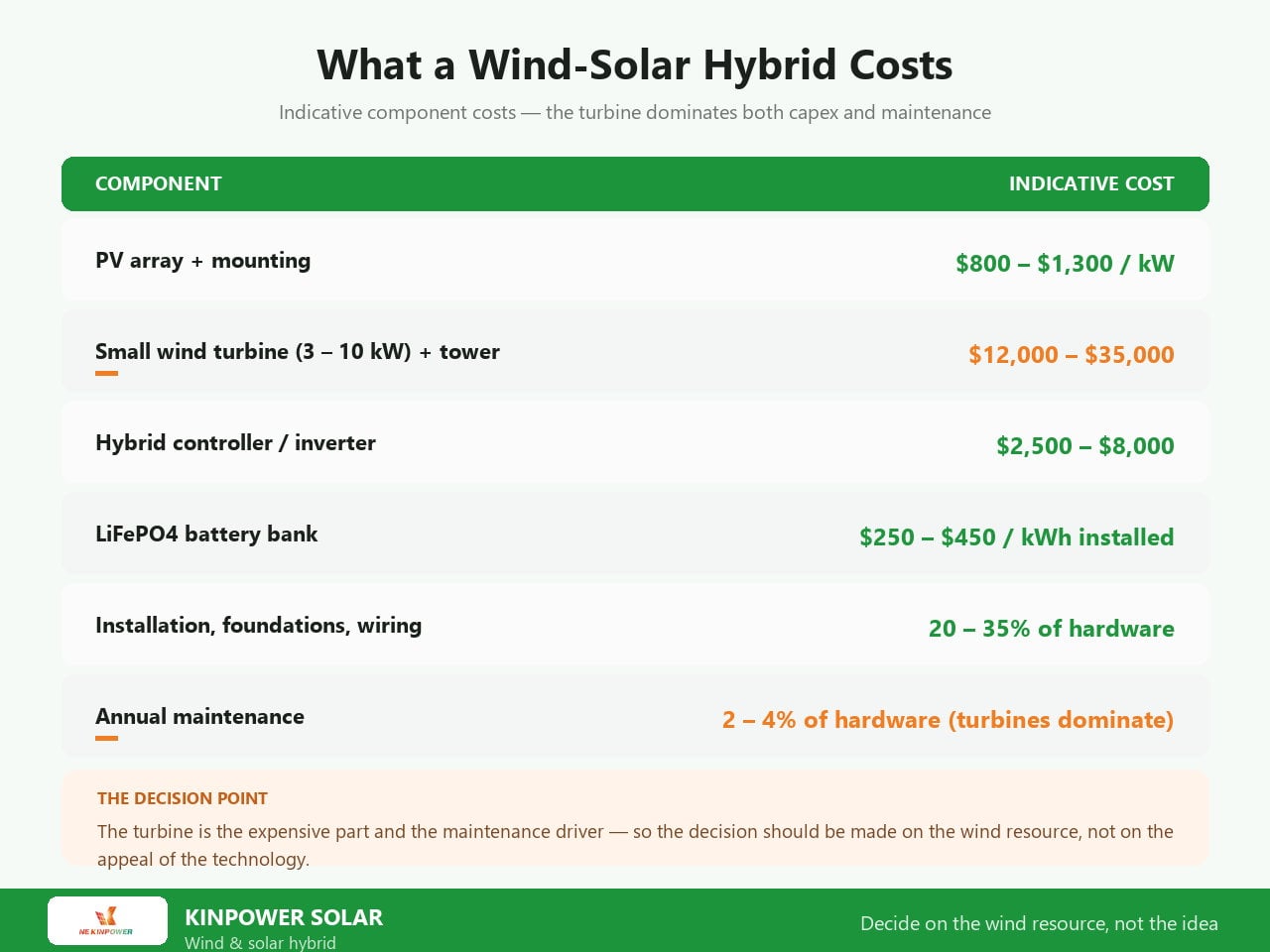
The turbine is the expensive part and the maintenance driver. That is why the decision should be made on the wind resource, not on the appeal of the technology.
The battery in a hybrid system does more work than in a pure PV system, and sizing it deserves care.
Start with the longest expected deficit. In a hybrid site, the battery must cover the gap between generation and load during the worst combination of low wind and low sun. That is often a period of two to four days, not one night — which is why hybrid off-grid batteries are proportionally larger than solar-only ones.
Then account for the turbine's variability. A turbine's output swings minute to minute. A battery that is too small will see frequent shallow cycling, which is less damaging than deep cycling but still shortens life. A rule of thumb is to provide at least four hours of average load as a buffer.
Then decide on a generator. Most hybrid sites keep a small backup generator. If one is present, the battery can be sized for two days rather than four, because the generator covers the tail. Without one, the battery must cover the worst case alone.
Finally, confirm the battery's charge acceptance. LiFePO4 banks accept charge quickly, which suits a turbine's variable output far better than lead-acid, whose acceptance tapers sharply above 80% state of charge. For a hybrid site, that difference alone can justify the LFP premium.
Q: Is a wind-solar hybrid better than solar plus more batteries? Only where the wind resource is genuinely strong and complements solar. Otherwise, extra PV and storage is usually cheaper and far lower maintenance.
Q: How much wind do I need? A site should show a minimum average wind speed of roughly 5 m/s at hub height, with a measured record behind the estimate. Below that, the turbine will rarely pay back.
Q: Can I add wind to an existing solar system? Often yes, if the inverter or controller accepts a second input. Many hybrid inverters do; otherwise a separate turbine controller and dump load are added.
Q: How much maintenance does a small turbine need? At least one inspection per year, with bearing and blade checks. Turbines need more attention than any other part of the system.
Q: Do turbines work in urban areas? Poorly. Buildings create turbulence that reduces output and accelerates wear. Urban wind is generally not a viable resource.
Evaluating a hybrid site? Kinpower supplies wind-and-solar integrated systems — PV arrays, hybrid inverters, wind interfaces and LiFePO4 storage — engineered as a single managed system with unified monitoring. See wind & solar integration or explore energy solutions.
 Hot News
2026-10-21
2026-10-19
2026-10-16
2026-10-14
2026-10-12
2026-10-10
 EN