
 EN
EN



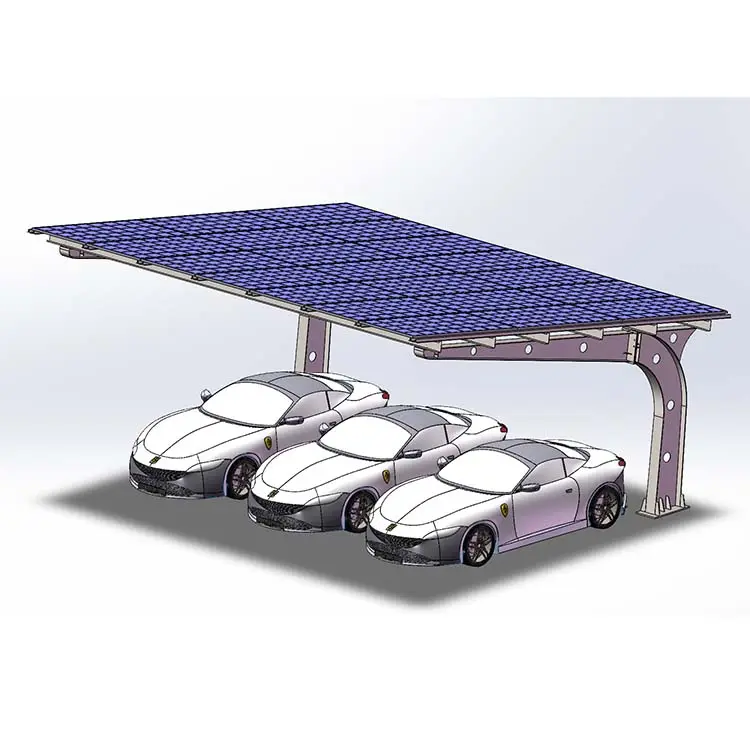
As electricity costs rise and commercial parking areas sit idle between vehicles, solar carports have become a practical infrastructure choice for industrial facilities, logistics parks, shopping centers, and public institutions. Unlike rooftop photovoltaic systems, a solar carport transforms underutilized ground-level parking space into a dual-purpose energy and shelter asset. This article explains what a solar carport is, how it works, what structural types exist, and how buyers can evaluate carport solutions for their specific site requirements.
Definition and Core Function
A solar carport is a canopy structure installed over parking bays, with photovoltaic panels mounted on the roof to generate electricity while providing shade and weather protection for parked vehicles. The panels face upward to capture solar irradiation, and the generated DC power is converted by a solar inverter into AC power for on-site use, EV charging, or export to the grid. Unlike ground-mounted solar arrays, a solar carport is designed to serve two functions simultaneously: power generation and vehicle shelter. This dual utility makes it particularly valuable in environments where rooftop area is limited or structurally insufficient for heavy panel loads.
Structural Types and Configuration Options
Solar carport structures vary widely in column arrangement, slope design, and material. Common configurations include single-column single-slope single-row, single-column double-slope double-row, H-shaped steel single-column single-row, and double-column front-and-rear frame designs. Each configuration suits different bay widths, wind and snow load requirements, and aesthetic preferences. For sites in regions with high snowfall, adjustable-angle structures offer a mechanical advantage: panels can be tilted to a steeper angle to shed snow loads in winter, or flattened in high-wind conditions to reduce structural stress. The solar parking shed that can automatically adjust its angle uses hydraulic push rods produced in collaboration with a qualified Chinese manufacturer, giving it a lower failure rate compared to simple fixed-frame alternatives. For buyers prioritizing cost efficiency without sacrificing structural integrity, minimalist low-cost photovoltaic carport frames are also available as a scaled-down entry option.
Key Advantages for Commercial and Industrial Buyers
The business case for a solar carport rests on six measurable benefits. First, it integrates solar generation with EV charging infrastructure, making parking areas a revenue-generating or cost-reducing asset. Second, it maximizes land efficiency by stacking energy production on top of existing parking space, avoiding the need for additional land acquisition. Third, it scales from small residential driveways to large logistics parks, allowing buyers to phase investment according to budget. Fourth, optional energy storage integration allows surplus daytime generation to be dispatched at night or during grid outages, improving self-sufficiency. Fifth, reduced electricity costs lower operating expenditure for facilities with high daytime power consumption. Sixth, the canopy provides protection from UV exposure, rain, and hail, reducing vehicle maintenance costs for fleet operators.
Application Case: 1.5 MW Solar Carport at a Brazil Shopping Mall
A practical illustration of commercial-scale solar carport deployment is a 1.5 MW project completed at a major shopping mall in Brazil. The project transformed the mall's surrounding parking area into a distributed solar generation site with two objectives: provide shaded parking for customers and offset the facility's rising electricity costs. The Kinpower carport system was engineered to cover a high-traffic area and deliver clean energy to the building's grid connection point. This case demonstrates how a parking lot, often treated as a cost center, can be converted into an energy-producing infrastructure asset without displacing any existing parking capacity. The Brazil project also shows the scalability of modular carport design, where individual bays can be progressively added to match expanding energy demand.
Additional Deployment Contexts
Beyond shopping centers, solar carports have been deployed across a range of environments, each with distinct requirements. In coastal tourist areas such as Maldives, one completed project used a hot-dip galvanized and PVC-coated structure to withstand salt spray and high humidity, with monocrystalline 550W panels generating approximately 15 million kWh annually to cover over 70% of the sightseeing fleet's charging needs. This result — reducing diesel consumption by roughly 50 tons per year — illustrates the measurable environmental return achievable from a well-specified system. For industrial and commercial buyers, the applicable environments include factory parks, office campuses, logistics hubs, highway service areas, bus depots, hotels, schools, hospitals, and municipal parking facilities. For each context, structural specifications — including column spacing, panel inclination, anti-corrosion treatment, and local wind/snow load compliance — must be reviewed against regional building codes.
How to Evaluate a Solar Carport Supplier
When sourcing a solar carport system, buyers should assess the following: whether the supplier provides certified structural design drawings with load calculations; whether the steel components use hot-dip galvanization or equivalent corrosion protection; whether panel specifications are traceable (e.g., 550W monocrystalline with stated efficiency ratings); and whether after-sales support, including installation documentation, technical guidance, and spare parts availability, is included. Buyers should also verify that the structural design accounts for local wind speeds and snow accumulation, as underspecified frames may fail under seasonal extremes. Requesting a project reference in a climate similar to the installation site — coastal, alpine, or inland arid — is a reliable qualification step. Kinpower, as the engineering brand of Hebei Jinbiao Construction Materials Tech Corp., Ltd., has documented carport deployments in Brazil, the Maldives, and Curaçao, which buyers may reference as operational proof points.
Frequently Asked Questions
Q: What is the difference between a solar carport and a rooftop solar system?
A: A solar carport is a ground-level, freestanding canopy structure installed over parking bays, whereas a rooftop solar system is mounted directly on an existing building roof. Carports require their own structural foundation and framing, and they provide vehicle shading as an additional benefit. Rooftop systems share the building's existing structure but may be limited by roof load capacity and orientation. Carports are preferred in sites where rooftop space is unavailable or insufficient.
Q: Can a solar carport include EV charging stations?
A: Yes. One of the primary advantages of solar carport systems is the integration of EV charging infrastructure. The carport generates power during daylight hours, which can be routed directly to EV chargers installed at each bay. Optional on-site energy storage allows charging to continue after sundown or during grid interruptions.
Q: How are solar carport structures protected against corrosion in coastal environments?
A: For coastal installations, structural components should be specified with hot-dip galvanization combined with PVC or epoxy coating to resist salt spray and high humidity. The Maldives project referenced in this article used this specification to ensure structural durability in a marine climate. Buyers in coastal zones should request corrosion protection test documentation and confirm the coating thickness against relevant international standards.