 ×
×
Home solar battery storage turns a daytime-only solar array into a 24-hour power plant. Instead of exporting surplus electricity for a low feed-in credit and buying it back at retail rates in the evening, you store it and use it yourself.
Three forces have made residential storage mainstream:
For homeowners, the result is a system that cuts bills, protects against blackouts, and reduces carbon footprint with a single investment.
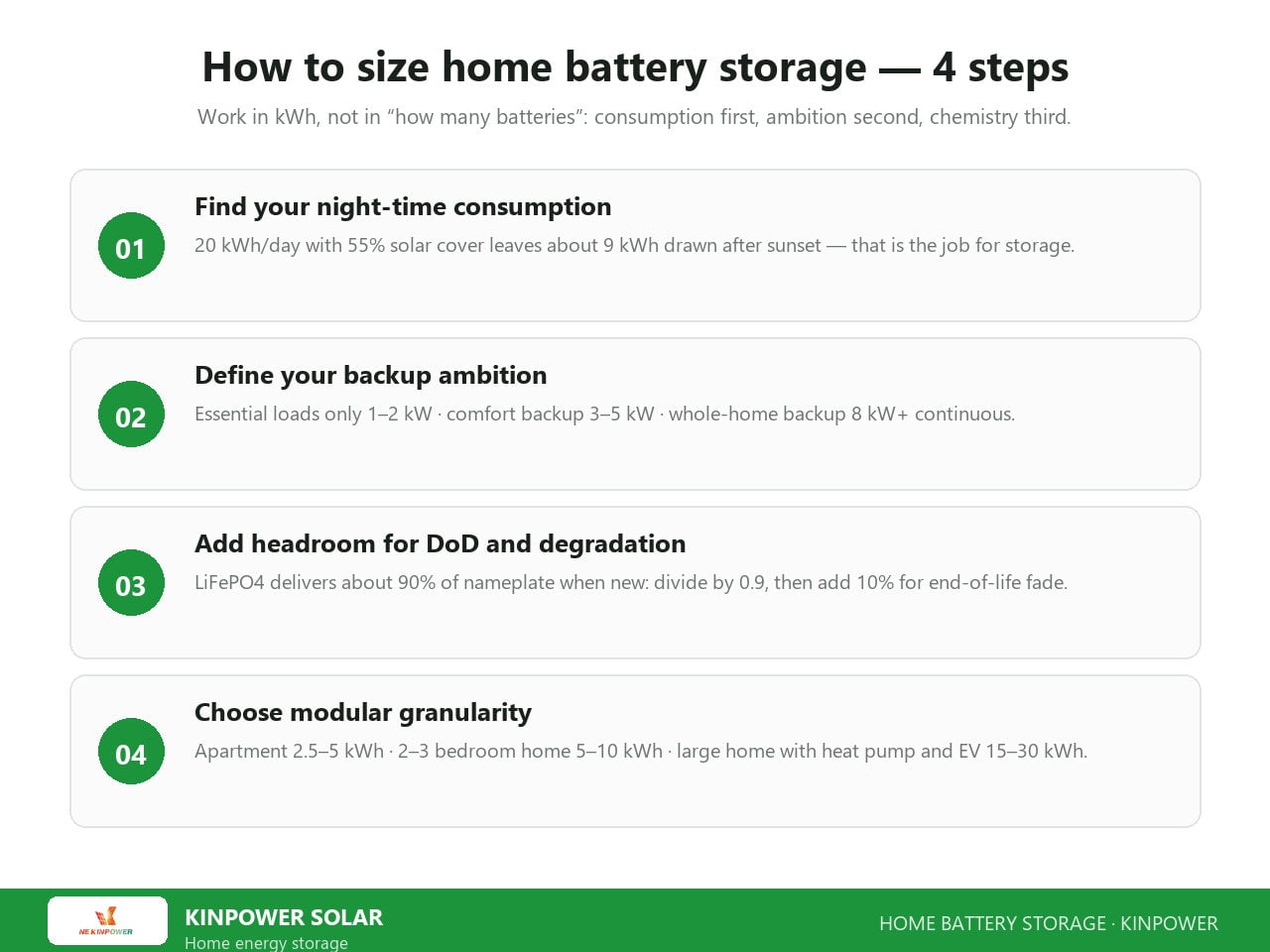
Step 1 — Find your nighttime consumption Take your daily kWh total from utility bills and estimate what share solar covers during daylight. Anything drawn after sunset is what storage addresses.
Example: 20 kWh/day, 55% solar-covered → 9 kWh drawn at night.
Step 2 — Define your backup ambition
Multiply continuous load by the outage hours you want to cover.
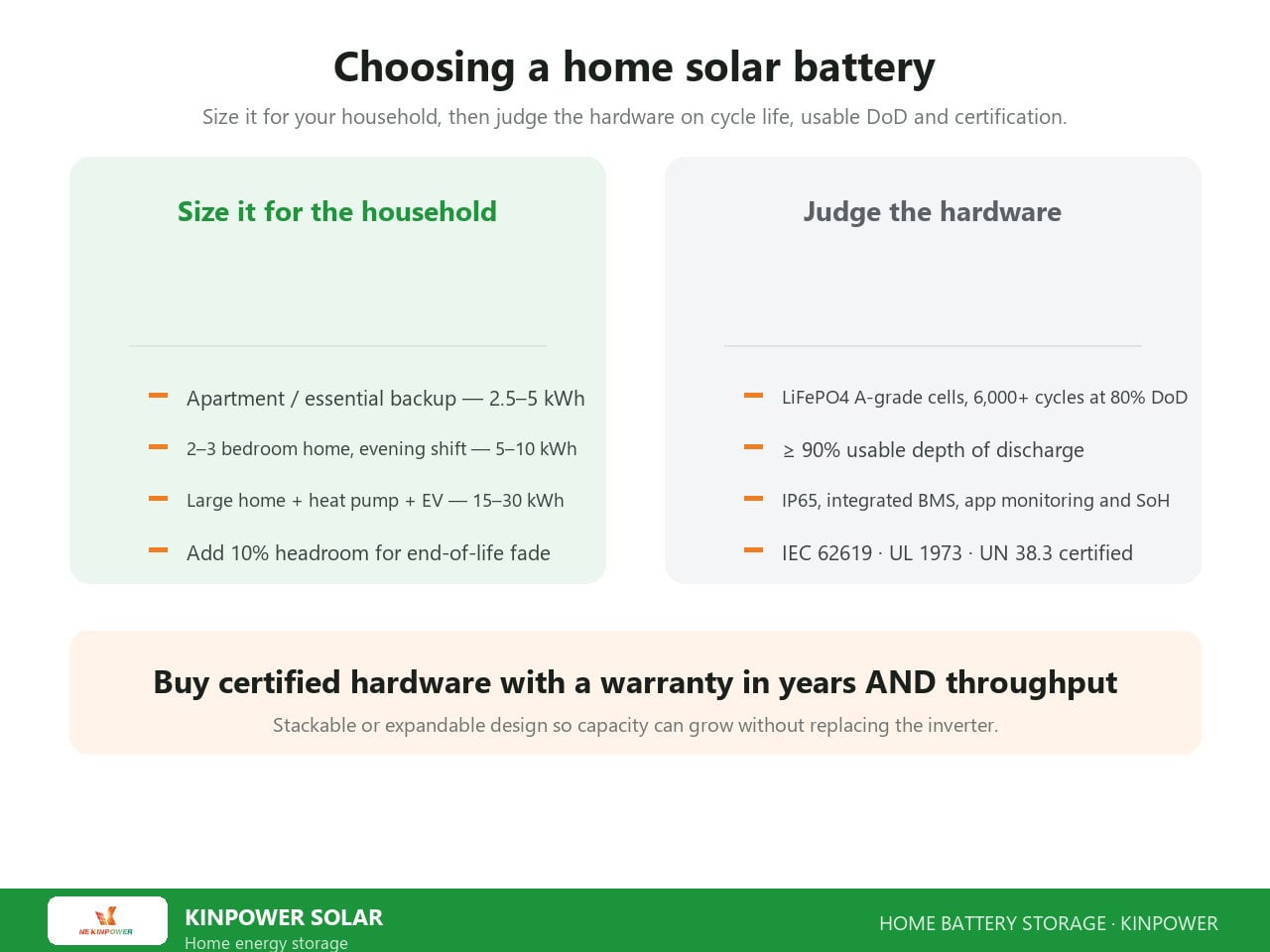
Step 3 — Add headroom for depth of discharge and degradation A LiFePO4 battery delivers ~90% of its nameplate capacity when new. Divide your requirement by 0.9, then add 10% for end-of-life capacity fade.
Step 4 — Choose modular granularity
|
Household |
Recommended storage |
Typical battery |
|
Apartment, essential backup |
2.5–5 kWh |
1 wall-mounted unit |
|
2–3 bedroom home, evening shift |
5–10 kWh |
1–2 stackable modules |
|
Large home, heat pump + EV |
15–30 kWh |
3–6 stackable modules or floor-standing cabinet |
|
Wall-mounted |
Stackable modules |
Floor-standing all-in-one |
|
|
Capacity range |
2.5–10 kWh |
5–30 kWh+ |
5–32 kWh |
|
Footprint |
Zero floor space |
Small tower |
Needs floor area |
|
Expansion |
Fixed |
Add modules later |
Fixed to cabinet |
|
Install complexity |
Medium (wall fixing) |
Low |
Low |
|
Best for |
Apartments, garages, tight spaces |
Growing families, scalability |
New builds, tech rooms, mobile use |
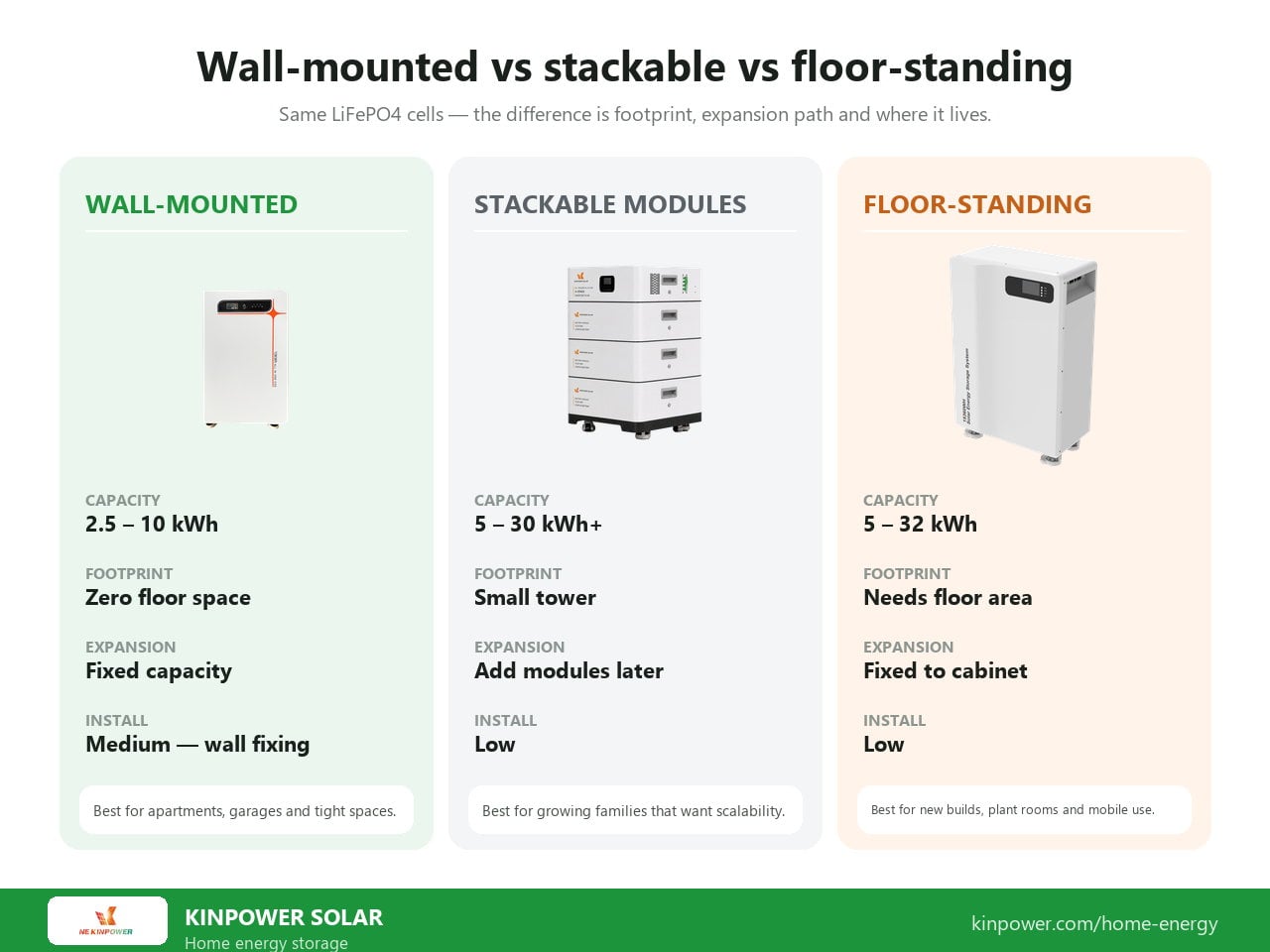
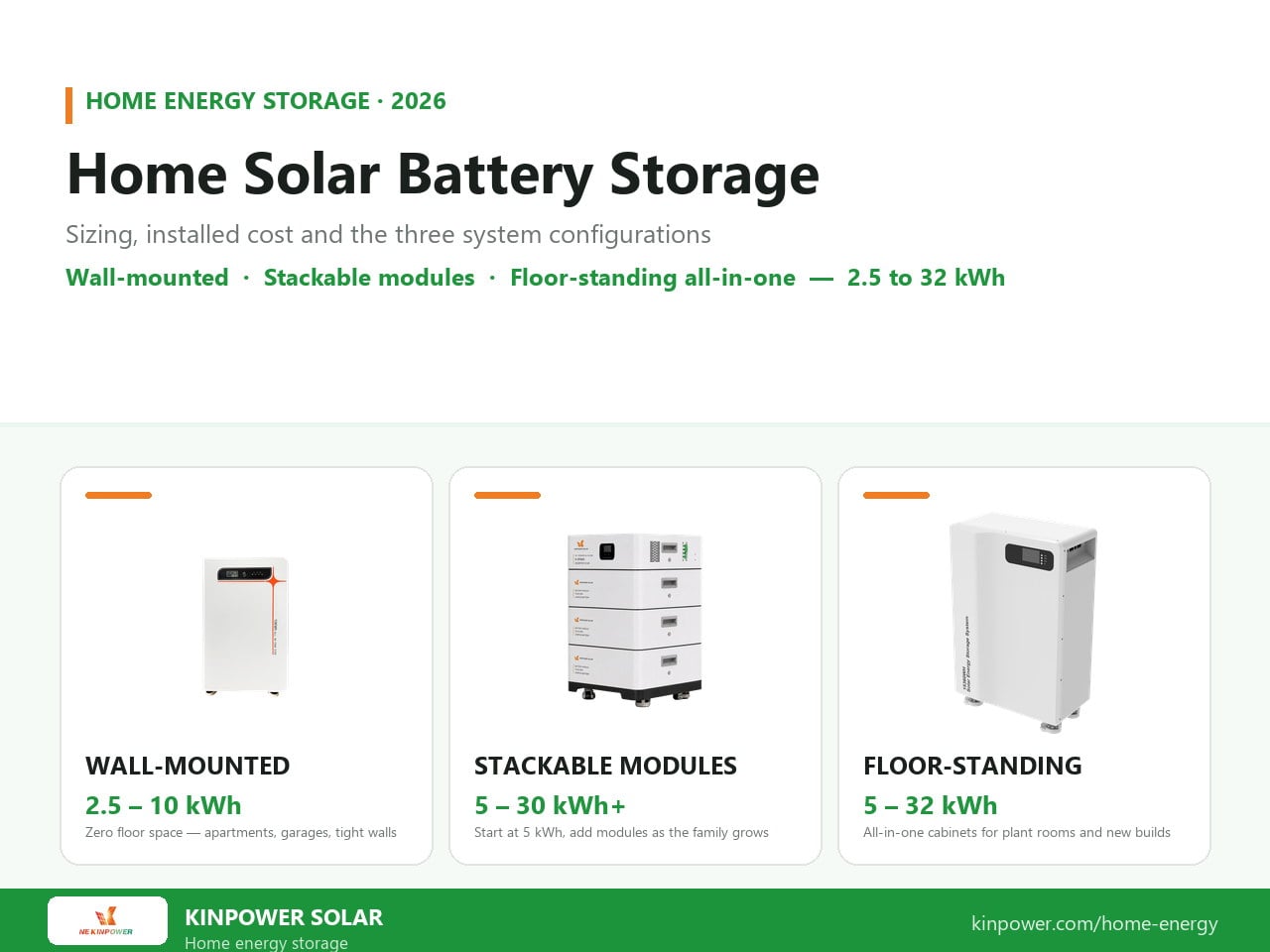
Wall-mounted units are the neatest solution where floor space is scarce — our 2.56–10.07 kWh LiFePO4 wall battery is designed for exactly this. Stackable systems win when you want to start at 5 kWh and expand to 25 kWh without replacing anything. Floor-standing all-in-one cabinets suit new-build plant rooms and applications that need wheeled mobility.
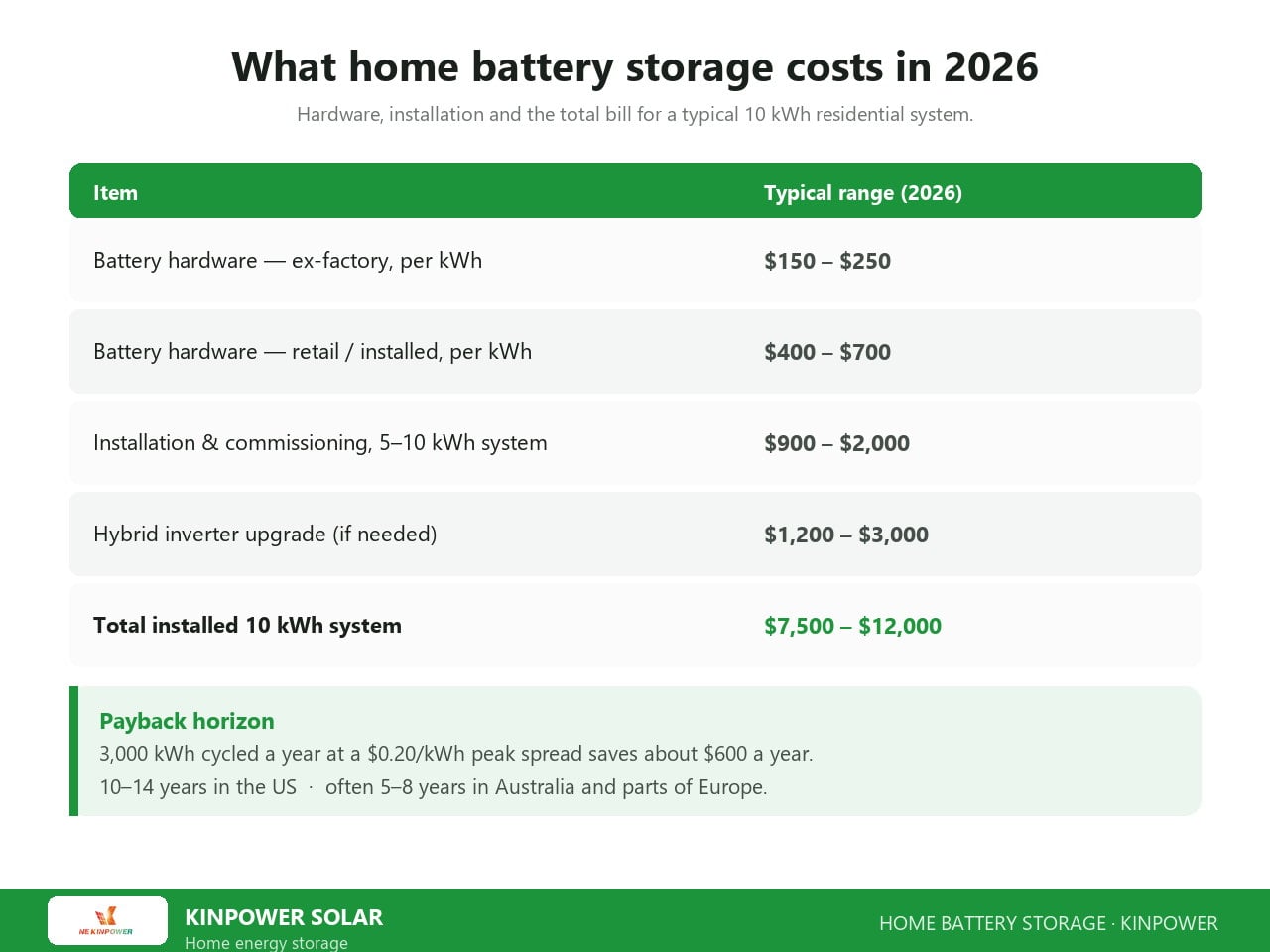
|
Item |
Typical range |
|
Battery hardware (ex-factory, per kWh) |
$150 – $250 |
|
Battery hardware (retail/installed, per kWh) |
$400 – $700 |
|
Installation & commissioning (5–10 kWh system) |
$900 – $2,000 |
|
Hybrid inverter upgrade (if needed) |
$1,200 – $3,000 |
|
Total installed 10 kWh system |
$7,500 – $12,000 |
Payback depends on your tariff structure. With a peak/off-peak spread of $0.20/kWh and 3,000 kWh cycled per year, a 10 kWh system saves roughly $600/year in bill arbitrage alone — before counting outage value and export credits. That's a 10–14 year horizon in the US, but often 5–8 years in markets with high peak rates such as Australia and parts of Europe.
Search results and installer quotes use many overlapping phrases for the same hardware. Use this decoder:
|
Term |
What it refers to |
|
Home solar battery storage / home battery solar storage |
The general concept — a battery bank charged by solar and used for self-consumption and backup |
|
Home batteries for solar storage |
The physical units installed in your home |
|
Home solar system battery storage |
The storage portion of a complete home solar installation |
|
Home PV battery storage / residential photovoltaic energy storage system |
Technical phrasing for PV-coupled residential storage |
|
Solar power storage for home / solar power storage home |
Same idea, expressed as the service being delivered |
|
Solar power home battery storage / solar power home battery backup |
Emphasises whole-home or backup capability; check continuous output, not just capacity |
|
Solar battery storage for house |
Common consumer phrasing for a 5–15 kWh home unit |
|
Solar energy batteries for homes / solar batteries for home solar systems |
Plural — indicates a multi-module bank |
|
Storage batteries for home solar power |
Legacy phrasing inherited from lead-acid days; today's equivalent is LiFePO4 |
|
Domestic solar storage batteries / domestic batteries for solar power |
UK/AU market wording for the same product |
|
Solar power domestic battery storage |
Variant of the above, often used in policy and rebate documentation |
|
Best storage batteries for solar power |
Comparative — judge on cycle life, DoD, warranty throughput and inverter compatibility |
|
Most efficient solar battery storage |
Refers to round-trip efficiency; LiFePO4 delivers 92–96%, versus 75–85% for lead-acid |
Three configurations cover almost every home: a single wall-mounted unit (2.5–10 kWh), a stackable tower (expandable 5–30 kWh), and a floor-standing all-in-one (5–32 kWh with integrated inverter).
Q: How long does a home battery last? A quality LiFePO4 system lasts 10–15 years. Plan for one battery replacement over a 25-year solar array lifetime.
Q: Can I install home battery storage without solar panels first? Yes — a battery with a hybrid inverter can charge from cheap off-peak grid power and provide backup, then accept solar later.
Q: Do I need a battery to have solar? No. But without storage, most of your solar value comes from export credits, which are increasingly being reduced.
Q: Will one battery power my whole house during an outage? Only if sized and wired for it. Most homes use an essential-loads panel; whole-home backup needs 15 kWh+ with a higher continuous output rating.
 Hot News
2026-10-08
2026-10-06
2026-09-30
2026-09-28
2026-09-23
2026-09-22
 EN
EN