 ×
×
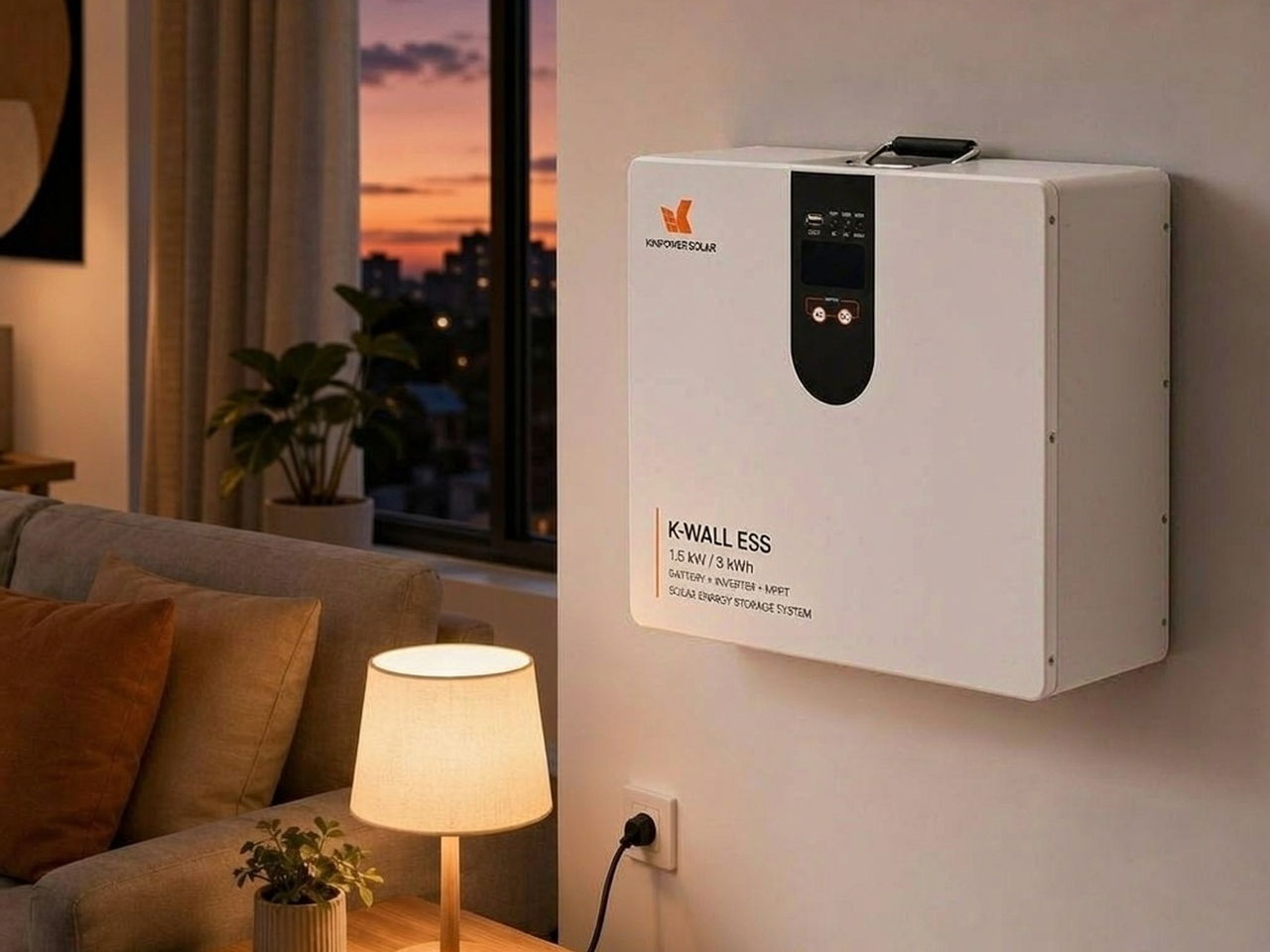
Ten years ago most solar storage was lead-acid. Today, almost every new residential and commercial system ships with a lithium battery for solar system — and specifically LiFePO4 (lithium iron phosphate).
|
Metric |
Lead-acid (AGM/GEL) |
LiFePO4 |
|
Usable depth of discharge |
50% |
90–95% |
|
Cycle life |
500–1,200 |
4,000–8,000+ |
|
Round-trip efficiency |
75–85% |
92–96% |
|
Weight per kWh |
30–40 kg |
8–12 kg |
|
Maintenance |
Water top-up, ventilation |
None |
|
Cost per usable kWh (lifecycle) |
Baseline |
40–60% lower |
The practical conclusion: a lithium ion battery for solar system with 5 kWh usable capacity does the same job as a 10 kWh lead-acid bank, lasts three to five times longer, and takes a fraction of the space.
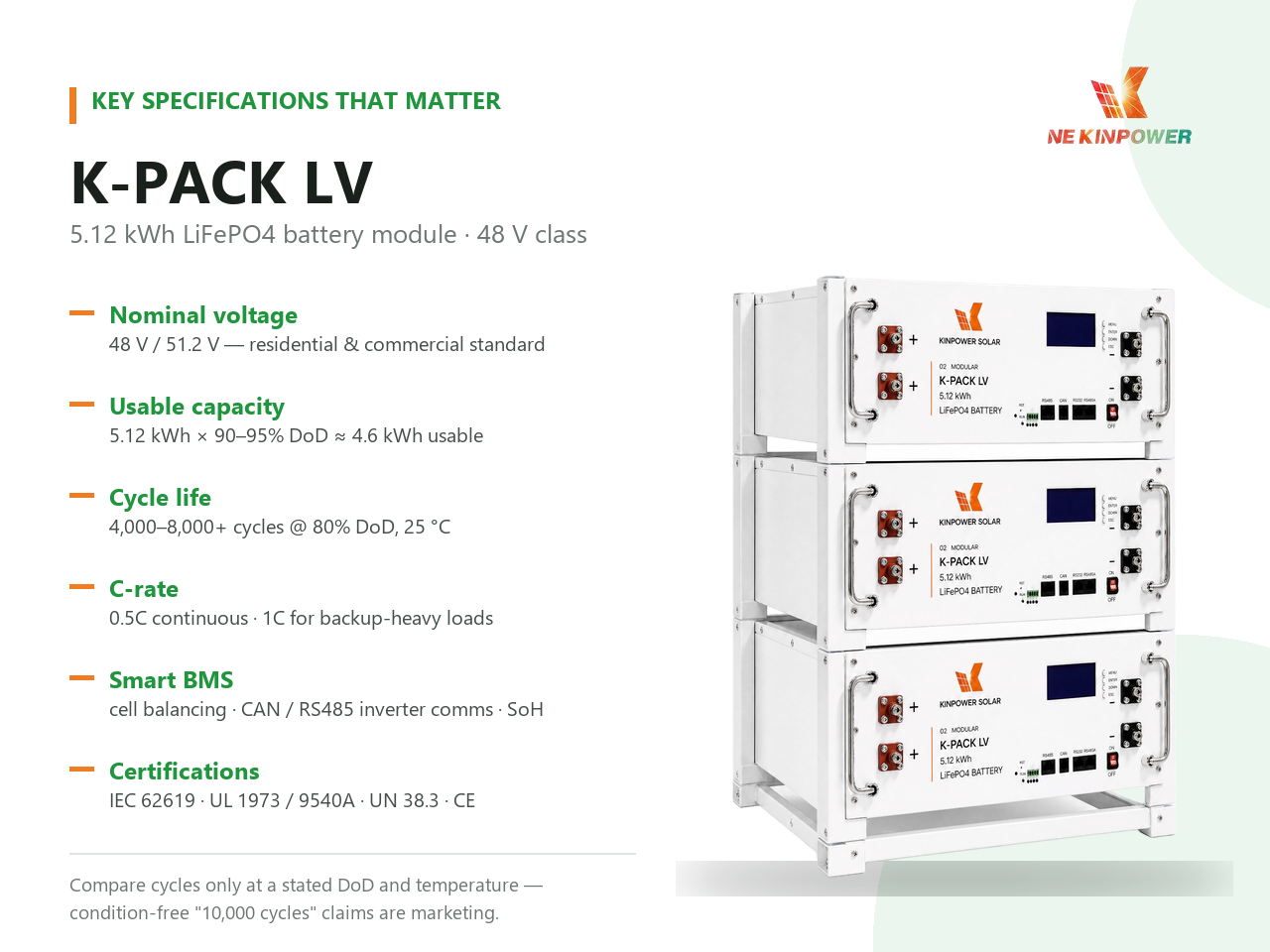
1. Nominal voltage
2. Capacity (kWh) Nameplate kWh × usable depth of discharge = usable energy. A 5.12 kWh module at 90% DoD delivers ~4.6 kWh usable.
3. Cycle life at a stated DoD Always compare cycles at the same depth of discharge. "6,000 cycles at 80% DoD, 25 °C, 0.5C" is a fair comparison; "10,000 cycles" without conditions is marketing.
4. C-rate Look for a continuous charge/discharge rate that covers your inverter's peak draw — 0.5C is standard, 1C is better for backup-heavy loads.
5. BMS quality The battery management system governs cell balancing, over/under-voltage, over-temperature and current limits. A good BMS communicates over CAN/RS485 with your inverter and reports state of health (SoH).
6. Certifications IEC 62619, UL 1973/9540A, UN 38.3 for transport, CE/UKCA. These are non-negotiable for insurance and grid connection in most markets.
Step 1 — Measure your nighttime load. Take total daily kWh, subtract daytime solar-covered consumption. Example: 18 kWh/day total, 60% covered by solar during the day → 7.2 kWh drawn at night.
Step 2 — Add backup requirement. Critical loads (fridge, lights, internet, medical equipment) × expected outage hours. Example: 1.5 kW × 6 h = 9 kWh.
Step 3 — Apply depth-of-discharge headroom. Divide by 0.9.
Step 4 — Round up to module granularity.
|
Daily consumption |
Recommended usable capacity |
Typical module count |
|
Apartment, essential backup |
2.5–5 kWh |
1 × wall-mounted 5 kWh |
|
Family home, evening load shifting |
10 kWh |
2 × stackable 5.12 kWh |
|
Large home with EV / heat pump |
20–30 kWh |
4–6 × stackable 5.12 kWh |
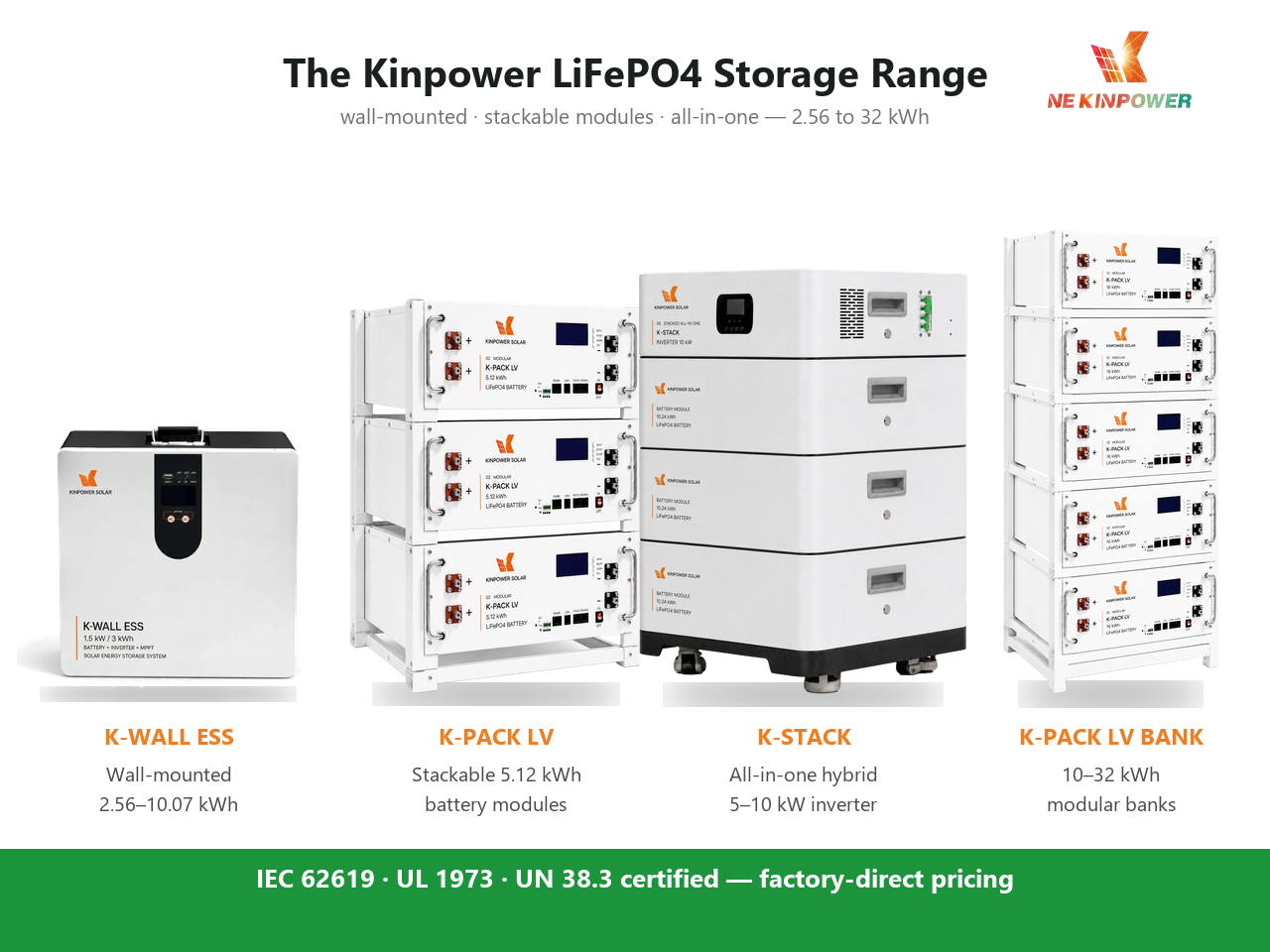
Price has fallen steadily and now sits in a well-defined band. Ex-factory reference prices for LiFePO4 storage modules in 2026:
|
Product type |
Typical ex-factory price |
Price per kWh |
|
5.12 kWh stackable module (48 V) |
$780 – $1,150 |
$150 – $225 |
|
Wall-mounted 5 kWh unit |
$850 – $1,250 |
$170 – $250 |
|
10 kWh wall/battery cabinet |
$1,600 – $2,400 |
$160 – $240 |
|
25.6 kWh stackable system with inverter |
$4,300 – $6,200 |
$170 – $240 |
|
15–32 kWh mobile/floor battery |
$2,900 – $6,000 |
$190 – $250 |
Installed retail prices are typically 2–2.5× ex-factory, because installation, commissioning, permits and installer margin are included.
Price drivers to understand:
Note that lithium-ion solar battery pricing follows raw material (lithium carbonate, LFP cathode) and shipping costs. Always request a current quotation rather than relying on older published figures — our 5 kWh battery price analysis breaks down what a home battery really costs with and without an inverter.
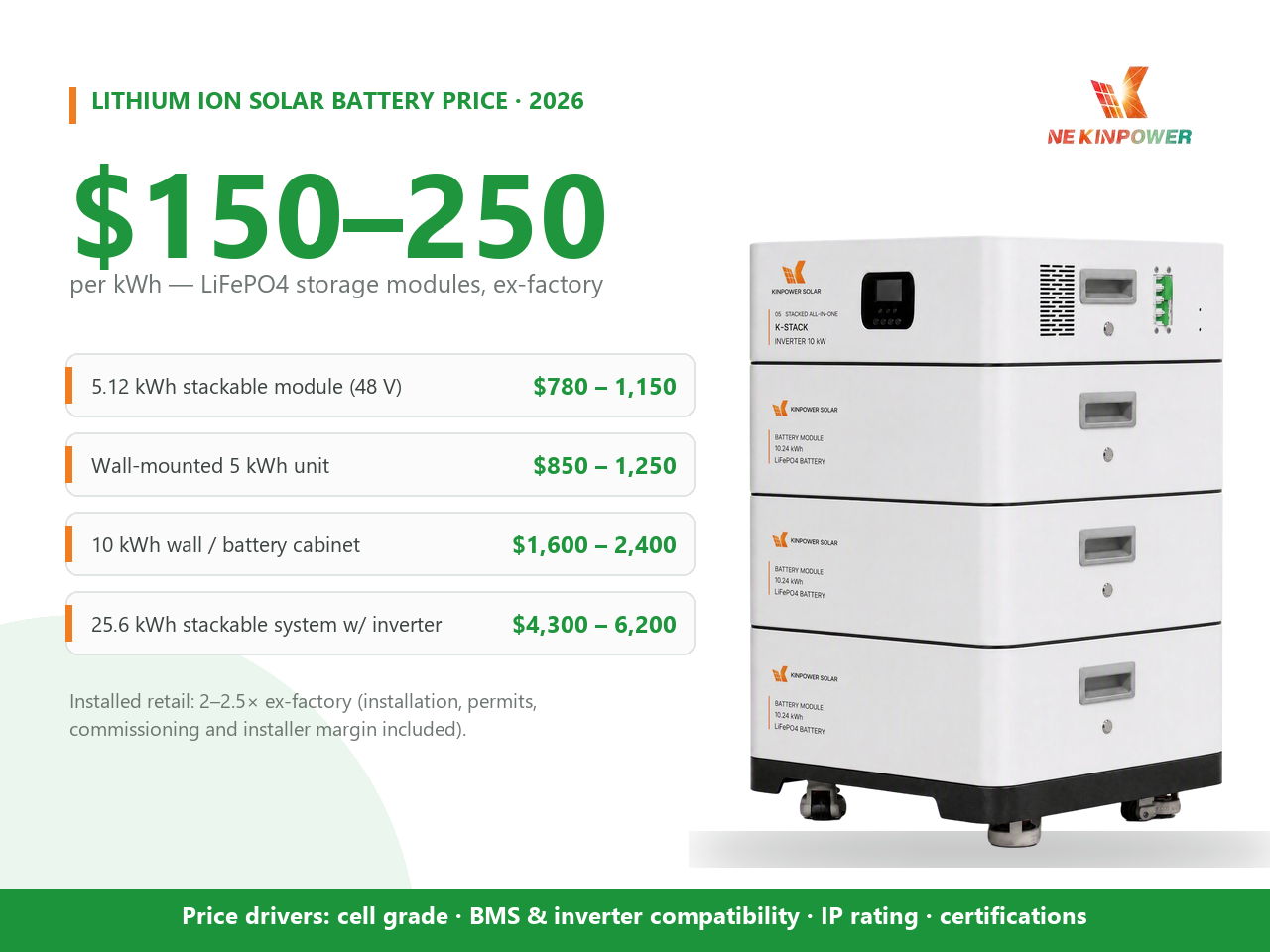
Battery shopping involves more naming variants than almost any other solar component. Here's how the terms map to reality:
|
Term |
Meaning |
|
Lithium ion batteries for solar panels |
Any lithium chemistry paired with a PV array; in practice, LiFePO4 for stationary storage |
|
Lithium battery for solar storage |
A battery dedicated to storing solar energy rather than general-purpose use |
|
Li ion battery for solar energy storage |
Engineering phrasing for the same product class |
|
Li ion tech solar battery |
Marketing term — ask for the chemistry (LFP vs NMC) and cell grade in writing |
|
Lithium ion battery with solar panel |
Often describes a compact kit or all-in-one unit pairing a panel and a small battery |
|
Solar system with lithium ion battery |
A complete PV + lithium storage installation |
|
Lithium ion battery for solar inverter |
A battery whose BMS is certified to communicate with a specific inverter brand |
|
Lithium ion battery pack for solar |
A module or pack designed for stacking into a larger bank |
|
Large lithium battery for solar |
Typically 10 kWh and above — cabinet or rack format for whole-home or commercial backup |
|
Lithium ion batteries for solar panels (off-grid) / lithium batteries for off grid solar |
Deep-cycle batteries sized for daily cycling without grid support |
|
Best lithium battery for solar / best lithium ion battery for solar |
Comparative language — evaluate on cycles, DoD, warranty and inverter compatibility, not brand claims |
|
Best lithium batteries for solar systems |
Plural — indicating bank-level selection, where balancing and matching matter |
|
Best lithium battery for solar storage |
Same evaluation criteria applied specifically to stationary storage |
|
Best solar lithium ion battery |
Superlative marketing; insist on test certificates and reference projects |
|
Solar lithium batteries for sale / lithium ion solar battery for sale |
Purchase-intent phrasing, often for direct-from-factory sourcing |
|
Solar lithium ion batteries for sale in bulk |
Distribution and project-scale purchasing — request volume pricing and shipping terms |
|
Lithium ion battery price for solar / lithium ion solar battery price |
Price-per-kWh comparisons, best quoted ex-factory for like-for-like specs |
|
Solar panels lithium ion batteries |
Shorthand for a bundled panel-plus-battery purchase |
Whatever the label says, the four numbers that decide quality are: usable kWh, cycle life at a stated DoD, C-rate, and certifications.
Q: How long do LiFePO4 solar batteries last? Typically 10–15 years in residential use — around 6,000 cycles at 80% DoD with 80% remaining capacity as the end-of-life threshold.
Q: Can I install a lithium battery in a cold climate? Yes, with a BMS that includes low-temperature charge protection or a heated enclosure. Charging below 0 °C is what damages lithium cells — reputable BMS units block it automatically.
Q: Is LiFePO4 safer than NMC lithium-ion? Yes. LFP chemistry has a higher thermal runaway threshold and no cobalt, making it markedly more stable — a key reason it dominates stationary storage.
Q: Should I buy one large battery or several modules? Modules. Stackable designs allow capacity expansion, simplify transport, and reduce downtime if one unit needs service.
Sourcing lithium batteries for solar? Kinpower manufactures LiFePO4 storage from 2.56 kWh wall-mounted units to 32 kWh mobile packs and 25.6 kWh stackable systems, with IEC/UN certification and factory-direct pricing.
 Hot News
2026-10-08
2026-10-06
2026-09-30
2026-09-28
2026-09-23
2026-09-22
 EN
EN