 ×
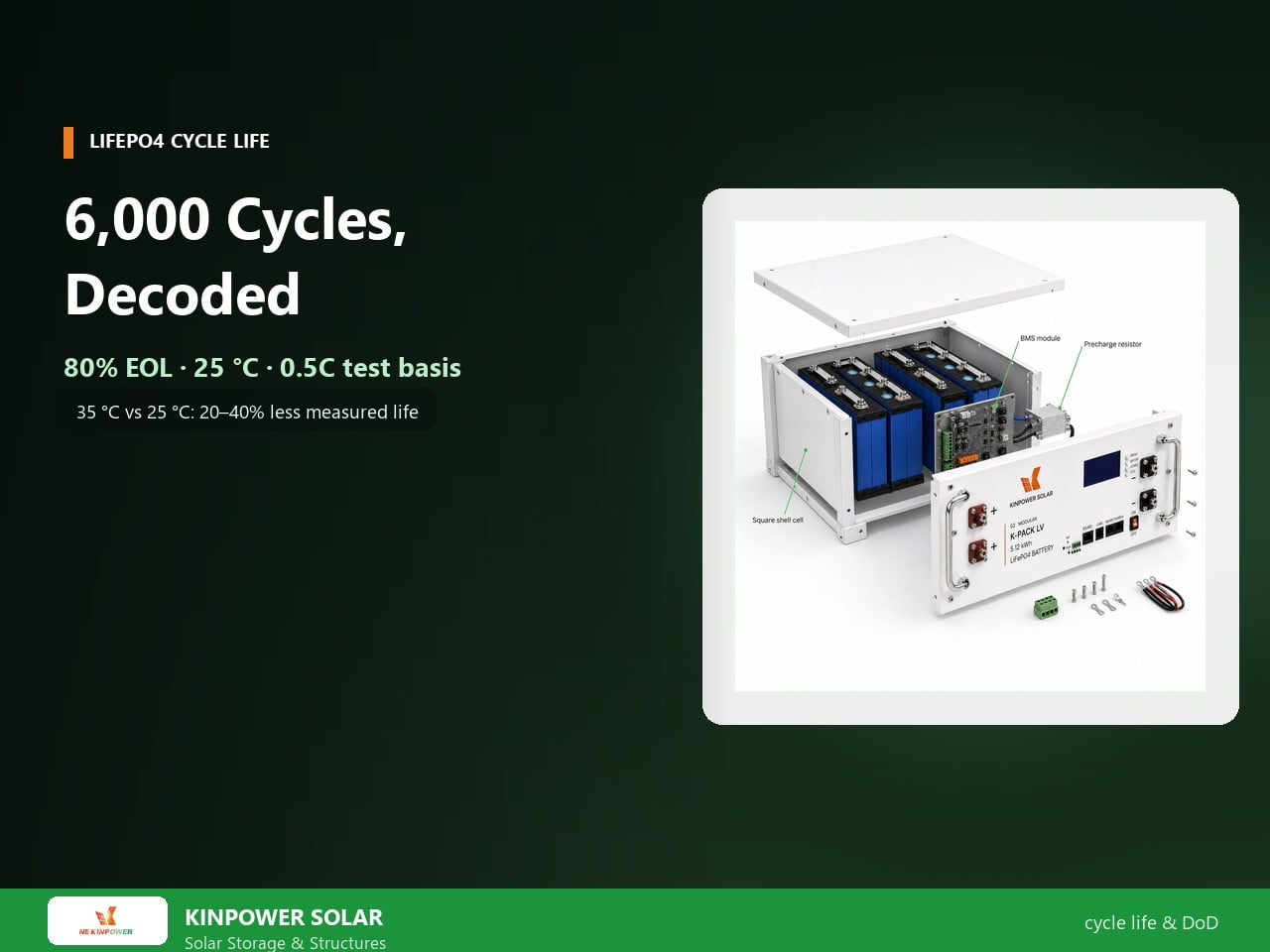
"6,000 cycles" is the most quoted — and most misunderstood — number in the storage industry. As a manufacturer, we would rather buyers understand what sits behind the number than take it at face value. Here is the engineering reality of lifepo4 battery cycle life.
A cycle life rating always hides a definition. The standard is 80% EOL (End of Life): the battery is rated for the number of cycles after which it still retains ≥ 80% of its original capacity, tested at a stated temperature, charge/discharge current (C-rate) and depth of discharge.
So a 6000 cycles solar battery at 80% EOL means: after six thousand full charge-discharge cycles under test conditions, the pack still holds four-fifths of its rated energy. It is not dead at cycle 6,001 — it simply continues below the warranty threshold, typically for several thousand more cycles with a steeper fade.
Two test-condition details buyers rarely ask about but should:
DoD (depth of discharge) — how much of the battery you actually use per cycle — is the single biggest lever on longevity.
|
Operating DoD |
Typical cycle life (A-grade LiFePO4, 25 °C) |
Effective throughput |
|
100% DoD |
~3,500–4,500 cycles |
3,500–4,500 "full" equivalents |
|
90% DoD |
~5,000–6,000 cycles |
4,500–5,400 equivalents |
|
80% DoD |
~6,000–8,000 cycles |
4,800–6,400 equivalents |
|
70% DoD |
~8,000–10,000+ cycles |
5,600–7,000 equivalents |
A useful conversion formula for solar battery degradation rate planning:
Annual throughput = daily cycles × usable kWh × 365. Service years ≈ (rated cycles × rated capacity × retention floor) ÷ annual throughput.
Worked example: a 10 kWh battery cycled at 90% DoD once daily moves 3,285 kWh/year. With 6,000 cycles at 90% DoD, theoretical throughput is 54,000 kWh — roughly 12–15 service years before hitting 80% capacity, and it keeps working beyond that.
This is why depth-of-discharge limits configured in the BMS (e.g., reserving 10% at the bottom and 5% at the top) often extend calendar life while costing almost nothing in daily usability.
Two packs with identical cells can diverge by thousands of cycles. The difference is made in the factory:
Cell grading and matching (分选配组). Cells are sorted by capacity, internal resistance and self-discharge into tightly matched groups. A pack built from mismatched cells forces the BMS to constantly bleed energy balancing the laggards — accelerating fade for everyone.
Intelligent BMS balancing. Kinpower's BMS runs continuous cell-voltage monitoring with active/passive balancing, current-limiting protection, and thermal management logic. Balanced packs age evenly; unbalanced packs fail at their weakest cell.
Process control. Incoming material inspection (IQC), laser welding torque and insulation testing, semi-finished aging runs, and 100% high-potential (hipot) insulation tests on finished packs. Cycle life is a process outcome, not a datasheet promise.
The cheapest quote in the market is usually cheap for a reason. Second-hand salvaged/re-celled packs (decommissioned EV modules or graded-down cells relabeled as new) show a predictable pattern:
|
Metric at year 3 |
A-grade new LiFePO4 |
Salvaged / re-celled pack |
|
Capacity retention |
88–94% |
60–75%, often with a cliff-fade |
|
Cell voltage spread |
< 50 mV at rest |
150 mV+ , BMS balancing saturated |
|
Failure mode |
Rare; usually external |
Cell-level imbalance, sudden capacity drop |
|
Safety |
Certified cells, traceable batch |
Unknown history, no manufacturer warranty |
Our in-house cycling comparisons show A-grade packs retaining over 90% after 1,500 test cycles while re-celled samples of the same nominal spec lose 25–35%. For a 10–15 year asset, the factory-direct price difference is repaid many times in avoided replacement.
Cycle life is only half the lifespan story. Calendar aging — degradation while the battery simply sits charged — runs in parallel and often dominates in lightly-cycled residential systems:
Rule of thumb: a well-made pack in a temperate climate with moderate cycling reaches 10–15 years of service; the same pack in a hot, always-full installation may fade to 80% in 6–8 years. The chemistry is identical — the operating profile decides.
Q: Does cycle life count partial cycles? A: Most modern BMS platforms count equivalent full cycles (throughput-based). Three 33% discharges ≈ one full cycle.
Q: Is 6,000 cycles at 80% DoD better than 5,000 at 90%? A: Compare total energy throughput, not the headline: 6,000 × 80% = 4,800 equivalents; 5,000 × 90% = 4,500. The 80% setting wins slightly — and ages slower.
Q: How do I verify cycle-life claims? A: Ask for third-party cell test reports (batch traceable), the EOL definition, test temperature and C-rate. We supply cycling test data and BMS specification documents on request.
Q: What warranty should I expect? A: 5–10 years or 6,000–8,000 cycles at 80% EOL is the honest standard for A-grade LiFePO4 residential storage in 2026.
Download Kinpower's cell cycling test reports and BMS specification sheets from our energy storage overview, or request batch-level traceability data for your project — we send the same reports our OEM partners audit against.
 Hot News
2026-11-24
2026-11-20
2026-11-17
2026-11-12
2026-11-10
2026-11-04
 EN