 ×
×
Many households planning to install energy storage equipment are most concerned about the core issues of home energy storage system cost,home energy storage system price,and how much a complete home energy storage system costs.In 2026,home energy storage systems are becoming increasingly popular and can be used in various scenarios such as photovoltaic grid connection,backup power during outages,and peak-valley electricity price savings.However,the price difference between complete systems with different configurations,brands,and installation conditions can be significant.
Many users only compare the bare equipment price while ignoring hidden costs such as accessories,installation,construction,and after-sales warranty services,which may lead to poor purchasing decisions.This article will comprehensively analyze the complete cost structure,market pricing standards,and key factors affecting home energy storage systems.It will also answer questions such as how much a home energy storage system costs and how to choose the most cost-effective configuration,helping users avoid unnecessary expenses and make reasonable budgets.
I.2026 Home Energy Storage System Price Trends:How Much Does a Complete Home Energy Storage System Cost?
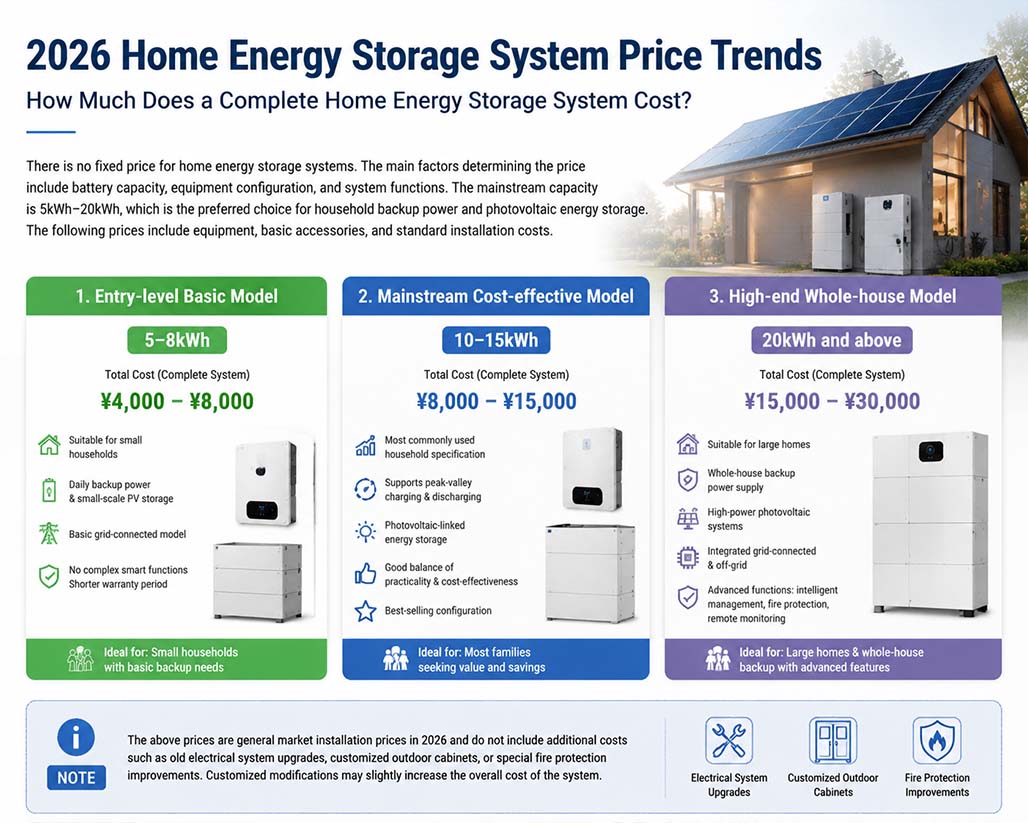
Currently,there is no fixed price for home energy storage systems in the market.The main factors determining the price include battery capacity,equipment configuration,and system functions.The mainstream household energy storage capacity is 5kWh-20kWh,which is also the preferred specification for household backup power and photovoltaic energy storage.The overall price range of home energy storage systems is relatively clear,including equipment,basic accessories,and standard installation costs:
Entry-level basic model(5-8kWh):The total cost of a complete home energy storage system is approximately RMB 4,000-8,000.It is suitable for small households requiring daily backup power and small-scale photovoltaic energy storage.These systems are usually basic grid-connected models without complex smart functions and have relatively shorter warranty periods.
Mainstream cost-effective model(10-15kWh):The complete system price is approximately RMB 8,000-15,000.This is the most commonly used household specification,supporting automatic charging and discharging based on peak and off-peak electricity prices,as well as photovoltaic-linked energy storage.It offers a good balance between practicality and cost-effectiveness and is currently the best-selling home energy storage configuration.
High-end whole-house model(20kWh and above):The complete system price is approximately RMB 15,000-30,000.It is suitable for large homes,whole-house backup power supply,and high-power photovoltaic systems.These systems are usually integrated grid-connected and off-grid models equipped with advanced functions such as intelligent management,fire protection,and remote monitoring.
Note:The above prices represent general market installation prices in 2026 and do not include additional costs such as old electrical system upgrades,customized outdoor cabinets,or special fire protection improvements.Customized modifications may slightly increase the overall cost of a home energy storage system.
II.Core Analysis:7 Key Factors Affecting Home Energy Storage System Costs
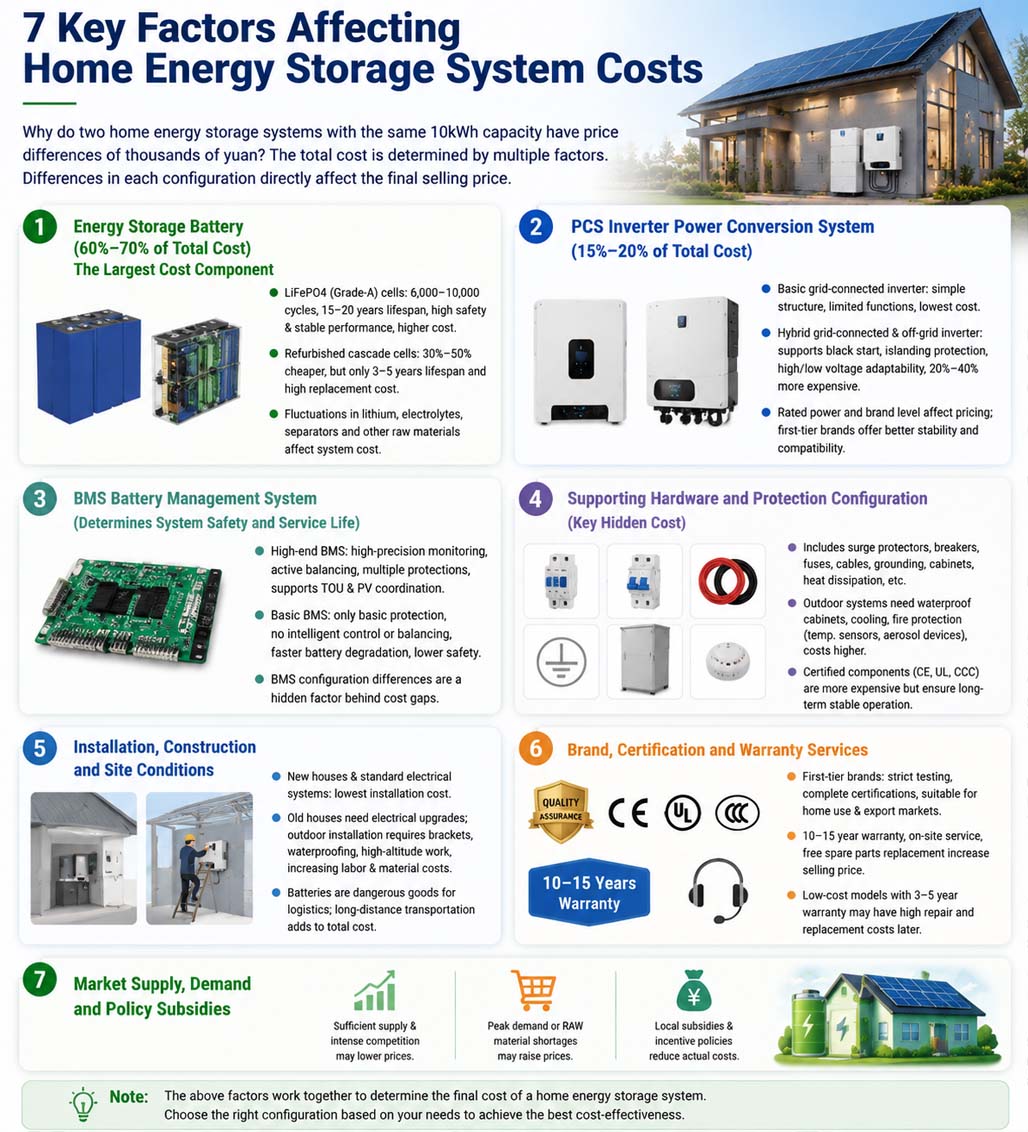
Many users wonder why two home energy storage systems with the same 10kWh capacity can have price differences of thousands of yuan.The reason is that the cost of a home energy storage system is determined by multiple factors,including core hardware,system configuration,installation and after-sales services,and market policies.Differences in each configuration directly affect the final selling price.
1.Energy Storage Battery(60%-70%of Total Cost,the Largest Cost Component)
The battery is the core component of a home energy storage system and the key factor determining the overall price.The battery material,quality,and service life directly create price differences.Currently,lithium iron phosphate(LiFePO4)batteries are the mainstream choice for home energy storage systems and have significant advantages compared with traditional lead-acid batteries and ternary lithium batteries.
New Grade-A LiFePO4 battery cells can achieve a cycle life of 6,000-10,000 cycles and a service life of 15-20 years.They offer high safety,stable performance,and low capacity degradation,making them the preferred choice for high-end home energy storage systems.However,their cost is relatively higher.
Low-priced models often use refurbished cascade battery cells,which can reduce costs by 30%-50%,but their lifespan is only 3-5 years,resulting in very high replacement costs later.Although they appear cheaper initially,their overall cost-effectiveness is actually lower.
In addition,fluctuations in the market prices of raw materials such as lithium,electrolytes,and separators will also directly affect the factory cost of complete systems.
2.PCS Inverter Power Conversion System(15%-20%of Total Cost)
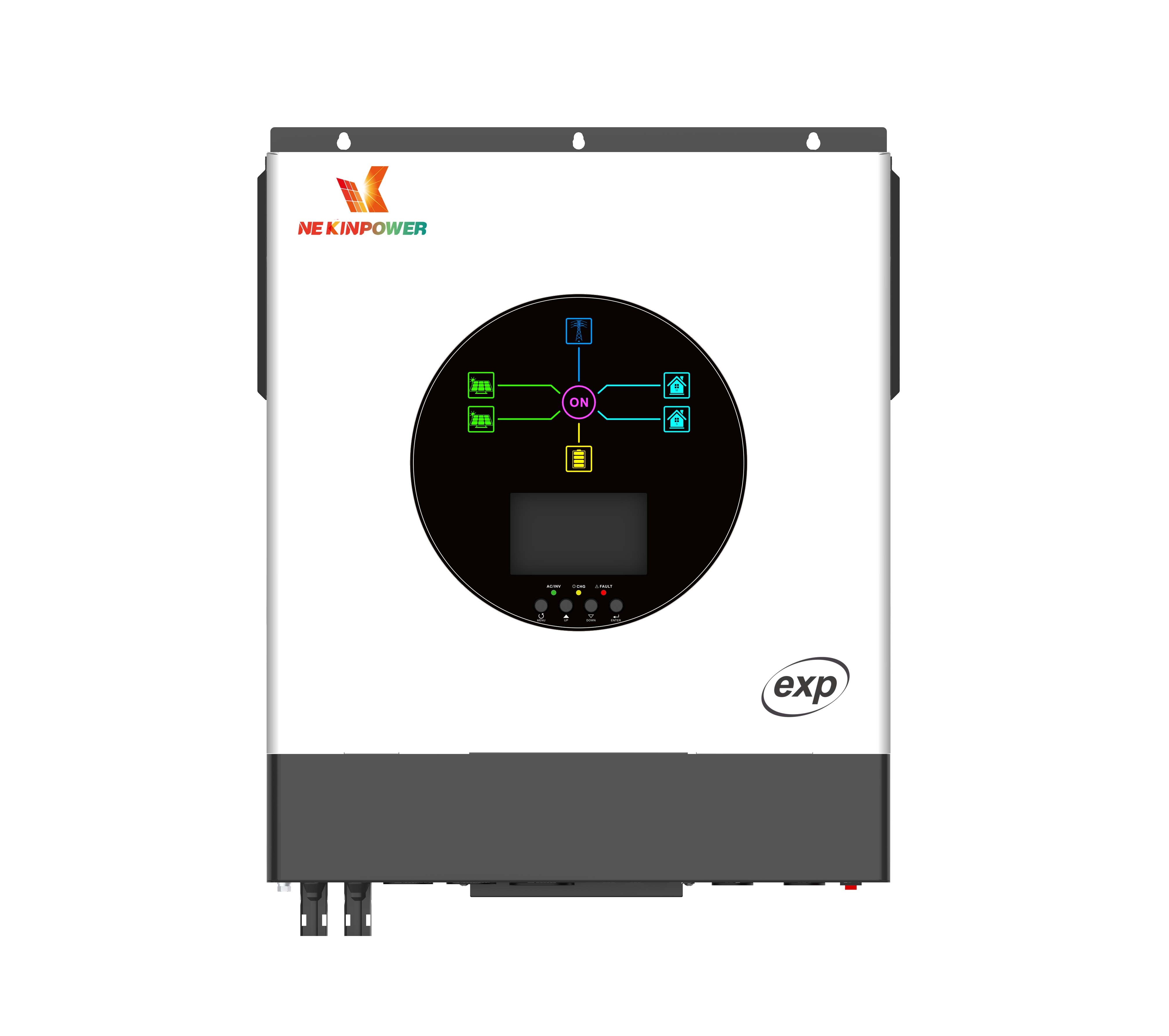
The inverter is the"heart"of the energy storage system and is responsible for power conversion.Different types of inverters create significant differences in home energy storage system prices.
Basic grid-connected inverters have simple structures and limited functions.They mainly support daily energy storage and self-consumption,resulting in the lowest cost.
However,hybrid grid-connected and off-grid integrated inverters,which are essential for many households,support functions such as black start during power outages,islanding protection,and high/low voltage adaptability.Their hardware and software development and adaptation costs are higher,making them 20%-40%more expensive.
At the same time,the rated power and brand level of the inverter also affect pricing.First-tier brand equipment offers stronger stability and compatibility,making its premium reasonable.Low-cost unbranded equipment may experience compatibility failures and excessive energy consumption.
3.BMS Battery Management System(Determines System Safety and Service Life)
Many low-cost home energy storage systems reduce BMS configurations,which is another hidden factor behind cost differences.
High-end BMS systems are equipped with high-precision monitoring chips,active balancing functions,and multiple safety protection mechanisms.They can monitor battery voltage,temperature,and current in real time,providing protection against overcharging,over-discharging,short circuits,and thermal runaway risks.They also support intelligent charging and discharging based on time-of-use electricity prices and photovoltaic load coordination.
Basic BMS systems only provide fundamental protection functions without intelligent control or balancing repair capabilities.This results in faster battery degradation and lower safety performance.Although they significantly reduce the cost of home energy storage systems,they create major risks during long-term operation.
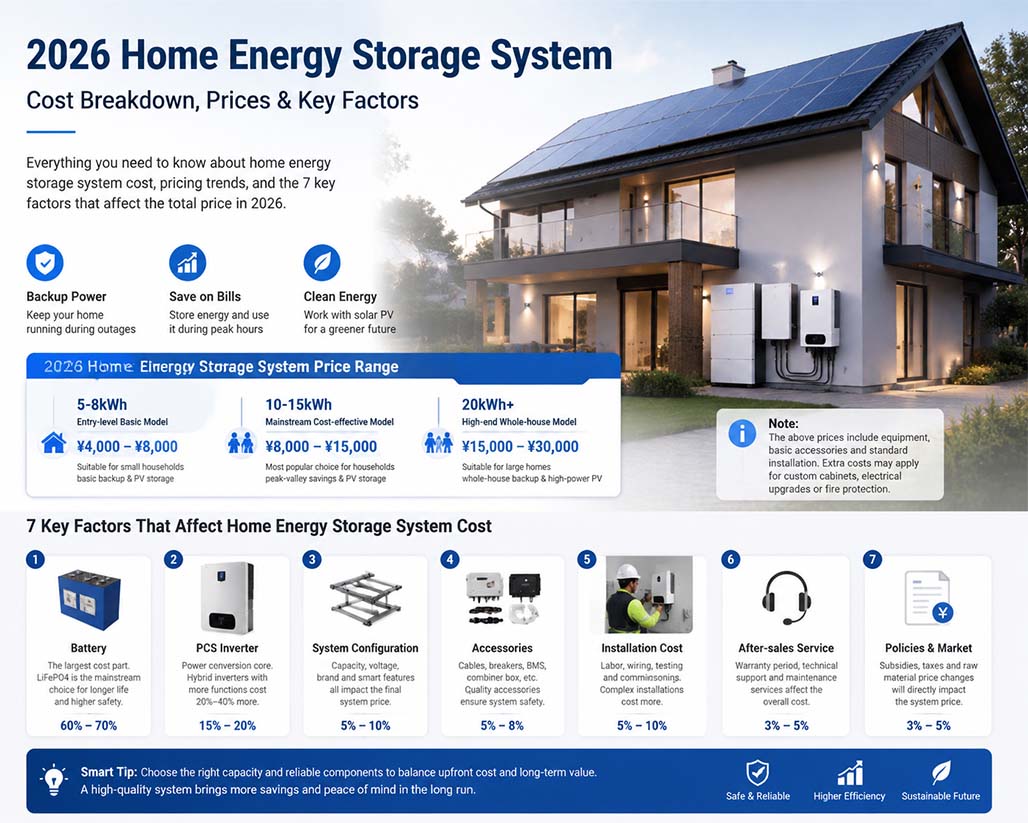
4.Supporting Hardware and Protection Configuration(Key Hidden Cost)
A complete home energy storage system is far more than just a battery and inverter.Compliant and safe accessories directly increase installation costs and are also a key difference between professional products and low-quality products.
These components include surge protectors,circuit breakers,fuses,dedicated energy storage cables,grounding systems,waterproof cabinets,and heat dissipation structures.
Outdoor installation models require corrosion-resistant and waterproof cabinets,enhanced cooling systems,and fire protection configurations(such as temperature sensors and aerosol fire extinguishing devices).Compared with indoor wall-mounted models,their costs are significantly higher.
At the same time,accessories that comply with international and domestic certifications such as CE,UL,and CCC are much more expensive than non-standard components,but they ensure long-term stable system operation.
5.Installation,Construction,and Site Conditions
The installation environment is an easily overlooked cost factor that directly affects the final cost of a home energy storage system.
For new houses with standardized electrical systems and simple indoor wall-mounted installation,construction costs are the lowest.
Older houses may require electrical modifications and wiring upgrades,while outdoor installations may require customized brackets,waterproof reinforcement,and high-altitude construction,all of which increase labor and material costs.
In addition,energy storage batteries are classified as dangerous goods for logistics.Long-distance transportation and compliant logistics delivery costs will also be included in the overall installation cost.
6.Brand,Certification,and Warranty Services
Brand premiums,compliance certifications,and after-sales warranty services are important reasons for price differences.
First-tier brand products undergo strict safety and performance testing and have complete international and domestic certifications.They can be used in various scenarios including household applications and export markets.Their initial R&D and quality control costs are higher.
At the same time,warranty periods directly affect costs.Services such as 10-15 year long-term warranties,on-site maintenance,and free spare parts replacement require manufacturers to reserve after-sales service costs,resulting in higher selling prices.
Low-cost models with only 3-5 years of warranty may have extremely high repair and replacement costs later.
7.Market Supply,Demand,and Policy Subsidies
Market conditions and local policies can cause short-term fluctuations in home energy storage system prices.
When industry capacity is sufficient and market competition is intense,complete system prices may decrease.During peak demand periods or when raw materials are in short supply,prices may increase slightly.
In some regions,household energy storage subsidies and energy-saving incentive policies can effectively reduce users'actual investment costs.
 Hot News
2026-10-08
2026-10-06
2026-09-30
2026-09-28
2026-09-23
2026-09-22
 EN
EN