 ×
×
Before you invest in a battery energy storage system, one question decides whether your project delivers value or collects dust: will the system actually match your electrical loads? An oversized system leaves you paying for capacity you never use, while an undersized one trips on startup surges or runs out of power halfway through an outage. The good news is that compatibility can be verified with four checks — power, capacity, electrical parameters, and battery communication. This guide explains how to size a battery energy storage system correctly and confirm it fits your home or business loads before you commit.
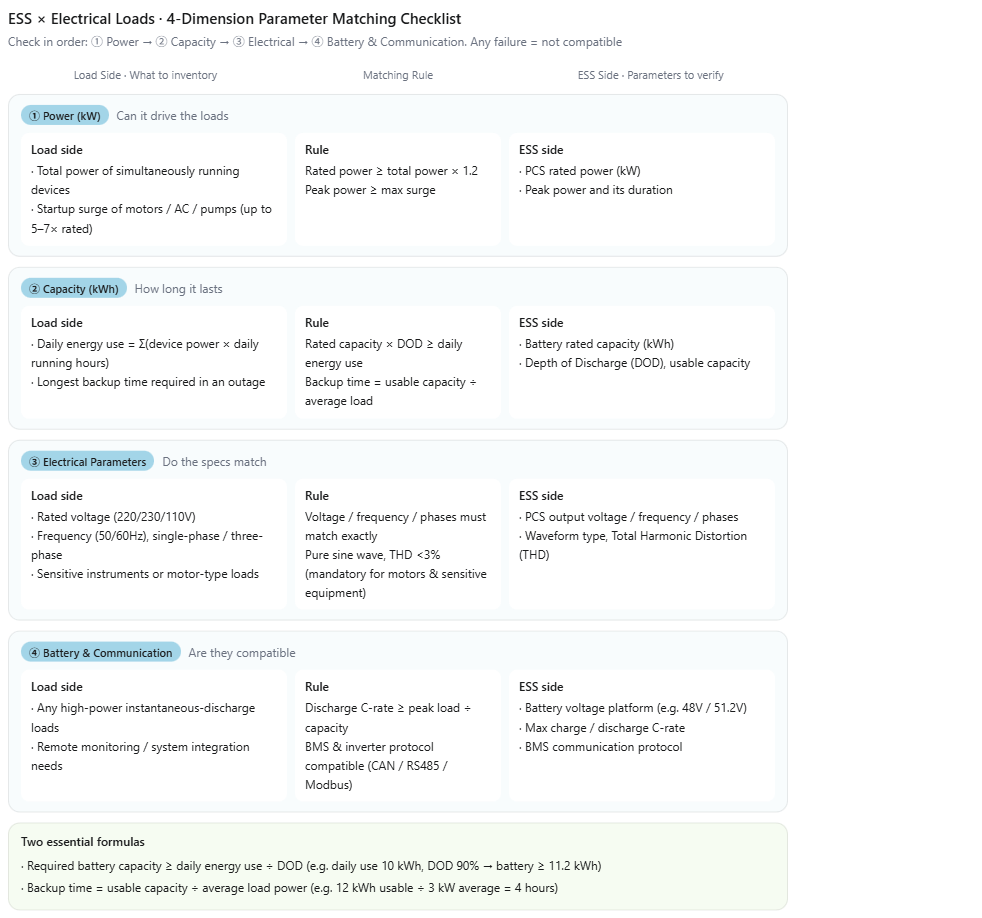
Power is rated in kilowatts (kW). The inverter's rated power tells you how much it can deliver continuously, while its peak power tells you how much it can handle for a short time. Both matter, because many loads demand far more at startup than they do in steady operation.
Motors, air conditioners and water pumps are inductive loads that draw 5–7 times their rated current when starting. A 1 kW water pump, for example, can spike above 5 kW for a few seconds. If the inverter's peak power cannot cover that surge, the system will shut down or fail to start the device.
How to check:
Capacity is measured in kilowatt-hours (kWh) and determines how long the system can power your loads. Nameplate capacity is not the same as usable capacity. Because batteries cannot be fully discharged, usable capacity = nameplate capacity × depth of discharge (DoD). Lithium iron phosphate batteries typically allow 90–100% DoD, while lead-acid batteries allow only about 50%.
To verify capacity, compare two numbers:
Your usable capacity must be at least the larger of the two. For example, if your home consumes 10 kWh per day and the battery has 90% DoD, you need at least 10 ÷ 0.9 ≈ 11.2 kWh of nameplate capacity.
A battery system must match your loads' electrical specifications exactly. Verify:
Waveform quality is equally important. Motors and sensitive electronics require a pure sine wave output. Modified-square-wave inverters cause motors to run hot, noisy and inefficient, and can damage precision instruments or medical equipment. For critical loads, keep total harmonic distortion (THD) below 3%.
Two details are frequently overlooked:
Whether you do the math yourself or ask a supplier, these two formulas cover most sizing needs:
Example: with 12 kWh of usable capacity and a 3 kW average load, the system provides 4 hours of backup.
Remember, power sizing and capacity sizing answer different questions. If you are unsure how to size a battery energy storage system for a specific application, an experienced manufacturer can run the calculation for you using your actual load list.
Q: How do I know what size energy storage system I need?
A: Start by calculating your daily energy use in kWh and dividing it by the battery's depth of discharge. To size a battery energy storage system correctly, you also need to verify that the inverter's rated and peak power cover your simultaneous load and the largest startup surge.
Q: What is the difference between kW and kWh in an energy storage system?
A: kW measures how much power the system can deliver at a moment — whether it can start and run your devices. kWh measures how much energy it stores — how long it can keep them running.
Q: How long can a home battery power my appliances during an outage?
A: Divide the usable capacity by the average load power. For example, 12 kWh of usable capacity with a 3 kW average load gives roughly 4 hours of backup.
Q: Why do motors and air conditioners need a pure sine wave inverter?
A: Inductive loads draw 5–7 times their rated current at startup and run inefficiently on modified waveforms. A pure sine wave with low THD keeps motors cool, quiet and efficient, and protects sensitive equipment.
Not sure whether an energy storage system fits your loads? Send us your load list — device name, rated power, quantity and daily running hours — and our engineers will size the right system for you, free of charge. [Contact us]
 Hot News
2026-10-08
2026-10-06
2026-09-30
2026-09-28
2026-09-23
2026-09-22
 EN
EN