 ×
×
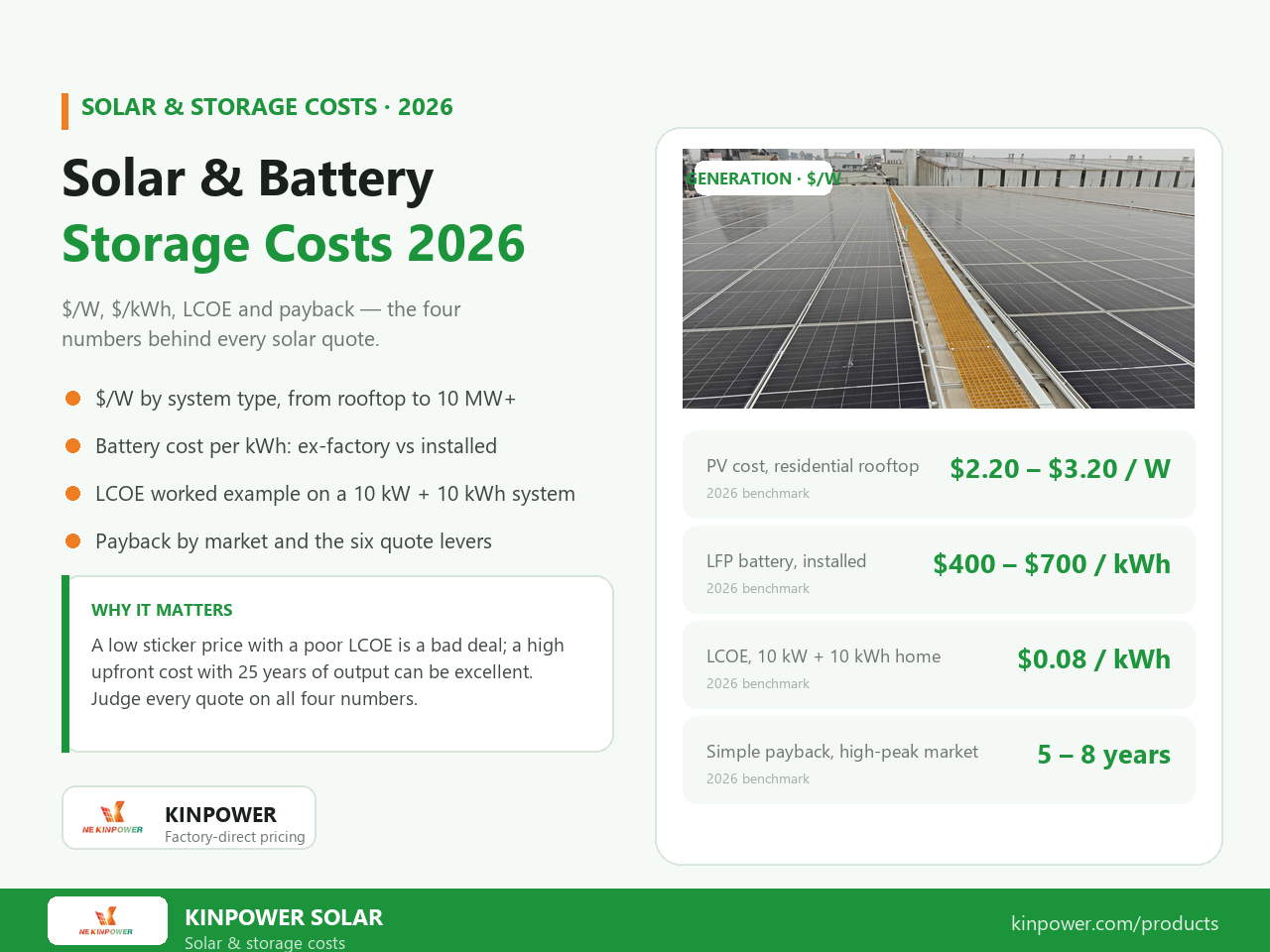
Every solar or storage quote can be reduced to four numbers, and mixing them up is the single most common source of confusion:
A low solar panel system cost with a poor LCOE is a bad deal; a high sticker price with 25 years of output can be excellent. This guide puts all four in one place for 2026.
|
System type |
Typical $/W (installed) |
Notes |
|
Residential rooftop (5–10 kW) |
$2.20 – $3.20 / W |
Higher labour and permitting per watt |
|
Commercial rooftop / carport (100 kW–1 MW) |
$1.30 – $2.00 / W |
Economies of scale begin here |
|
Utility-scale ground-mount (10 MW+) |
$0.70 – $1.10 / W |
Excludes land and grid interconnection in some markets |
|
Off-grid with storage |
$3.00 – $5.00 / W |
Battery-heavy, location-dependent |
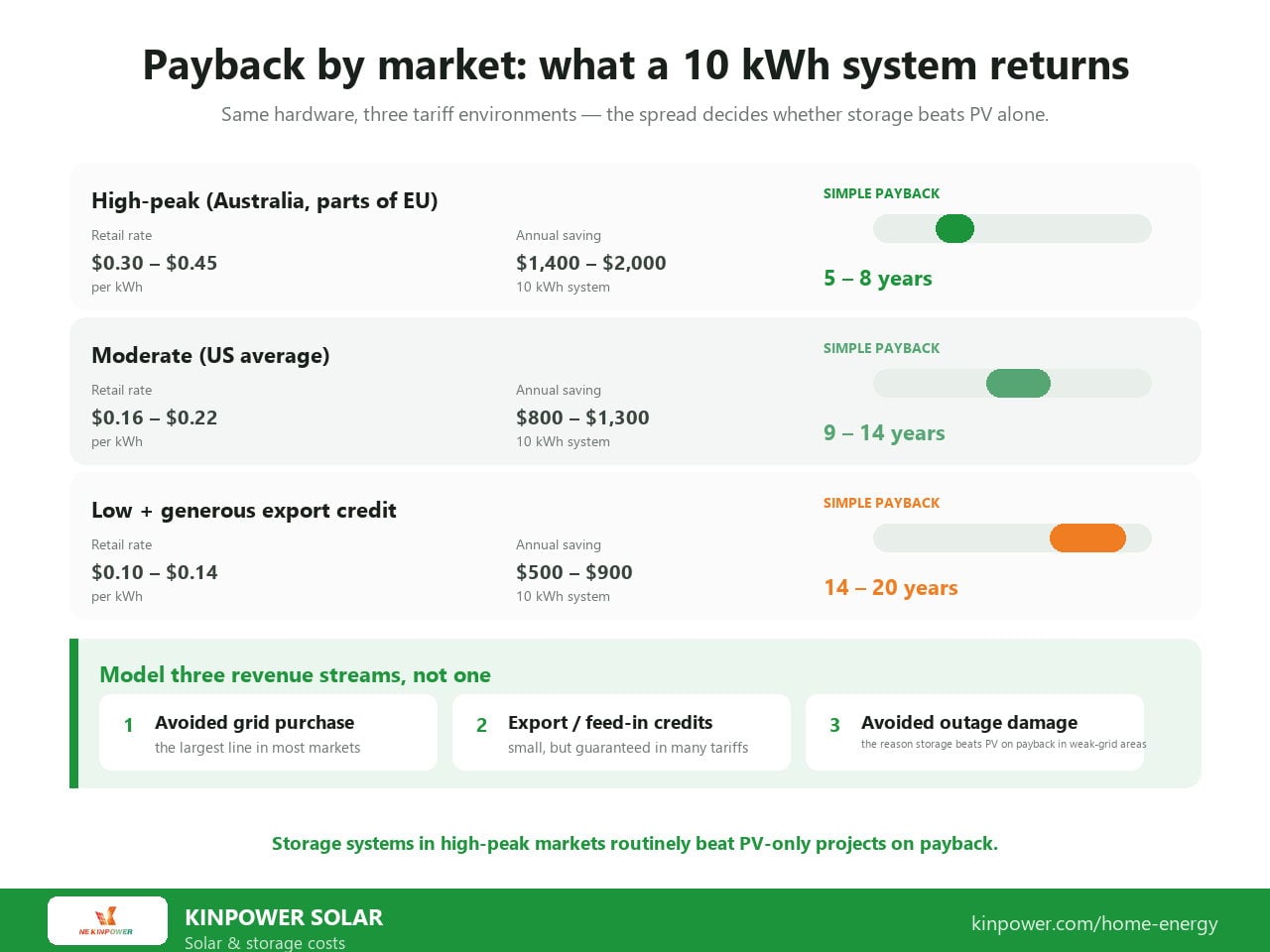
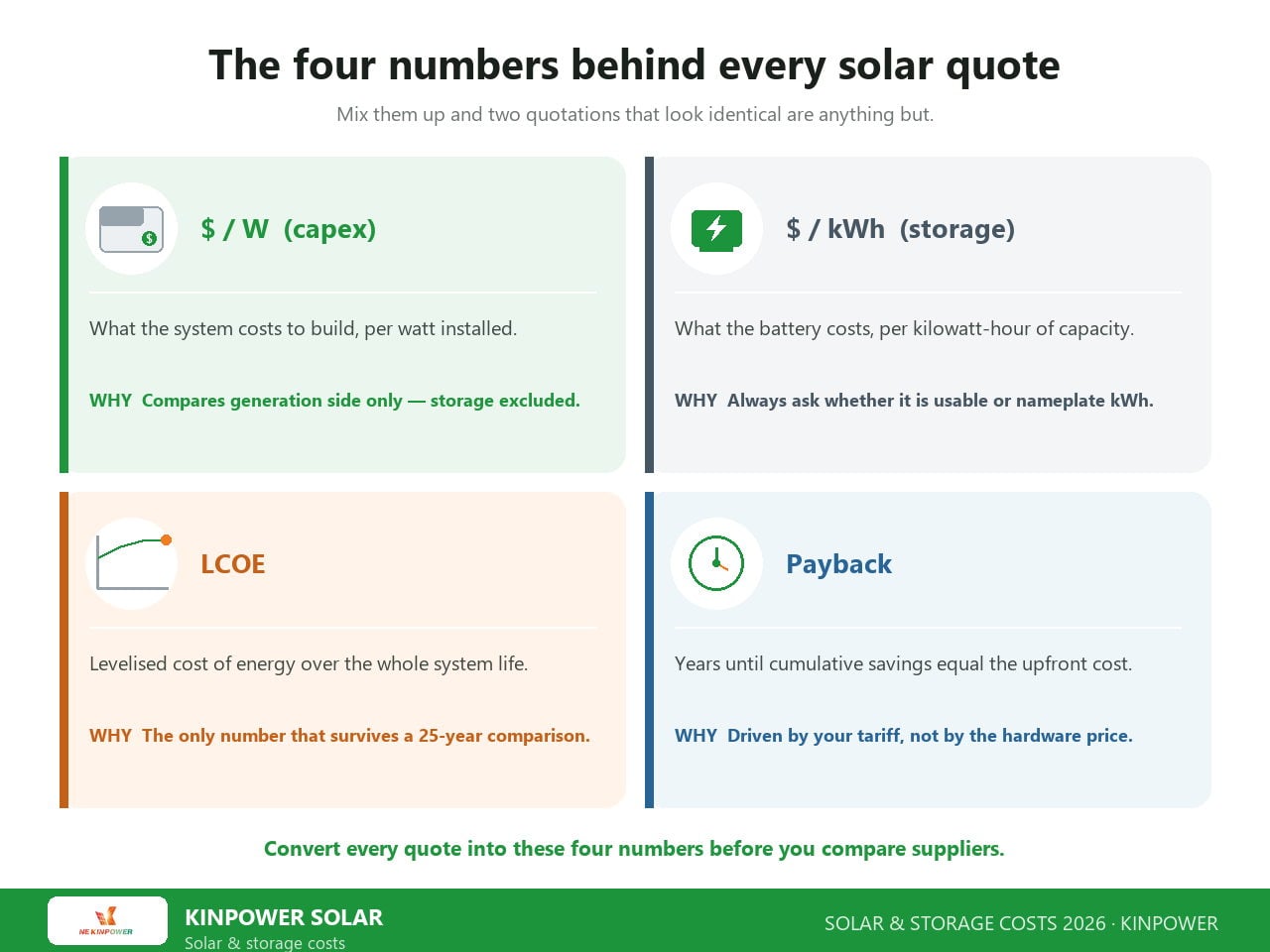
The pv system price in each row moves with module efficiency, mounting type, local labour rates and whether storage is included. Modules are now the smallest line item — often under 25% of total cost — which is why the cost of solar power per kWh keeps falling even when hardware prices flatten: the savings come from balance-of-system and installation efficiency.
The solar battery system price is quoted in two ways — ex-factory and installed. Know which one you are being sold.
|
Battery type |
Ex-factory $/kWh |
Installed $/kWh |
Typical cycle life |
|
LiFePO4 (LFP) residential |
$150 – $250 |
$400 – $700 |
6,000+ @ 80% DoD |
|
LiFePO4 C&I cabinet |
$180 – $320 |
$350 – $600 |
6,000+ @ 80% DoD |
|
Containerised utility-scale LFP |
$120 – $220 |
$250 – $450 |
6,000+ @ 80% DoD |
|
Lead-acid (legacy) |
$90 – $150 |
$200 – $350 |
1,200 – 1,800 @ 50% DoD |
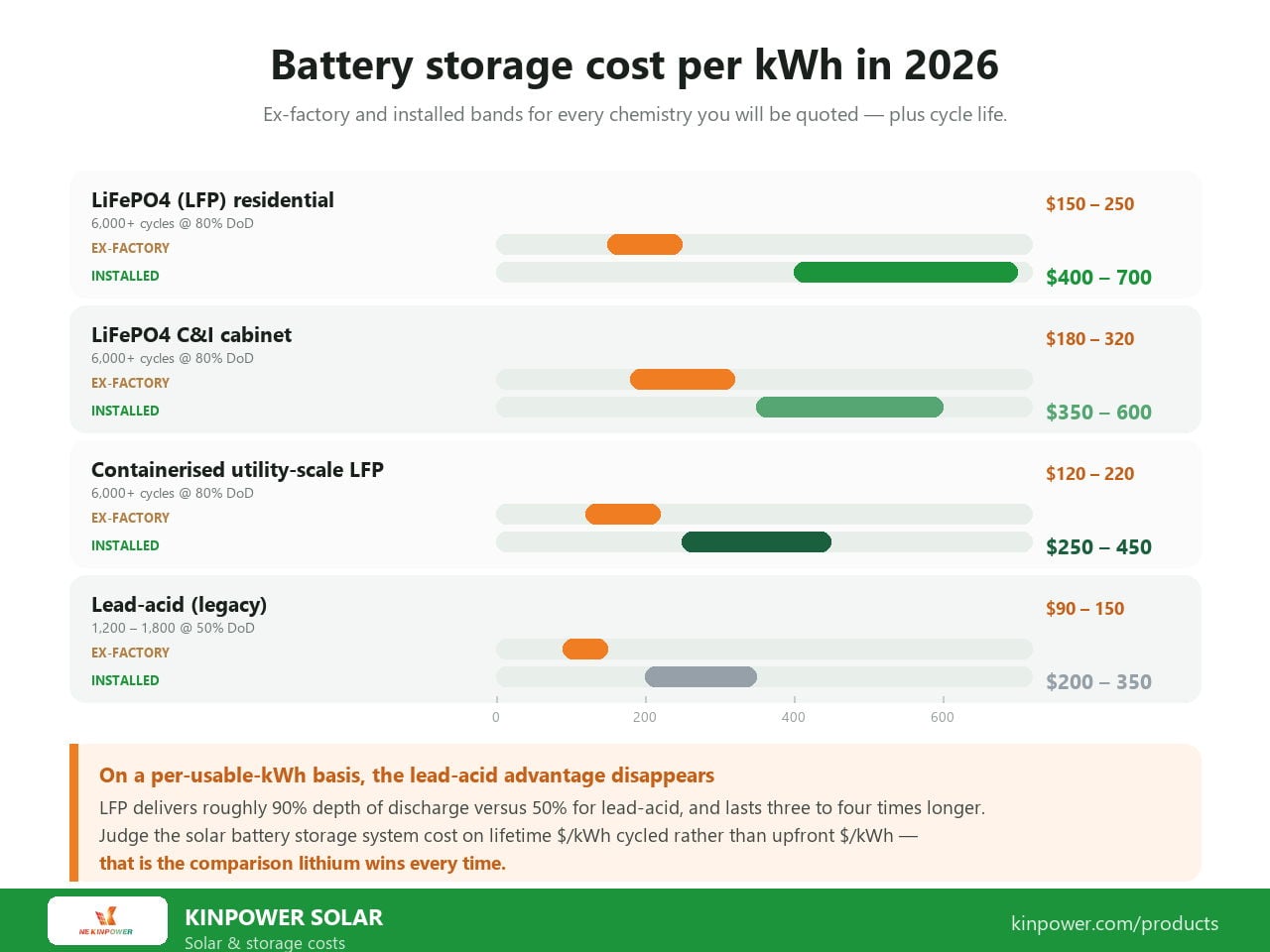
On a per-usable-kWh basis the lead-acid advantage disappears: LFP delivers roughly 90% depth of discharge versus 50%, and lasts three to four times longer. That is why the solar battery storage system cost is now almost always quoted for lithium, and why the cost of solar battery storage systems is judged on lifetime $/kWh cycled rather than upfront $/kWh.
|
Configuration |
Hardware + install |
Battery included |
|
5 kW PV, grid-tied, no battery |
$8,000 – $14,000 |
No |
|
10 kW PV + 10 kWh LFP |
$18,000 – $28,000 |
Yes |
|
20 kW PV + 40 kWh LFP (small commercial) |
$55,000 – $95,000 |
Yes |
|
100 kWh C&I cabinet ESS |
$35,000 – $60,000 |
Yes |
|
1 MWh containerised BESS |
$250,000 – $420,000 |
Yes |
The cost of solar panels with battery storage typically lands 40–70% above PV alone for a comparably sized array, because the battery, hybrid inverter and additional wiring are added on top. The residential solar power system cost therefore groups into two budgets: the generation side and the storage side. Treat them separately when comparing quotations — vendors frequently blur them to make one number look competitive.
For developers, solar power plant cost is expressed per watt of DC capacity, and storage is priced separately per kWh:
|
Component |
2026 benchmark |
|
PV modules + mounting |
$0.28 – $0.45 / Wdc |
|
Inverters / PCS |
$0.05 – $0.10 / Wdc |
|
BOS + civil works |
$0.15 – $0.30 / Wdc |
|
EPC + commissioning |
$0.20 – $0.35 / Wdc |
|
Total, ground-mount PV |
$0.70 – $1.10 / Wdc |
|
Add-on BESS (2–4 h duration) |
$120 – $220 / kWh |
Co-locating storage at a utility PV plant adds roughly 30–60% to total capex but unlocks capacity payments, avoids curtailment and allows energy shifting into evening peak prices — often the difference between a marginal and a profitable cost of solar power per kWh at the plant level.
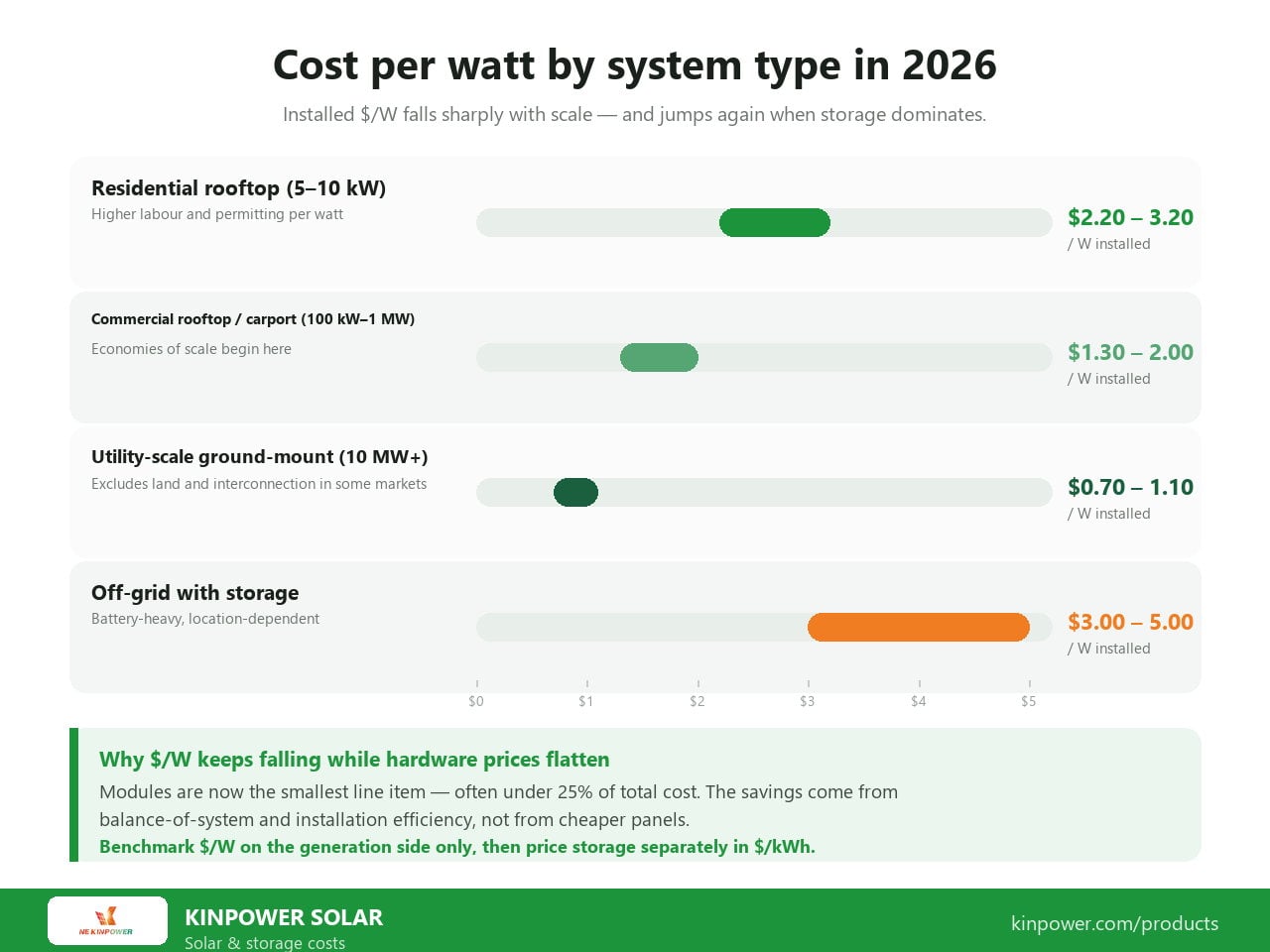
LCOE answers the real question: what does a kWh cost me over 25 years?
LCOE = (total lifetime cost) ÷ (total lifetime energy produced)
Worked example — a 10 kW PV + 10 kWh LFP residential system:
Compare that to a retail tariff of $0.25/kWh and the economics are obvious. Storage raises LCOE slightly but raises self-consumption value far more, which is why storage-heavy systems can have a higher LCOE yet a faster payback.
|
Market |
Retail rate |
Annual saving (10 kWh system) |
Simple payback |
|
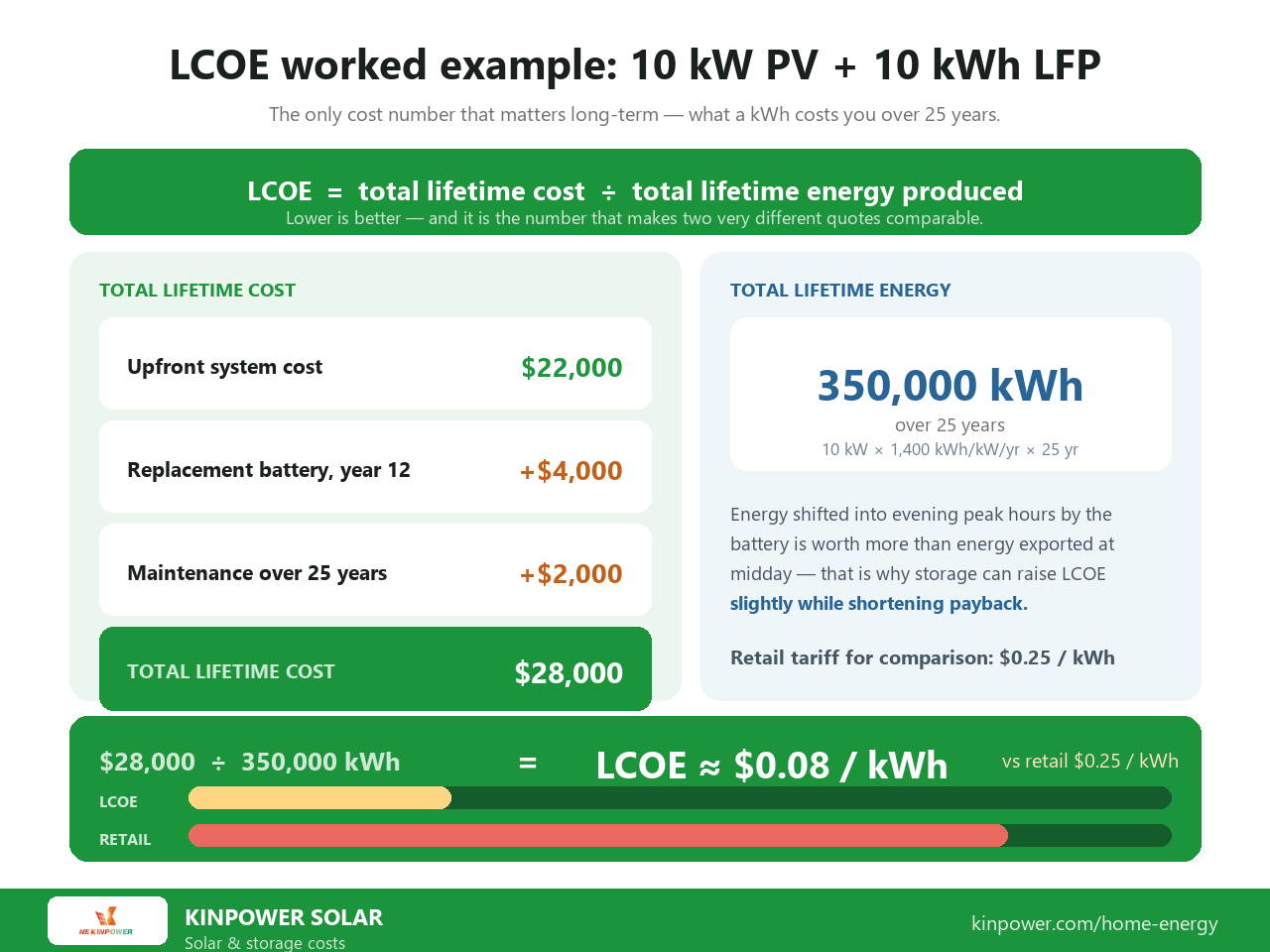
High-peak (Australia, parts of EU) |
$0.30 – $0.45 / kWh |
$1,400 – $2,000 |
5 – 8 years |
|
Moderate (US average) |
$0.16 – $0.22 / kWh |
$800 – $1,300 |
9 – 14 years |
|
Low + generous export credit |
$0.10 – $0.14 / kWh |
$500 – $900 |
14 – 20 years |
Include three revenue streams when you model it: avoided grid purchase, export/feed-in credits, and the avoided cost of outage damage. Storage systems in high-peak markets routinely beat PV-only projects on payback because they capture the expensive evening hours rather than exporting cheaply at midday.
The sticker price is not the lifetime cost. Budget for these five items, which are frequently omitted from initial quotations:
|
Item |
Typical annual cost |
Notes |
|
O&M and monitoring |
0.5 – 1.5% of capex |
Higher for tracking and carport structures |
|
Insurance |
0.3 – 0.8% of capex |
Some markets require storage-specific cover |
|
Battery degradation |
Replaced once at year 10–15 |
Provision |
|
Inverter replacement |
Once at year 12–15 |
15–25% of original inverter cost |
|
End-of-life recycling |
$20 – $60 / kWh |
Rising regulatory requirement in the EU and US |
Adding these to the solar battery storage system cost typically raises the 25-year total by 20–35% over the raw installed price — which is exactly why LCOE, not capex, is the number to optimise.
The same LiFePO4 hardware can carry a very different solar battery system price depending on where it is sold, and the gap is almost entirely non-hardware:
|
Region |
Installed $/kWh |
Main cost driver |
|
China |
$250 – $420 |
Lowest labour and mature supply chain |
|
Europe (DE, NL, UK) |
$450 – $750 |
Labour rates, permitting, VAT |
|
North America |
$500 – $800 |
Labour, permitting, interconnection queues |
|
Australia |
$400 – $650 |
High labour, strong installer competition |
|
Middle East / Africa |
$350 – $600 |
Logistics and import duties dominate |
For buyers in high-cost markets, factory-direct procurement can bring installed cost closer to the ex-factory band — the single most effective lever on the cost of solar battery storage systems. When you request a quotation, ask for the ex-factory price and the installation scope separately, so the two are never conflated.
Q: What is the average cost of a solar battery system in 2026? A 10 kWh residential LFP system typically costs 4,500–7,000 installed; a 5 kWh unit lands nearer 3,000–4,500. Cost per kWh falls as capacity rises.
Q: Is battery storage worth the extra cost over solar alone? In markets with a peak/off-peak spread above $0.15/kWh, yes — storage usually pays back faster than the PV array itself. In low-spread markets, PV-only is the better first investment.
Q: Will battery prices fall further? Cell prices continue to decline but at a slower rate than 2020–2023. Balance-of-system, installation and certification now dominate the installed cost of solar battery storage systems, so expect single-digit annual declines rather than the steep drops of the past.
Q: How do I compare two quotes that use different units? Convert both to installed $/W for generation and installed $/usable-kWh for storage, then calculate LCOE over 25 years. Any quote that cannot be expressed in those terms is not a fair comparison.
Q: Does a bigger solar power plant cost less per kWh? Yes — utility-scale projects reach 0.03–0.06/kWh LCOE, versus 0.08–0.14 for residential, because $/W drops and fixed costs spread over far more energy.
Worried your quote is above market? Kinpower supplies residential wall-mounted and stackable LiFePO4 batteries, C&I cabinet ESS and containerised systems factory-direct, with published $/kWh ranges and certified test reports — so you can benchmark any quotation. See home energy solutions or browse the full product range. For a worked example on a single product, see our 5kWh battery price guide.
 Hot News
2026-10-12
2026-10-10
2026-10-08
2026-10-06
2026-09-30
2026-09-28
 EN
EN