 EN



Why the Price Tag Is Higher Than Rooftop Solar
Anyone who has priced out a solar carport has probably noticed the sticker shock compared to rooftop panels. The gap is real and it comes from the structure itself. A carport needs steel columns, deeper footings, and engineering for vehicle impact, wind uplift, and snow drift. Those structural costs add roughly 30 to 50 percent to the installed cost per watt compared to a rooftop system. A rooftop array sits on a building that already exists and already has a foundation. A carport has to build its own support from scratch. The math changes when you factor in what the carport actually does. It generates power, it shelters vehicles, and it creates mounting points for EV chargers. Those functions have value that rooftop solar cannot replicate.
Real Numbers for Different Project Sizes
The cost per watt drops as systems get larger because fixed costs get spread across more capacity. Small residential carports run higher per watt, while utility-scale commercial projects get closer to rooftop pricing. The table below gives a snapshot of typical installed costs.
| System Type | Cost per Watt | Typical Size | Total Investment |
|---|---|---|---|
| Residential carport | $3.50 to $4.50 | 5 to 15 kW | $17,500 to $67,500 |
| Small commercial carport | $3.00 to $4.00 | 100 to 300 kW | $300,000 to $1,200,000 |
| Large commercial carport | $2.80 to $3.50 | 500 kW to 2 MW | $1,400,000 to $7,000,000 |
| Rooftop solar for comparison | $2.00 to $2.80 | Varies | Varies |
These figures cover the full installed system, including structure, panels, inverters, and electrical work. The range within each category depends on site conditions, foundation requirements, and whether battery storage or EV charging is included.
What Drives the Cost Up or Down
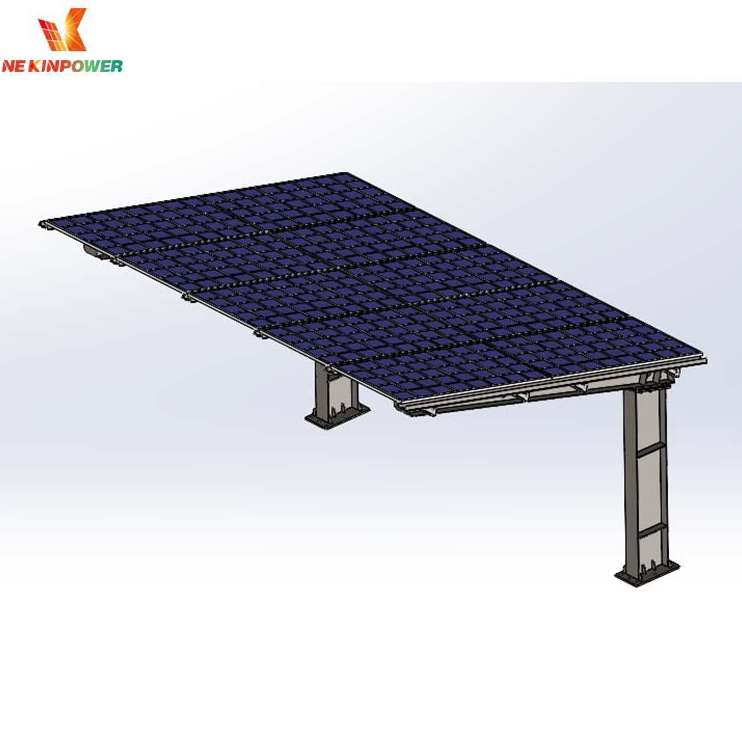
Several variables push the final number around more than most people expect. Site conditions matter a lot. Rocky soil or high water tables make foundation work expensive. Poor soil might require deeper piers or helical piles instead of simple concrete footings. Wind and snow loads drive steel sizing. A site in a high-wind zone or a heavy snow region needs beefier columns and beams, which adds cost. The structural type also matters. A single-post cantilever design costs more per bay than a double-post T-frame because the foundation has to resist more overturning force. That premium runs 20 to 35 percent above the T-frame baseline per bay. On sites where parking layout is tight and single-column placement is the only option, the cantilever may still pencil out, but it is not the default choice for cost-conscious projects. Panel selection, inverter type, and whether the system includes battery storage all layer on top of the structural base.
The Financial Case Beyond the Sticker Price
The upfront cost is only part of the story. A solar carport produces electricity for decades, and that production has a calculable value. The levelized cost of energy for a carport system typically lands between $0.045 and $0.065 per kilowatt hour over 25 years. Commercial grid rates run $0.10 to $0.15 per kilowatt hour on average, and peak time-of-use rates can hit $0.18 to $0.35. That spread is where the payback comes from. For a commercial fleet depot, the demand charge savings alone can be significant. One analysis of a 600 kW carport project showed demand charge reduction contributing meaningfully to the annual savings, on top of the energy offset. Payback periods for well-designed commercial projects generally fall in the 5 to 8 year range.
Incentives That Change the Math
Incentive programs in the US and Europe can cut project costs substantially. The federal Investment Tax Credit covers 30 percent of solar costs for eligible projects. The Section 30C program offers up to $100,000 per charger for alternative fuel refueling infrastructure. Accelerated depreciation through MACRS allows commercial owners to write off a large share of the asset in year one. Stacked together, these incentives can reduce total project cost by 40 to 60 percent. In the UK, the Workplace Charging Scheme covers 75 percent of charger costs up to a cap, and the Plug-in Van Grant provides additional support for fleet electrification. The incentive landscape shifts with policy cycles, so any budget should verify current programs before finalizing numbers.
Where Integrated Delivery Makes a Difference
A solar carport is not a product you can buy off a shelf and bolt together. It is a system that has to be engineered for the site, permitted, and commissioned. On a recent project in the Midwest, a fleet operator discovered that the original structural drawings had used ground-mount wind coefficients instead of the open building provisions required by ASCE 7-22. The uplift forces had been underestimated by 10 to 15 percent, and the foundation design had to be revised before permit approval. That kind of error costs time and money. Working with a partner that handles structural engineering, system design, and manufacturing under one roof reduces the chance of those gaps. Kinpower has been building solar and energy storage systems for years, with multiple production bases and vertically integrated capabilities covering R and D, production, and project support. The engineering team runs structural calculations and system sizing in house, which keeps the carport structure and the solar array aligned from the first drawing. For projects where the budget needs to hold and the schedule needs to be realistic, that integration matters.